More than physical violence, antisemitism against European Jews now reveals itself through incidents such as school bullying and ostracism at the workplace. Israeli expat communities on the continent could become a bridge between Israeli and European societies.
STOCKHOLM – The rioting that followed the soccer match between Maccabi Tel Aviv and the Dutch team Ajax in Amsterdam at the beginning of the month engendered mixed reactions in Israel. Initially, there was shock over its blatant antisemitic character and lamentations over "the Islamization of Europe." That was followed by claims that the violence was prompted by the conduct of Maccabi Tel Aviv fans and that comparisons to Kristallnacht trivialized the Holocaust.
Such arguments merit discussion, but, to delve more deeply, it's worth considering the European perspective in addition to the Israeli one. First of all, when Maccabi Tel Aviv fans faced physical violence, they were facing a very extreme expression of anti-Israelism and antisemitism. However, for Jews who live in Europe, it's just one manifestation of antisemitism, albeit perhaps the most frightening one, but certainly not the most common.
Other manifestations are less photogenic, but they impose a heavy burden on the lives of European Jews: pestering at school, aggressive campaigns on social media, cultural and academic boycotts, hurtful comments, and tension and ostracism in the workplace. Physical violence is rather rare.
Secondly, antisemitism is much more than an individual case of racism. In European public discourse, there is a nascent recognition that it's a kind of conspiracy theory. Those falling into its net and spreading it might be people who have never met a Jew, and perceive themselves as liberals who "have nothing against the Jewish people." They don't even need to use the word "Jewish." The conflict in the Middle East and the so-called gray area between what is antisemitic and what is anti-Israel has made it possible to use code words such as "globalists", references to George Soros – and, of course, Zionists.
It's not a new phenomenon, but it involves a world of new concepts. Instead of old-style antisemitism in which the Jews were considered Christ's killers, or more modern antisemitism accusing the Jews of controlling the world through the banking system, revolutionary movements and secret societies, there are contemporary allegations that prove confusing even to those who don't hold clearly racist views. The most popular ones claim Jews spread COVID-19 to profit from vaccines, are behind the war in Ukraine, and are breaking up nation-states. In addition, the well-known conspiracies about Jewish control of the media and the financial markets are still going around.
The Israeli left has also sometimes fallen into the trap. Since it rightly opposes continued Israeli control of the West Bank and the war crimes in Gaza, it finds European partners for its worldview. Sometimes they're serious and honest partners, however, other times, they're actors spreading allegations of genocide who support Islamist terrorist groups and propaganda advocating Israel's destruction.
Just as the Israeli far-right finds neo-Nazi partners as a result of their campaign against Muslims, some on the left find antisemitic partners because they oppose the occupation – even if its opposition is to Israel's 1949 armistice borders rather than to those post-1967.
Third, real-life antisemites, unlike those portrayed in the media, aren't two-dimensional figures. The coverage of what happened in Amsterdam focused on scenes of masked men of Middle Eastern origin looking for blood. In the real world, antisemitism has been hiding behind more familiar faces with other characteristics, other backgrounds and motives: young Europeans who read Trotskyite literature, high school students using antisemitism as a means of abusing classmates, and university lecturers attempting to attract attention to themselves.
Not all immigrants are antisemitic. Not all antisemites are immigrants, and the antisemitic incidents in Europe aren't necessarily spontaneous outbursts of hate or protest. They're also a product of campaigns financed by actors such as Qatar, Turkey and Russia. Just as most rapists don't look like monsters and don't lurk behind bushes in dark parks, the antisemitic monster sometimes lives within ordinary and seemingly unthreatening figures.
When soccer fans come to Europe and witness demonstrators spreading hate against Israel under the banner of the Palestinian flag, they experience it as a physical threat. When European Jews witness the same demonstration, more than violence, they fear that the hostile crowd includes their children's kindergarten teacher, their bank clerk or their nurse at the local clinic.
And one last point. We're used to identifying the victims of antisemitism in Europe with members of local Jewish communities. In Amsterdam, the victims were Israeli tourists who experienced it for the moment and then returned home. But among those two distinct groups, there's another. In recent years, groups of Israeli expats in Europe have established communities engaged in education, culture and social initiatives; the Hebrew language and secular Israeli identity are flourishing there.
These communities experience and deal with antisemitism differently, constituting both an opportunity and a risk in that regard. On the one hand, they're liable to constitute an attractive target for violent attacks and antisemites. On the other hand, their members might build a bridge for dialogue between Israeli and European societies that could help to deal with the sickness of antisemitism that the continent has been suffering from for centuries.
Since my article about Amnesty and Swedish schools was written and published in Swedish and since the debate with Amnesty Sweden's Secretery Genral in Svenska Dagbladet was also in Swedish, I finally got round to translating the original texts into English so that non-Swedish speakers can see what the all the fuss was about…
When a Jewish woman from Umeå was featured on DN's first page after she decided to leave town, at least one writer, Göran Rosenberg, was critical. The article explained that the woman was leaving because of decades of antisemitic harassment. Still, Rosenberg wasn't impressed. "Today, DN publishes on its entire front page that a woman in Umeå (of Israeli origin) intends to leave the city because of her experiences of antisemitism ", he wrote and added that DN failed to explain the background: "consequently, we are not told that the same woman was very active in supporting Israel in the Gaza war". A couple of days later he explained in Expressen that antisemitism is being used as a political weapon. The woman from Umeå, it seems, had it coming. After all, she's not a "Swedish Jew", rather she's "a woman in Umeå (of Israeli origin)". Rosenberg's message is clear: while Antisemitism against regular Jews like himself, is despicable, Zionists and Israelis just "experience" antisemitism which is actually just good old criticism of Israel, or as Swedes elegantly call it – Israelkritik.
I thought of this when I talked to an organization called "Zikaron" last week. This small but extremely important organization offers lectures on the fates of Holocaust survivors to Swedish schools. The lectures are carried out by young people, grandchildren or great grandchildren of survivors who are taking over the historic burden of remembrance. Naturally, this has nothing to do with Israel. The Holocaust took place before there was an Israel and the victims were not "settler colonialist" or responsible for the "blockade of Gaza". And yet, it turns out that sometimes even the Holocaust is too problematic for some schools. When I talked to one of Zikaron's organizers, she told me that after the massacre of October 7th last year there were about ten schools that cancelled their lectures due to reasons like "wrong timing" or "sensitive timing" and since then, there has been less demand for their lectures. Could this also be "Israelkritik" or is it just that Swedish schools are too scared of upsetting the sensitive souls who find Holocaust education provocative. Or perhaps they don’t want to get in trouble with activist bullies who didn't get the memo saying that it's ok to talk about dead Jews from the 40s and the problem is only with the other kind of Jews, the ones with guns from the Middle-East. Whatever it is, anyone who's worried about Swedish schools being cowards can rest assured. They found their courage elsewhere.
While Holocaust education may be too sensitive, foreign policy political activism seems to be no problem at all. Otherwise, how could 39 Swedish schools be "partner schools (samarbetsskolor)" of Amnesty, a political organization which is as far from mainstream as it gets. These schools use Amnesty's "Schools for Human Rights" model (skola för mänskliga rättigheter) for teacher's education, planning "theme days" (temadagar) and providing material and lectures. They even take part in global campaigns. This model may be great for highlighting human rights and democracy, but there's a serious problem when it comes to the conflict in the Middle-East, since Amnesty is anything but impartial.
In recent years Amnesty International positioned itself clearly as opposed to everything Israeli. It has disproportionately targeted Israel for years, it has supported boycott campaigns and some of its campaigners and partners have supported or even been linked to terror organization and Islamist movements (to name some: Yasmin Hussein, Saleh Hijazi and Moazzam Begg). It almost entirely ignores attacks against Israel and atrocities committed against its civilians, it bases its information about Gaza casualties on Hamas' propaganda and it makes claims which are obviously false like "Israel's military operations in Gaza continue to kill people on a scale that has never been seen before".
But it's not only talk. Amnesty Sweden actively campaigned against policies of the Swedish government, like the decision to pause funding for UNRWA (based on information that some of its employees took part in the October 7th massacre) and the decision to stop funding Swedish Ibn Rushd study circle (after accusations that the organization has ties to the Muslim Brotherhood and spreads antisemitism). In fact, whoever wants an idea of what Amnesty really supports can take a look at the kind of people it awards its prizes to. Elin Forghani, a Vänsterpartiet activist from Östersund just won Amnesty's new "Noismaker" prize after publicly claiming that: "Israel is a colonial project and an outpost of the West in the Middle East and always has been". And just to make clear what should be done with the colonizers she wrote: "we can make Israel and their sponsors sweat, tremble and fall. Liberation is in sight".
Naturally, in a democracy political activism is more than legitimate. However, it's also clear that Amnesty is in no way neutral or objective. It's a political player in global geo-politics, but it's still marching into Swedish schools, presenting itself as a non-biased public informer and bearer of a universal truth. Although political parties and organizations are allowed in Swedish schools and naturally Democracy and human rights should be part of their education, this isn't a case of mainstream education. Amnesty is getting a special "partner" status as a long-term official partner while other political actors are just guests, implying that Amnesty represents facts while the others represent opinions.
It's unclear why Swedish schools should be discussing the war in Gaza in the first place, but if they must, the material should be written and supervised carefully by serious state actors. This isn’t the place to start outsourcing. I spoke to a few parents and students in a Stockholm high school. They told me about their complaints to the school management regarding Amnesty's Gaza war education material and about lessons using material from Globalis, an organization run by "Svenska FN-förbundet" an organization which claims to "work for a better and stronger UN ". The UN in the title shouldn't be confused with impartiality. When I spoke to one student, he told me that since the lessons about the Israeli-Palestinian conflict started "it feels like I have to go to school to defend Israel twice a week. It's not that the teacher lies but it's so one-sided. For example, there were two lessons about the Palestinian Nakba and only half a slide about the expulsion of Jews from Arab countries and Iran and even that, according to the teacher, could be understood as a result of "Mossad activity". When the students were given texts on the subject, they were given guiding questions like: "what support is there for the claim that Israel is an apartheid state?". Student I spoke to talked about feeling very uncomfortable and worried about their classmates. "I feel I have to give the other side", one of them said, "because the other students in the class don't know the whole picture".
In an incident in another school, UN day was celebrated in the schoolyard by waving flags of different countries. According to one of the teachers, when some angry spectators who were passing by threatened to enter the school and remove the Israeli flag, the reaction wasn’t standing up to the threatening bullies and informing the police. Instead, the flag was removed and the person waving it was asked not to wave it again.
It seems that our schools are becoming a ridiculous case of Dr. Jackyle and Mr. Hyde. On one hand, they're wannabe rebels, dealing with the world's most complicated conflicts by employing radical political activists, while on the other hand, they're so afraid of controversy and conflict that they can't even wave a flag of a UN member country or talk about the Holocaust.
It's true, only a few schools cancelled Holocaust lectures and only some are Amnesty partners. But it's also true that only some pro-Palestinian demonstrators support violence (which is what shouting "Intifada!" means), only part of vänsterpartiet supports the PFLP and only a handful burned an Israeli flag outside a synagogue. Not to mention that just several thousand attended a Hamas conference in Malmö, and only a few hundred contribute to Islamist, antisemitic movements, and only one Imam praised Hezbollah's leader and only one or two artist spread antisemitic conspiracy theories, and only a small minority screamed at Holocaust survivors entering a memorial ceremony. How many minorities will it take to get the message? and when will our schools become part of the solution instead of part of the problem.
Amnesty Sweden's comment (originally in Swedish):
Our schoolwork is based on international conventions and Swedish school's governing documents.
On December 10th, 1948, the newly formed UN adopted the Universal Declaration of Human Rights. For the first time, the world had an agreement that viewed all people as free and equal, regardless of gender, skin color, religion or other beliefs or characteristics.
In 2011, knowledge of human rights was incorporated into the Swedish curriculum. Since 2012, Amnesty has been supporting upper secondary schools with teaching materials, lectures, and a model for working with human rights, based on both international conventions and Sweden's school governing documents.
David Stavrou, guest columnist for Svenska Dagbladet, criticizes Amnesty for supporting upper secondary schools in their work on human rights education, by making directly false accusations about Amnesty as an organization and our work. But these claims are easy to refute: No, Amnesty does not support the call for a boycott of Israel. Yes, Amnesty has condemned attacks on civilian Israelis and called for those responsible for these war crimes to be held accountable. No, our teaching materials and lectures are not about Israel and Palestine.
David Stavrou claims that we are a biased organization and that our criticism of Israel is disproportionate. This is a direct false statement that is often made by representatives of the Israeli government. Amnesty is an impartial, politically independent organization. We do not accept government funds because we want to be free to investigate human rights violations without being dependent on anyone. Our demands and criticisms are based on international law and respect for human rights. And we assess all states by the same standards.
Even though our lectures in high schools this fall did not address the war in Gaza, high school students have asked many questions about the situation in Gaza. Human rights, contrary to what David Stavrou suggests, apply both in times of peace and in conflicts. Amnesty's focus in all conflicts is the protection of civilians and their human rights.
Amnesty is not alone in criticizing Israel's indiscriminate attacks on civilians, the forced displacement of Palestinian civilians, and the denial of humanitarian aid into Gaza, three clear examples of violations of the laws of war. Knowledge of human rights is necessary. We are happy to contribute to helping upper secondary schools fulfill the curriculum, providing students with more knowledge and the conditions to protect their own rights and work to ensure that others' rights are respected, both now and in the future.
Anna Johansson, Secretary General, Amnesty International Sweden.
David Stavrou's reply:
It’s great that Amnesty Sweden takes texts which are published in Svenska Dagbladet seriously. However, it’s a bit surprising because, during the process of writing the article, I contacted their press service to ask questions that had arisen after conversations with students at their partner schools. No one responded. To avoid mistakes, I wrote again, but I was ignored once more. On the other hand, Amnesty’s response suggests it might not matter – it’s filled with answers to questions no one asked and avoids addressing the questions that were actually raised.
No one suggested that schools shouldn’t teach human rights and democracy. No one asked whether human rights are important during wartime. Even if one appreciates the Secretary General of Amnesty’s inspiring words, that wasn’t at all what the article was about. Everyone knows human rights are important. The question is whether her organization is qualified to be the one teaching our children about them.
One question that goes unanswered, however, in the one addressing Amnesty’s partners abroad that have had connections to terrorist organizations and Islamist movements. Perhaps it’s because she is aware of the collaboration with Moazzam Begg, for example. Begg, a former Guantanamo detainee, was invited to Sweden by Amnesty despite having supported the Taliban. This isn’t something I’m claiming – it’s what a senior official within Amnesty in London, Gita Sahgal, said. She argued that collaboration with "Britain’s most famous Taliban supporter" and links to groups promoting Islamic right-wing ideas damage Amnesty’s integrity and pose a threat to human rights. Amnesty’s reaction – she was dismissed.
Then there’s the claim that Amnesty doesn’t support a boycott of Israel. If that’s the case, why did Amnesty’s Regional Director for the Middle East and North Africa write the following: "We urge the international community to cease all forms of support – whether direct or indirect, through actions or omissions – for Israel’s apartheid system"? (Direct quote from Amnesty’s website).
As for Amnesty having condemned attacks on Israeli civilians, it is true that they’ve done so on certain occasions. After October 7th, it would have been absurd if they hadn’t. But anyone familiar with Amnesty’s publications knows that the Secretary General’s statement is misleading. During September and October, Amnesty International published 14 texts on their website criticizing Israel. That’s as many as the texts about Syria, Afghanistan, and Iraq – combined. Iran received seven texts during the same period, Sudan and South Sudan six in total, and Belarus only four. During these two months, 7,517 rockets were fired at Israel. Amnesty published nothing about these attacks, which kill and injure and have forced over 140,000 Israeli citizens to live as internally displaced persons for more than a year.
"We assess all states by the same standards," writes Amnesty’s Secretary General. That’s hard to believe when reading about their "regional activist seminars" in Stockholm and Malmö in November. The program begins with "Palestine then and now" and continues with "a deeper understanding of the Palestine issue through a Palestinian perspective." Then there’s a lecture on the Palestine groups in Malmö, followed by "panel discussion: Academics for Palestine." Later in the day, there’s "panel discussion: on Palestine, struggle, and conflict." It seems like the Rohingyas, Uighurs, the Belarusian opposition, and Tigrayans from Ethiopia will have to wait for the next seminar because the next workshop is "What can I do? A guide to action for Palestinian liberation." This is organized by, drumroll, BDS Sweden. Yes, BDS – Boycott, Divestment, and Sanction (remember the Secretary General’s statement: "But these claims are easy to refute: No, Amnesty does not support the call for a boycott of Israel." Does she think we can’t read?).
None of the speakers at the seminar are pro-Israel; instead, it’s full of well-known pro-Palestinian activists. And that’s entirely okay. The Svenska Dagbladet article wasn’t about whether Amnesty is right or wrong or about their right to be pro-Palestinian. It was about impartiality. I wonder if any of the young people who participated in the activist seminar are students from one of Amnesty’s 39 partner schools. I suggest that Sweden’s school principals take what the Secretary General wrote seriously. When she writes that she’s glad to "give students more knowledge," it becomes clear that their schools are her recruitment ground.
It was a regular day at a regular Stockholm pre-school. The children arrived in the morning and after the parents rushed off to work, they got busy making cute creations using paint and beads. But this day had a special theme – the bracelets the children made were all in the colors of the Palestinian flag, as were the hand prints that they put on white sheets of paper titled "Support Palestine". According to a social media post, the pre-school was also involved in raising money for the Sewedish Palestinagrupperna NGO.
This wasn't just a local initiative. It turns out that a self-titled "preschool teacher and lecturer who fights to strengthen the preschool's mission", who has tens of thousands of followers on social media, has been giving ideas and inspiration for what he called "pre-schools for Palestine day". The content itself was hardly impressive, but it made an impression on some pre-school teachers who decided to impose their political activism on 4 and 5-year-olds. In Jönköping, for example, a couple of pre-school teachers got children to draw watermelons to "show love and solidarity with Palestine". in Upplands-Bro, a pre-school teacher claimed on social media that "the children have been given beads and crafts in the colors of the Palestinian flag" and went on to say that the children will ask their parents to buy food for Palestinians and let Palestinians live in their homes.
Where is all this coming from? Surely, Swedish educators know that political activism in schools is opposed to the school law. In order to understand the phenomena, I went to a teacher's union meeting dedicated to a discussion about the union's policy concerning Gaza. Since the teachers attending the meeting, some of them wearing so-called Palestinasjals, didn't know who I was, they spoke freely about their concerns.
One spoke passionately about the disgrace of Swedish teachers supporting the Nazis in the 1940s. She then said "in twenty years someone will write – 'my teachers were silent!' I don't want to bear that shame". Another spoke about the cowardly silence in Swedish schools and said that many teachers are willing to speak out and show civil courage. The use of "civil courage" is interesting here. Civil courage means that there's a price for your actions. Otherwise, why is it courage? Raoul Wallenberg saved tens of thousands of Jews in Budapest 1944. The price – death in a KGB prison. Nelson Mandela fought for equality in apartheid South-Africa. The price – 27 years in prison. Miss Gunilla promotes Hamas narratives. The price – a reasonable salary from the Municipality of Stockholm funded by Swedish tax payers. There is, of course, a real price too, but it's not paid by the teachers. It's paid by children who feel unsafe and unwelcome when they encounter pro-Palestinian activism where there supposed to feel protected and appreciated.
In the union meeting, however, the teachers claimed that it's not about being pro-Palestinian, it's about values. "we have the Children's Rights Convention in our curriculum, human rights, children's rights", one of the said, "children are being slaughtered, burned to death in tents, and we cannot even make a statement". This claim is worth addressing since human rights are, and should be, part of the school plan. But since the world is a complicated place, school programs stick to values, history and social sciences and generally avoid ongoing, political conflicts. If schools would deal with this war, they'd have to deal with others. There are active genocides, civil wars and massacres going on in dozens of countries and still, Swedish schools don't dedicate their resources to Tigrayans, Darfurians, Curds, Uyghurs and Rohingya people and they certainly didn't discuss the victims of the October 7th massacre in Israel. Should Gaza be an exception just because it's a fashionable topic in Swedish activist circles? Even if the Palestinians were defenseless victims of a one-sided genocide and even if drawing watermelons could somehow save them, the result of turning Swedish schools into a political Hyde-Park will be even less time left for mathematics, Swedish, arts and science. Do Swedish students really excel in these subjects so much that they can allow themselves this righteous indulgence?
But even if they did, focusing on Gaza would be problematic. The current war in Israel and Gaza has victims on both sides. Israeli children as well as Palestinians were killed, Israeli teen-agers were raped and kidnapped, Israeli students also lost their homes and became orphans and their schools are being bombed and destroyed too. Swedish activists who publicly "support Gaza", don't see this as an equally important issue. The teacher's union leadership even explained that solidarity help funds only go to UNRWA because Israel "can take care of itself". This comes from believing in a specific narrative: Israel is a colonialist state based on ethnic cleansing of indigenous Palestinians who are now victims of a genocide.
There are, however, competing narratives. For example: the Jewish national movement (aka Zionism) and the Palestinian national movement both have justified claims on the same territory and they're involved in a bloody conflict which can only be solved by compromise. And here's another: Iran is using its Palestinian and Lebanese proxies in order to annihilate Jews while it's engaging in an influence campaign in Europe which is designed to acquire western allies (such as Swedish teachers) who'll support its antisemitic genocidal aggression. The battle between these narratives is important, it's what politics are all about, and it should take place in many places, but not in schools, and aiming at 4-year-olds is a particularly cheap shot.
And finally, there's antisemitism. A Malmö school report (2021), a Stockholm school report (2022) and a government report (2024) all clearly show that Jewish students and Jewish teachers in Swedish schools are victims of antisemitism and that one of the reasons for this is that the Israeli-Palestinian conflict is present in classrooms and schoolyards. Does anybody seriously believe that even more of it will help addressing antisemitism? Of course not. But fighting antisemitism isn't as fashionable as it used to be, and it's not only about schools anymore.
It's happening everywhere. Political activists preach against indifference and demand that teachers, nurses, midwives, and social-workers "stand up for Palestine". That's all very well, but here's another option; perhaps teachers can stand up for their students, midwives can stand up for future mothers and nurses for their patients. Political activists can arrange demonstrations, write op-eds and promote the "global intifada" in their spare time, just like people with similar hobbies burn the Quran or shave their heads and march for "white power" after work and not during office hours. At the end of the union meeting, one of the teachers said: "I'm a child of the revolution. I came to Sweden from Iran and the revolution there started from the teachers". Sweden's teachers can exercise their freedom of speech because they live in a democracy, but considering the results of the revolution in Iran, perhaps it's best if they do it as far away from children as possible.
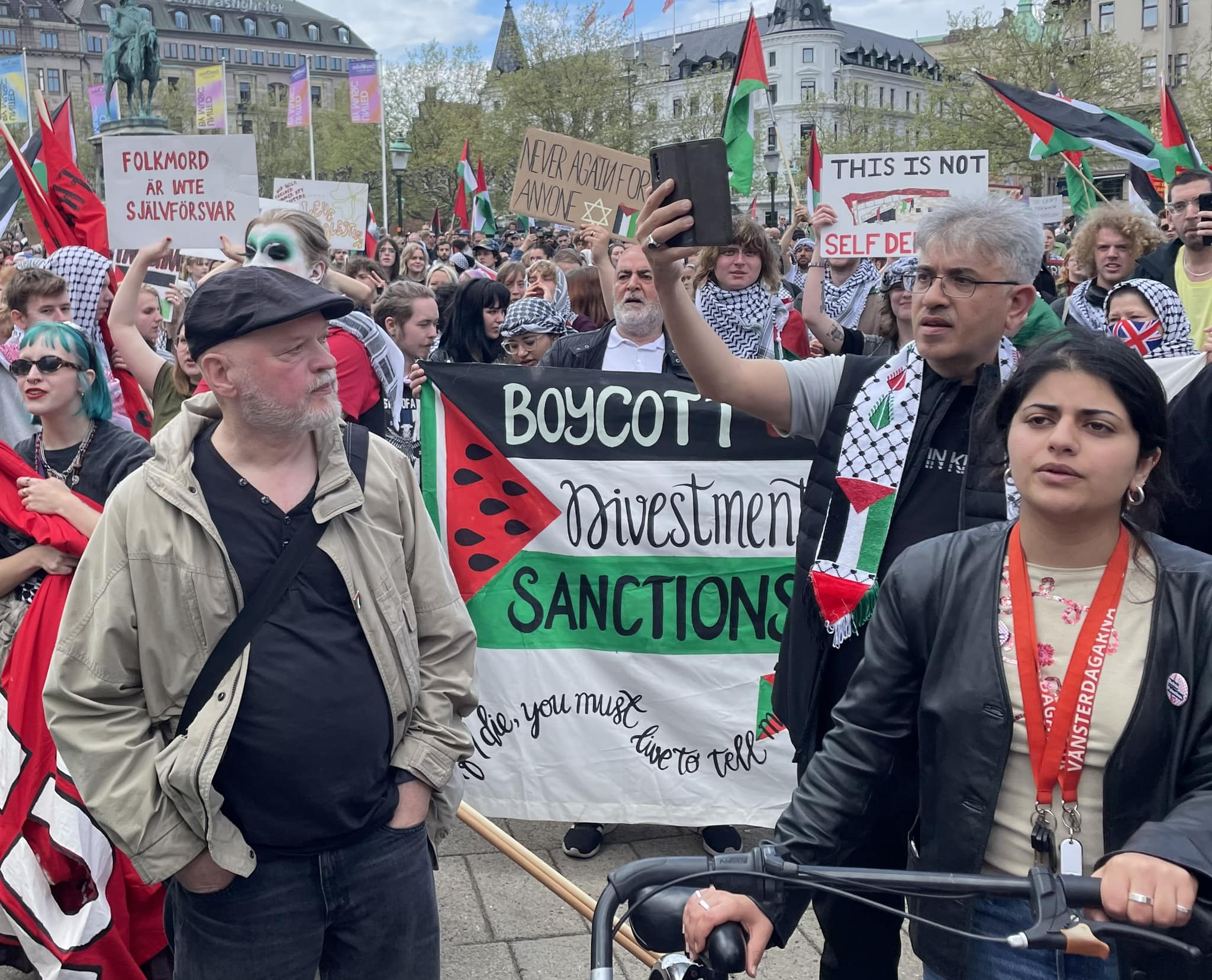
Thousands of people marched through Malmö to protest Israeli singer Eden Golan's participation and to demand a Gaza cease-fire. Police removed dozens protesting outside of the arena.
MALMÖ — After performing to boos and applause, and as thousands protested outside, Israeli singer Eden Golan ultimately placed in fifth in the 68th Eurovision Song Contest final, receiving 329 points from the public vote.
Golan's performance of the power ballad, "Hurricane," in Thursday's semifinal shot up her odds. Though she faced some booing at dress rehearsals, she was voted into the final by viewers around the world.
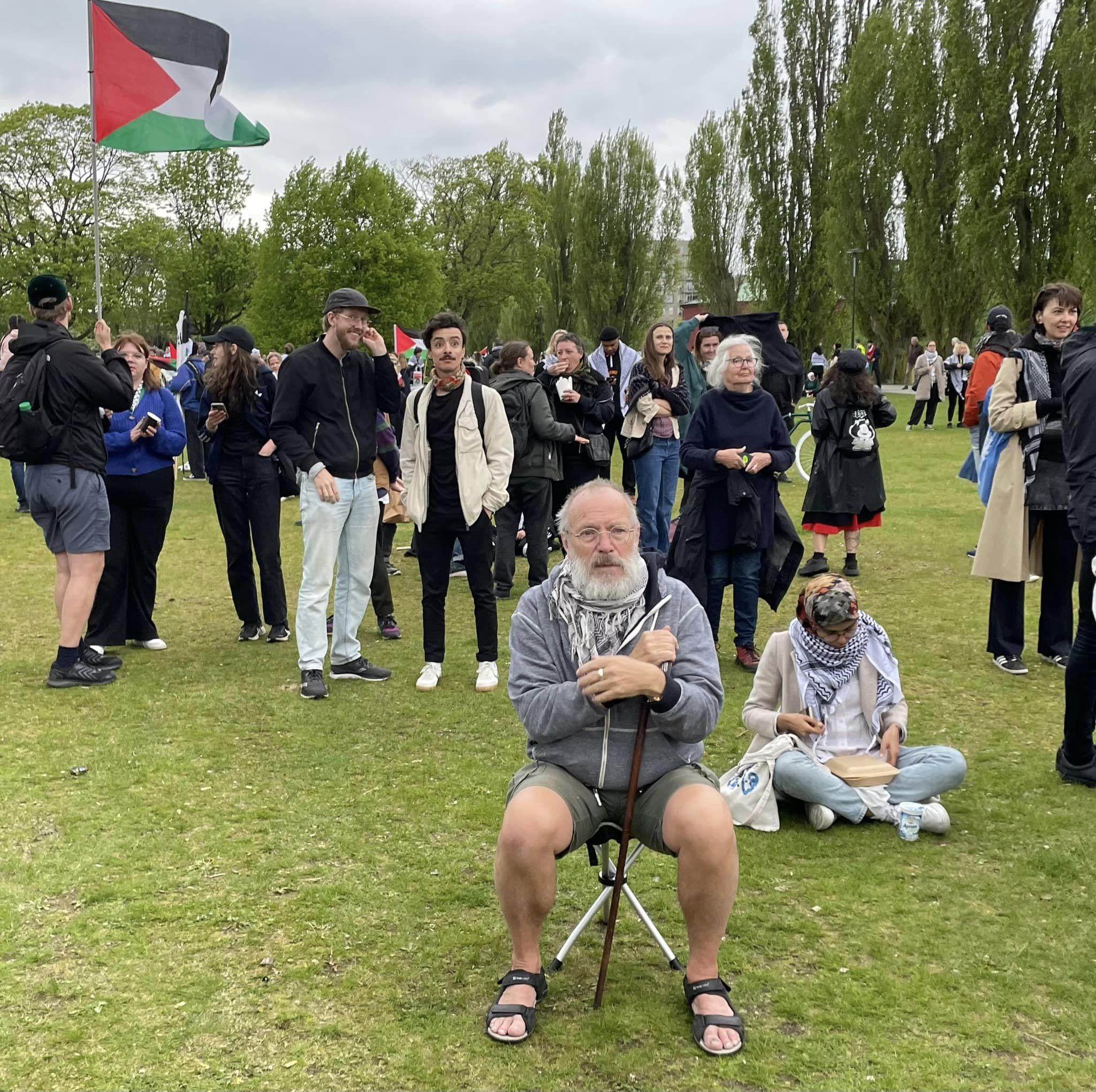
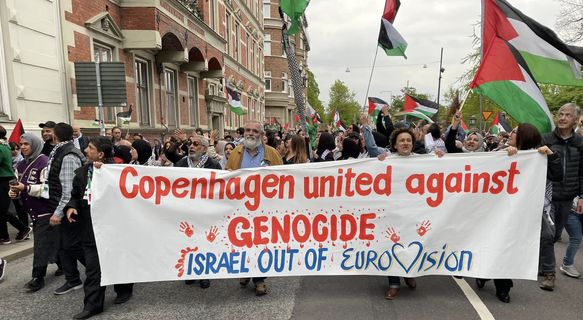
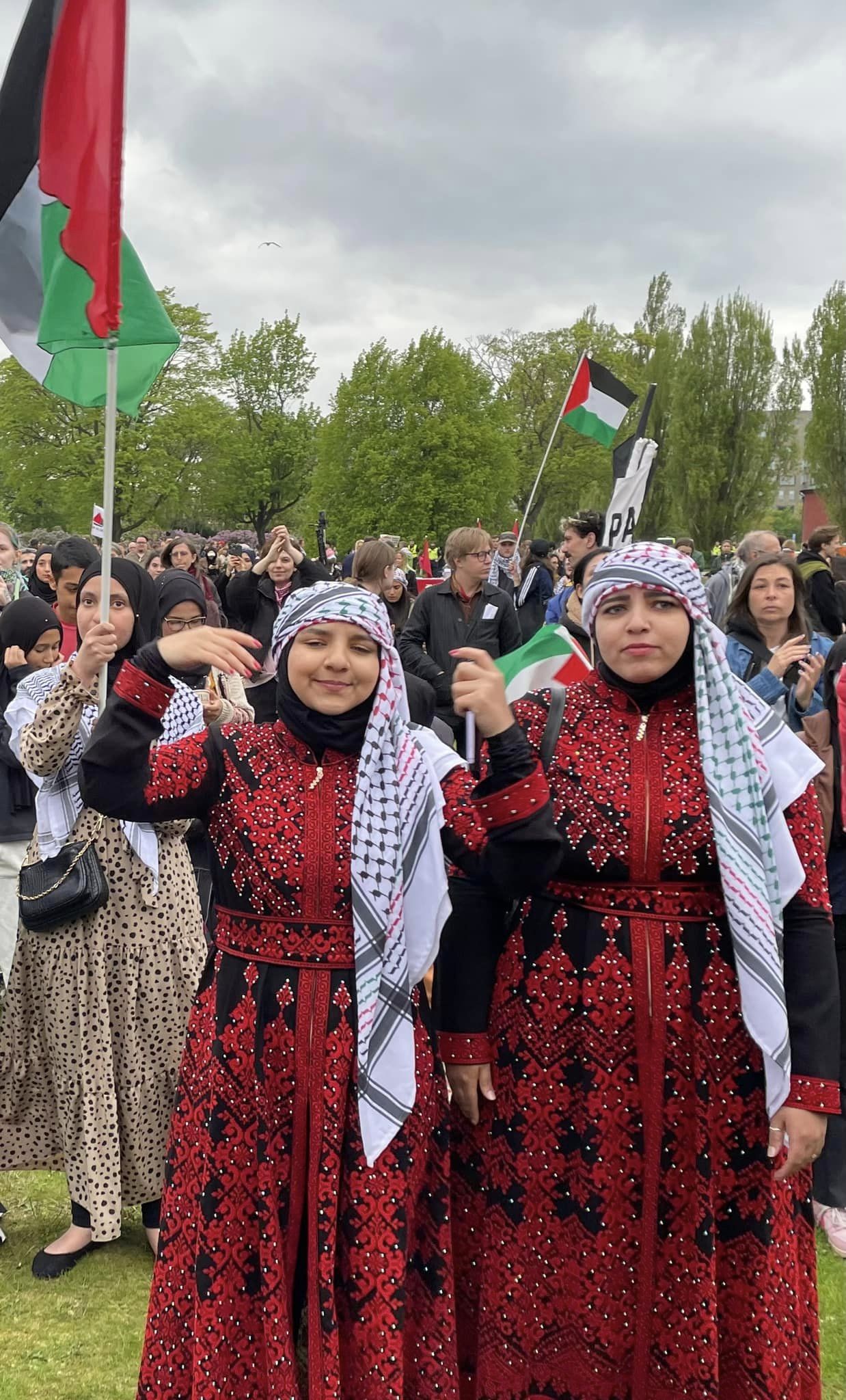
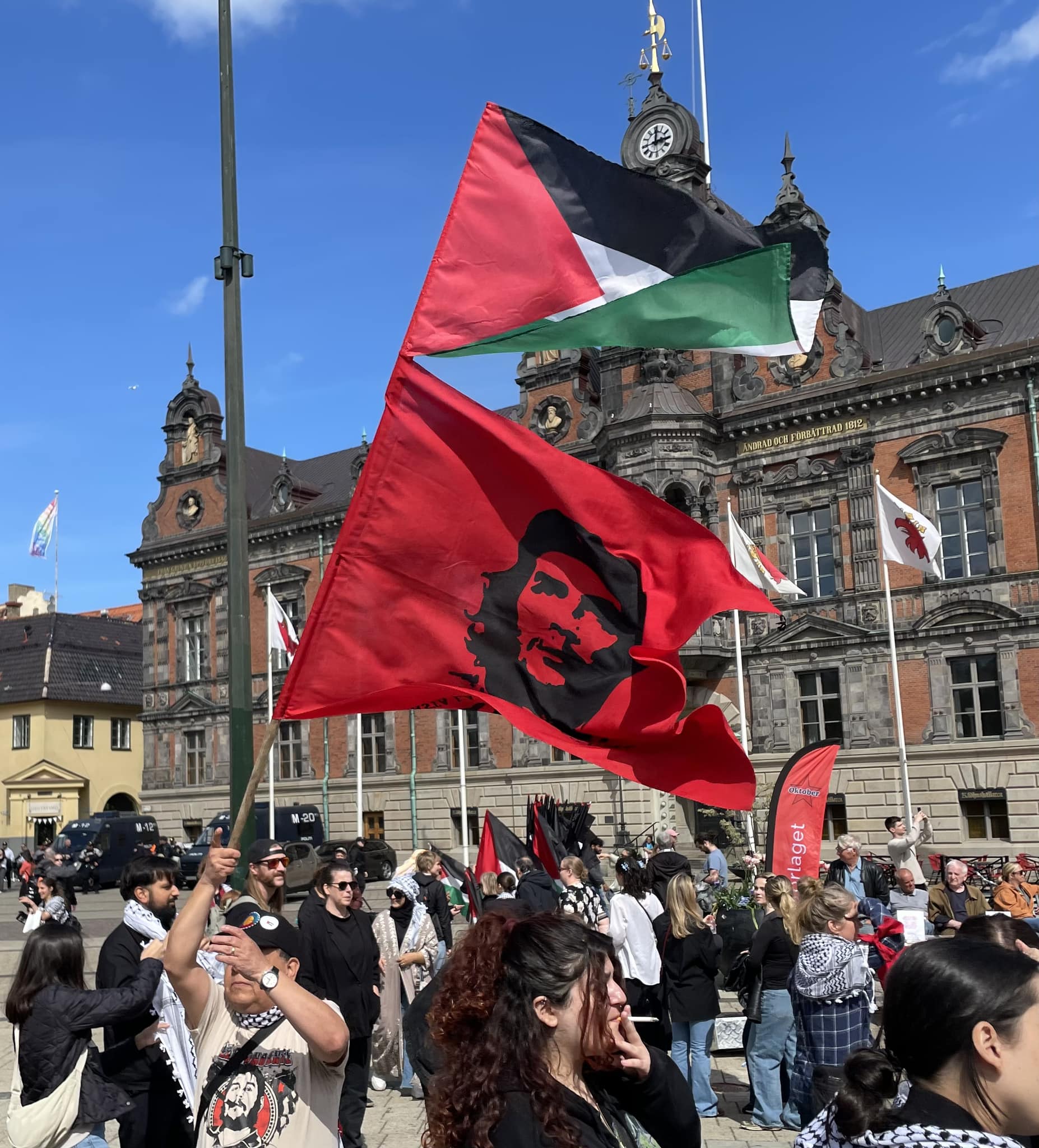
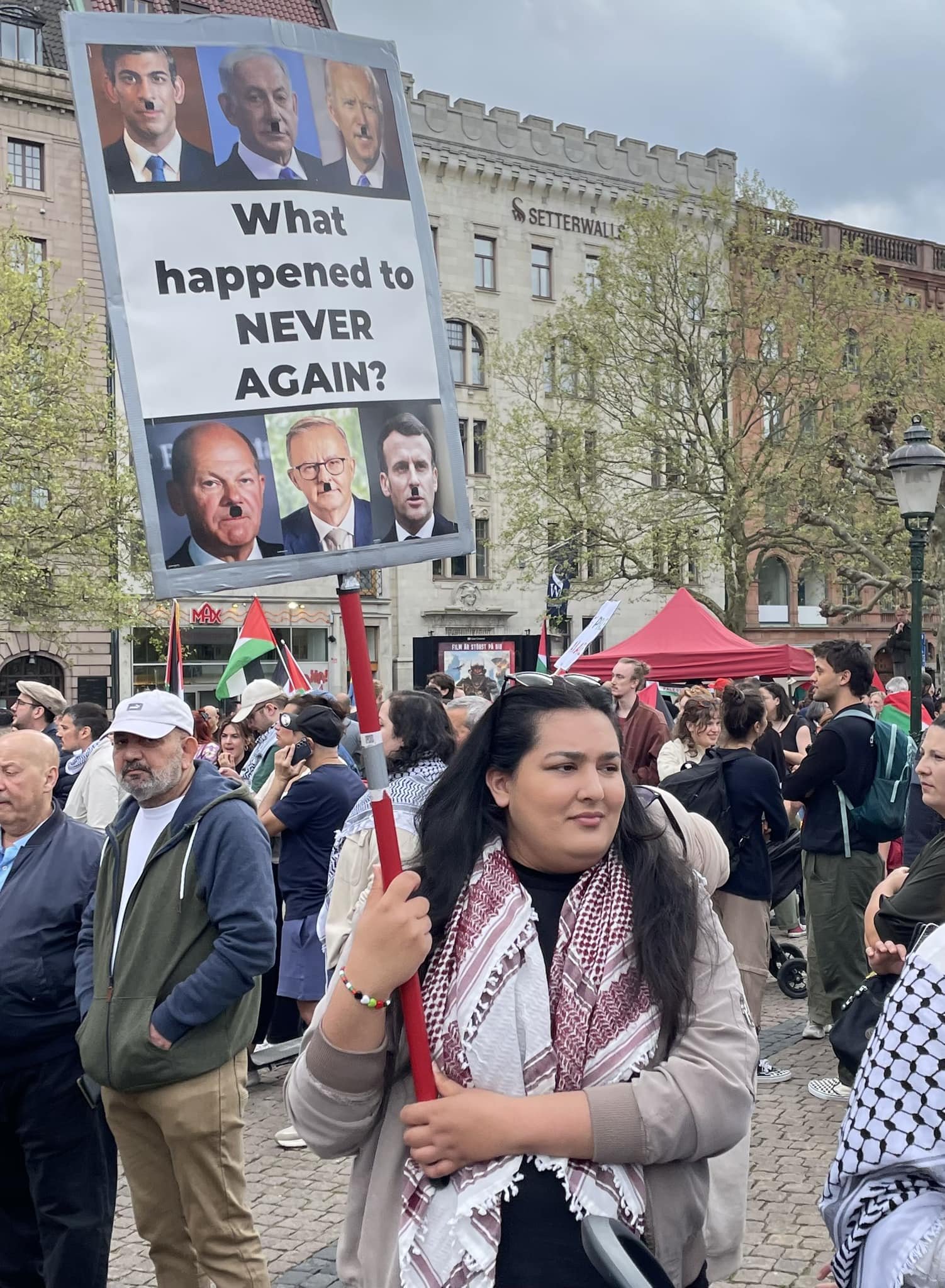
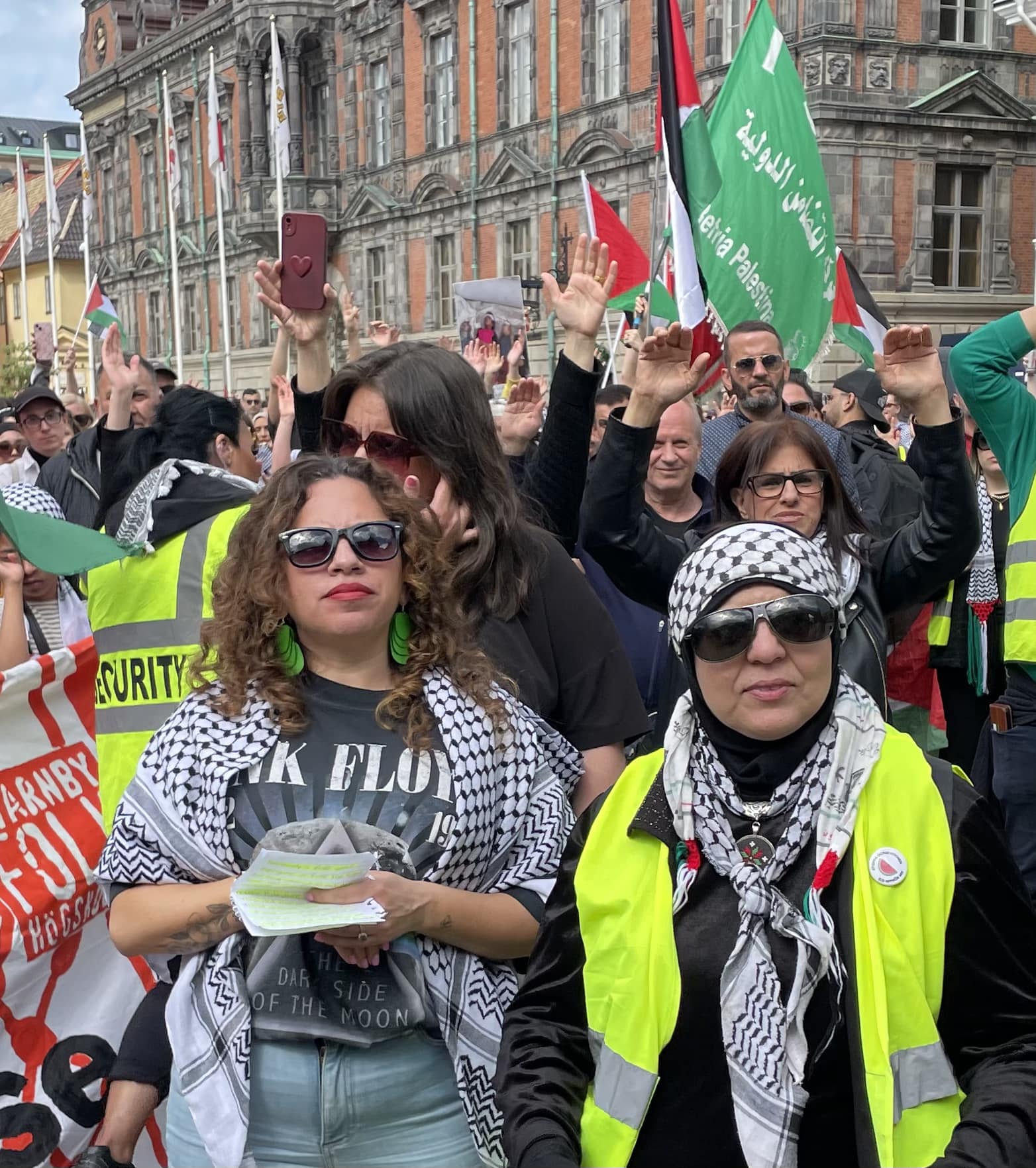
Police removed dozens of pro-Palestinian demonstrators protesting outside the Malmö Arena as the final began on Saturday. Earlier, thousands attended a pro-Palestinian demonstration to protest Israel's participation in the event held in the city Saturday night.
The competition that pits nations against one another for pop music glory concluded in the Swedish city, with Switzerland claiming the trophy, and Israel at the center of a political storm.
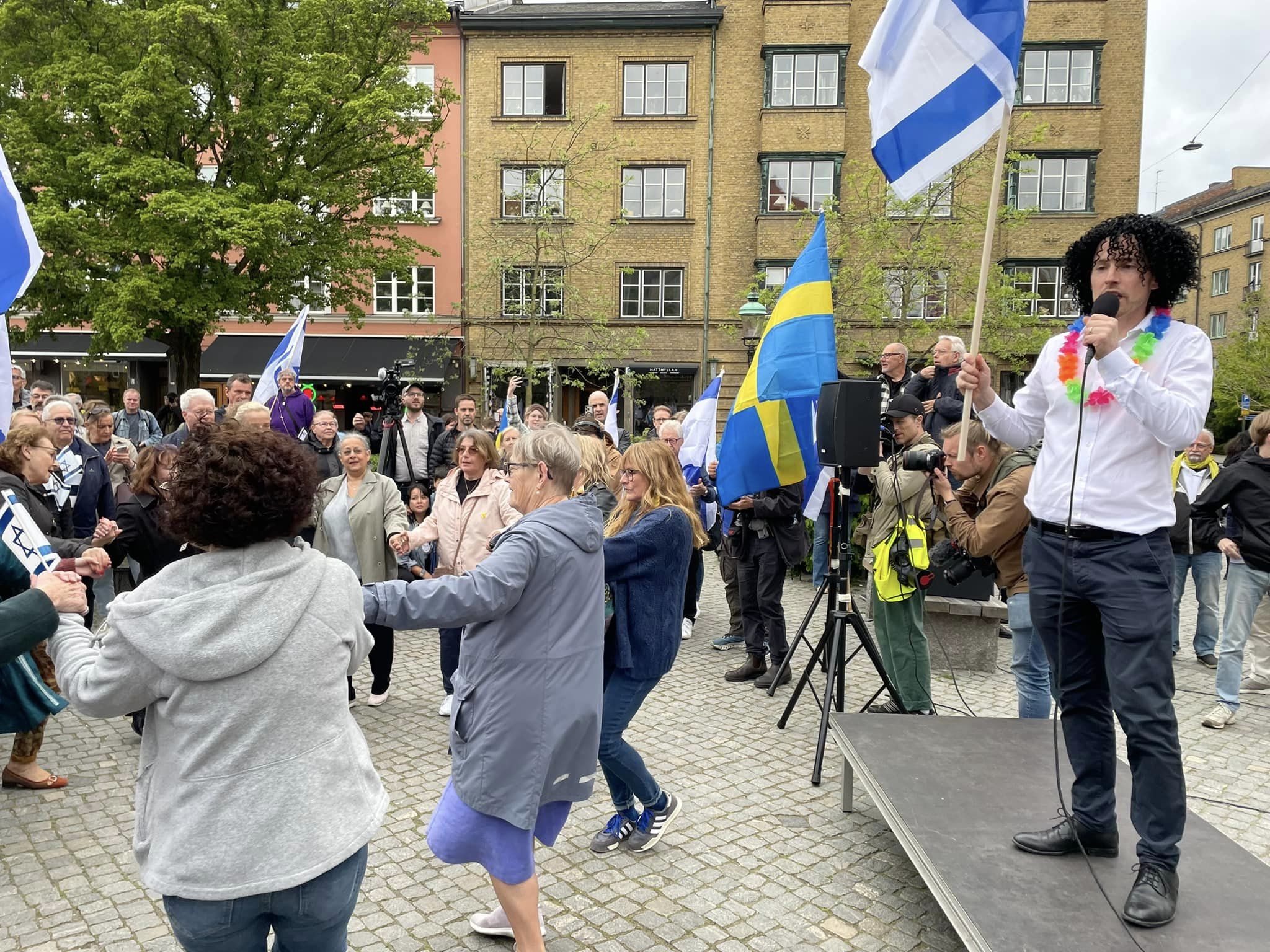
Meanwhile, a few minutes walk away from the pro-Palastinian protesta, a completely different demonstration took place. Under heavy police protection, about 100 supporters of Israel gathered. The event included singing of Israeli Eurovision songs alongside dancing.
All photos: David Stavrou
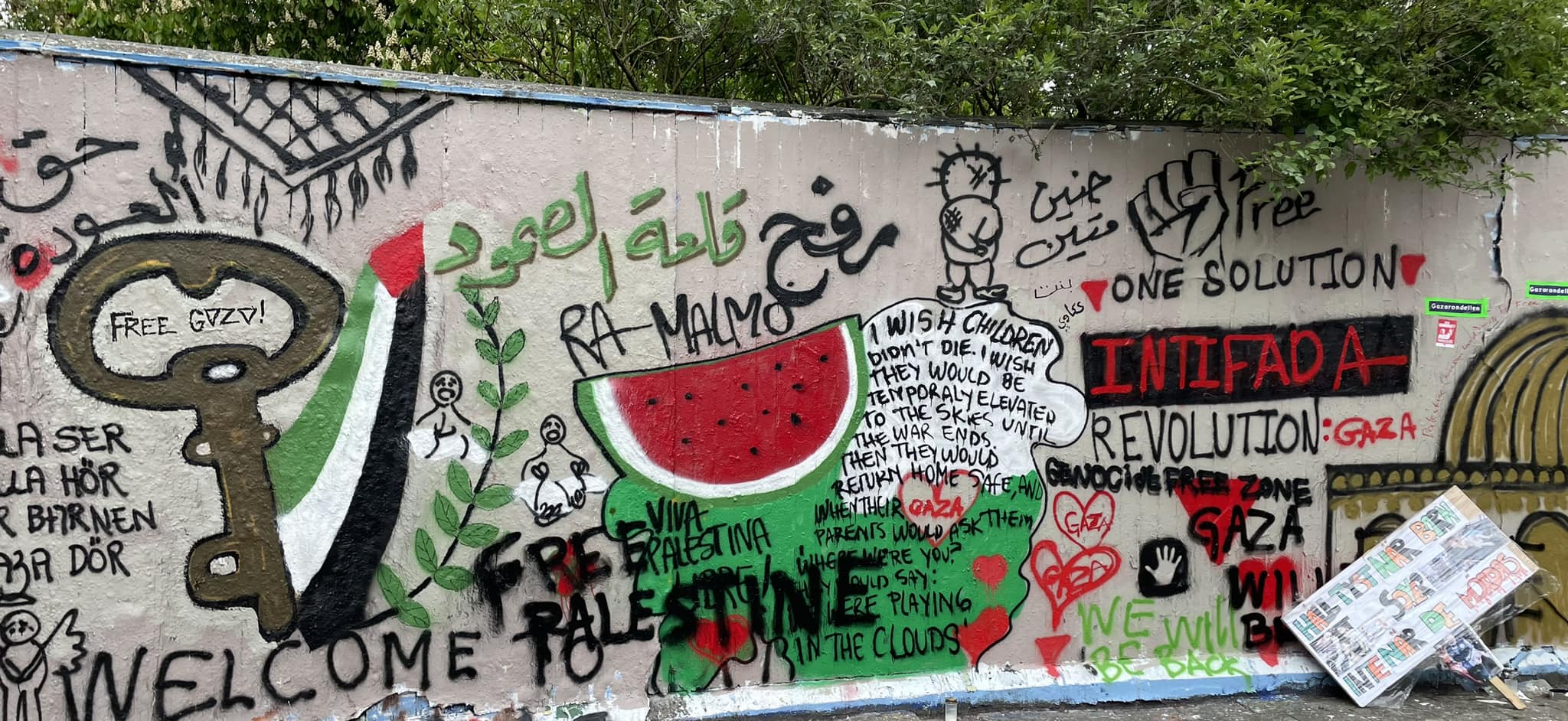
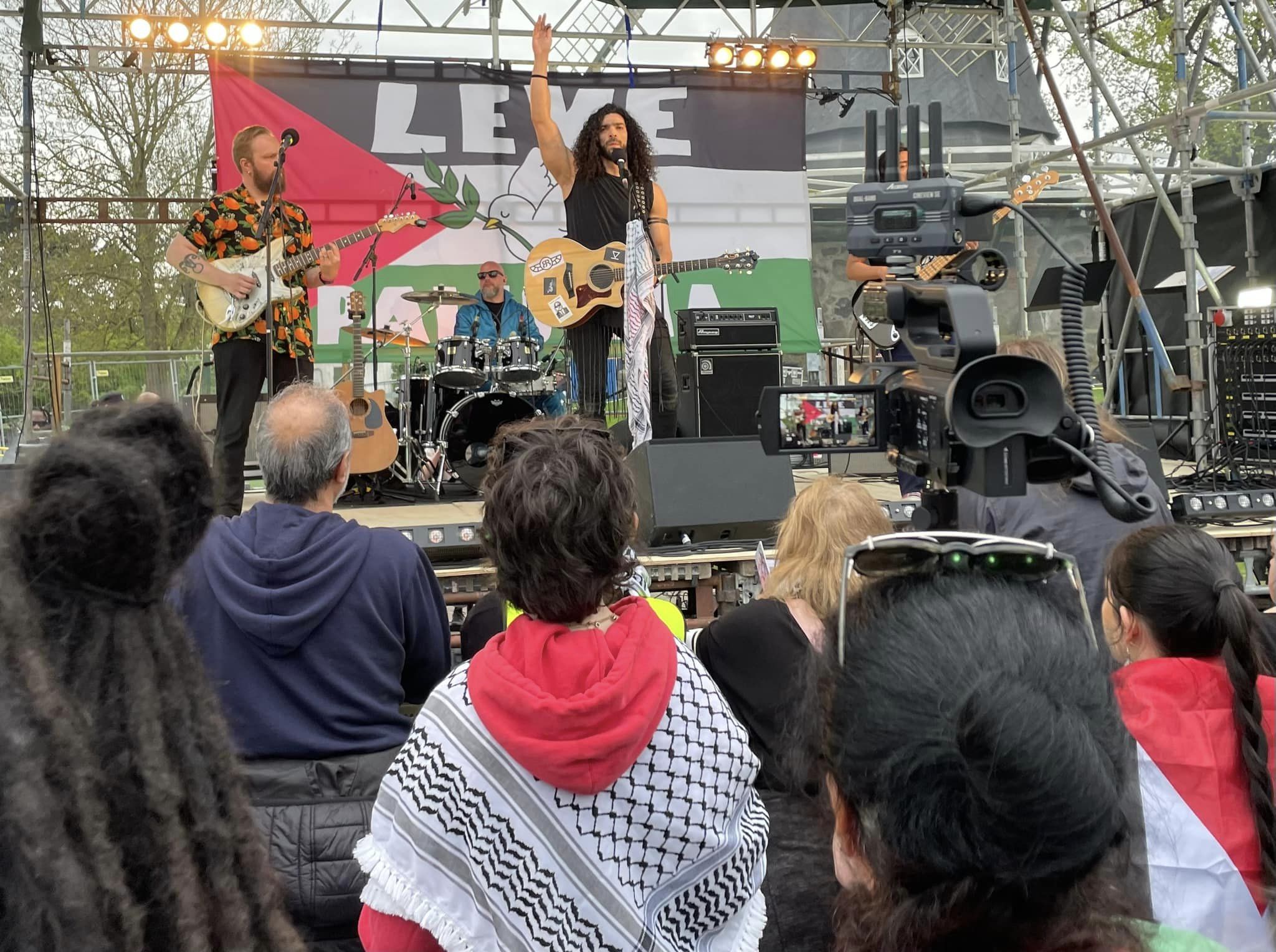
On the evening of the final competition, demonstrators took part in Falastinvision, a pro-Palestinian musical protest event held at a venue in the city. Attendees waved Palestinian flags and banners while chanting protests against Israel and its actions in Gaza.
Described on its website as a "genocide-free song contest," the event featured various singers and bands who registered in advance and competed for a prize. According to the organizers, the event aims to "shed light on the Palestinian issue" and protest against the decision of the European Broadcasting Union to allow Israel to participate in Eurovision amid accusations of committing war crimes.
Israeli Prime Minister Benjamin Netanyahu praised 20-year-old Golan for performing despite "contending with an ugly wave of antisemitism."
The discourse within the Swedish and European left is important even if you're not part of it and the insane embrace of Hamas by so-called left-wing radicals, climate change fighters, human rights activists and western intellectuals and academics must be challenged.
Imagine this powerful image: in a country which is slowly being taken over by right-wing nationalists, it's becoming harder to speak truth to power and to speak up for the underdog and the repressed. But then, from the trenches of the opposition, rises a fearless figure. He knows he'll be arrested and tortured if he's caught crying out, and so he does what intellectuals from resistance movements allways do under tyrannical regimes. He uses sarcasm, he sharpens his pencil and cleverly plays with words to produce a text which is radical and subversive, but at the same time meticulously designed not to be flagged down by the authorities. That way the avant-garde academic doesn’t get in trouble with the all-powerful secret service henchmen who are hunting down traitors.
Sweden 2024. While a war is going on in Gaza and in Israel, the whole political elite is powerfully supporting Israel. It's blue and white from left to right and it's not allowed to speak up for the Palestinians. And then, a single voice of a brave dissident rings out. He wrote a text. It's called "I Condemn Hamas" and it's brilliantly designed by a rhetorical trick – the title is mainstream and boring, everyone condemns Hamas. The content seems to be the same, but under the surface lies the explosive message – it's the exact opposite of condemning Hamas, it's actually supporting it (Malm, Anders, Jag Fördömer Hamas, Parabol, 01/11-23). At last the opposition has a voice – Andreas Malm has weighed in. It's a powerful text and a powerful image. The only problem is that none of it is true.
Malm's claim is clear – everyone's condemning Hamas, mainstream media, politicians and public discourse in general. He, on the other hand, thinks this is false. Hamas may have killed civilians, kidnapped children and burned down residential buildings on October 7th, but according to him this isn't unique. It's all been done before by Israel. Malm doesn't claim this directly. He does it by sarcasm. The same kind of sarcasm is pointed at the Swedish discourse. "In Sweden there are strikingly few who have condemned Hamas in the past few days. Those who have done it have only done it once, so that we now wonder if it was really meant honestly", he writes creating an illusion which is the exact opposite of the truth. In fact, Sweden is one of the countries in which the Hamas did surprisingly well. At least for an organization which is internationally recognized as a terror organization.
Hamas supporters have spoken openly in conferences and seminars in Sweden, money has been raised for Hamas freely in Sweden; just in the last few months there have been dozens of pro-Palestinian demonstrations with speeches supporting Hamas or at least not condemning them including demonstrations celebrating the events of October 7th on the day they happened. Unlike other countries, these demonstrations are not only legal, they're supported by some of the political elite and many in the media, in the cultural world and in civil society. Malm's style implies that Swedish publicists have to condemn Hamas or they'll be cancelled. Nothing could be further from the truth. In fact, Malm himself is a writer who has supported Hamas publicly in several newspapers, magazines and publications. As far as I know, he's yet to be arrested, censored or fired. In Sweden it’s allowed to burn the Koran, join parties which support North-Korea and have Neo-Nazi marches on Yom-Kippur. No one's preventing anyone from supporting Hamas. Indeed, I recently met Hamas supporters in Sergels Torg. They were members of two perfectly legal Swedish movements, RKU, the revolutionary communist youth movement and NMR, the friendly neighborhood neo-Nazis. Who knows, perhaps Andreas Malm himself was there supporting them both.
However, the Swedish context is only the beginning of Malm's mistake. The claim that the massacre on October 7th was more of the same, that it was Palestinians retaliating with the same kind of violence Israel uses, is worth studying. "What happened on Black Saturday, October 7th was something new in the history of the Israeli-Palestinian conflict", Malm writes using his smug self-satisfied irony, "it redraws the political and moral map of the Middle East for good. Gunmen stormed into communities and shot children to death with rifles. They did not care at all about the age of the victims. Hundreds of civilians were killed – people with no connection to any military activity, murdered simply because of their identity. Entire families disappeared". If this wasn't so true, it would be real cutting-edge political satire. But Malm's satire, is in fact the sad truth. Nothing like October 7th ever happened before in this conflict. Israelis and Palestinians never killed so many people in one attack or in one day. Not in Kafar Qasim (1956), not in Deir Yassin and Tantura (1948), not in Hebron (1996) and not in the bombings of Gaza in previous years. There were never so many acts of torture and violence against civilians, never so many people kidnaped and never such brutality. And yes, October 7th did redraw the political and moral map of the Middle-East for good. I couldn't have said it better myself.
Israel made many mistakes in the last few decades; like any other army it has committed war crimes during conflict, some of its civilians, especially in the West-Bank are violent extremists and its occupation of the West-Bank continues to be a hindrance to peace in the Middle-East. But October 7th was unique. It's not only about the brutality or the number of victims. The really scary number is the number of the people who committed the crimes. Unlike 9/11 which was executed by a small Jihadist vanguard of 19 Al-Quade operatives, and unlike Utøya which was the work of one (Andreas Malm cracks a little clever joke making the comparison), October 7th was carried out by about 3,000 people. Many of were sipplied with written instructions about how to murder, torture and kidnap civilians, some were also provided with drugs and with body cameras. This wasn’t a spontaneous, heat of the moment action. It was a planned strategy. On October 7th the world saw a society capable of drafting 3,000 people who were 100 percent committed to murder.
Andreas Malm perhaps hasn't heard the story told by David Tahar, father of Adir Tahar, an Israeli soldier who was killed on October 7th. Tahar told Israeli Chanel 14 that before the funeral he insisted on seeing his son's body even though army officials advised against it. The reason was that apparently after he was killed Hamas fighters decapitated Adir and took his head back home to Gaza. A few weeks later, after receiving intelligence from captured terrorists, an Israeli military unit retrieved the head. It was hidden in a bag with some tennis balls and a few documents inside an ice-cream shop freezer in Gaza. Apparently the head was up for sale. The price was 10,000 US Dollars. I know there are many who don't believe Israeli media and think that Zionists fathers are so perverted that they can make up this kind of story for propaganda purposes. So here's another one. This time from the New York Times.
Sapir, a 24-year-old accountant who attended the rave party near Kibbutz Reim on October 7th gave a testimony which was reliable enough for the NYT which told the story of what she saw from her hiding place (Gettleman, Schwartz and Sella, "Screams Without Words": How Hamas Weaponized Sexual Violence on Oct. 7", The New York Times, 28/12-23). Sapir says she saw "a young woman, blood running down her back, pants pushed down to her knees. One man pulled her by the hair and made her bend over. Another penetrated her. Every time she flinched, he plunged a knife into her back. Sapir said she watched another woman "shredded into pieces". While one terrorist raped her another pulled out a box cutter and sliced off her breast. "One continues to rape her", she said, "the other throws her breast to someone else, and they play with it, throw it, and it falls on the road". She said the men sliced her face and then the woman fell out of view. Around the same time, she said, she saw three other women raped and terrorists carrying the severed heads of three more women.
These are just two testimonies from October 7th. There are thousands more. One could always claim, as Malm does in earlier texts, that all this violence should be seen in context. But this kind of violence has no context. If it was really about freedom, or fighting the occupation there would be no need for mass rape, kidnapping babies and removing body parts. The atrocities, the rockets, the tunnels and the complete subordination of Gazans to Hamas militants are all far darker and more sinister than Malm's theories. It's not the price paid for Israel's colonialism. If for no other reason, because this isn't colonialism. Israel isn't Algeria.
According to Malm, the conflict between Israel and the Palestinians isn't a war between two indigenous peoples which have a legitimate claim to the same territory and therefore are engaged in a violent conflict. Instead, there is one legitimate native nation and for over a century it has been fighting an occupation by invaders who came from other countries as colonizers. The invaders are supported by imperialist powers and they are now committing genocide. This kind of aggression according to Malm must be, should be and always has been resisted with violence. In fact, Malm's latest text is one of many in Parabol making the same claim.
These texts rarely even mention the events of October 7th which I would suggest is a sign of total moral bankruptcy. But that's me and I may be biased. The problem here is different, it's about intellectual honesty. The description of the Israeli-Palestinian conflict as a story of a colonial power murdering the natives is incredibly shallow and misleading. It's perfectly ok to oppose Israel's policies (as I do myself most of the time), it's perfectly ok to name-drop Edward Said and Franz Fanon, make comparisons to Apartheid South-Africa and quote Israeli officials making outrageous genocidal statements which can then be quoted at the ICJ in the Hague. But people who have studied the region, as I guess Malm has, know very well that Jews, not only Palestinians are natives to it. And no, I'm not referring to Jesus and Abraham. Biblical stories cannot be a base for international geo-politics. I'm referring to facts completely ignored by the whole post-colonial discourse.
Take Gaza, for example, in the place where Rimal, the political center of Gaza City used to stand, a synagogue was built in the year 508 AD. We know that the figure in the center of the ancient mosaic which was found there is King David. How do we know this? Because his name is written there. In Hebrew. Gaza has a long bloody history – Romans, Christian Crusaders, Arab armies, the Egyptians, Napolean's army, the Ottomans and the British Mandate all controlled Gaza. During this history, Jews lived in Gaza, they didn't arrive in ships in the 1940s. They were there during the time of the Romans, 2,000 years ago, they were there in the Middle-Ages and during the time of Islamic rule, then again in the 14th and 15th century and under the rule of the Ottoman empire. Some were still there even after WW 2.
As in many other areas in the region, for thousands of years, Jews thrived and declined in Gaza, they were expelled and fled, they killed and were killed, built and destroyed, returned, immigrated and emigrated. Arabs in the region have a similar, though somewhat shorter, story (I'm referring to them as Arabs, because the name Palestinians wasn't used in the way that we use it today until after WW2). The story of the region being a land inhabited by indigenous Palestinians who were attacked by American, European and Russian Jews arriving from abroad after the Holocaust and kicking out the natives is a fairytale. Concepts like colonialism and indigenous peoples aren't abstract. Unfashionable as it may seem, these things have actual meanings beyond TikTok clips made by demonstrators wearing fashionable red, white and green scarfs. They can be discussed in terms of archeological findings, origin and descent, historical continuity of settlements, language and culture, collective ancestral ties to a territory and to natural resources, self-identification, experiences of subjugation and discrimination and so on. It may be frustrating, but when it comes to Israel, to the West-Bank and to Gaza, both Jews and Palestinians are natives. They're all a combination of immigrants and people who are decedents of families who haven't left for generations. And they've all suffered from violence, massacres, displacement and trauma.
And there's another similarity between the Jewish national movement (aka Zionism) and the Palestinian one. They both have a genocidal wing. These are the people on both sides who don't accept the idea of territorial compromise in order to achieve peace. The people who are willing to go as far as killing or expelling the other group in its entirety. They're usually religious fanatics, they're extremely violent, they totally oppose democracy and human rights, they're willing to kill and die for the cause and they've always been around. On the Jewish side, they began to become a serious threat after Israel's 1967 victory with the rise of the settler movement in the occupied West-Bank. These days they're becoming stronger, they're getting closer to government circles, but they're still far from being anywhere near a majority in Israeli society.
On the Palestinian side, things seem to be worse. If on the Zionist side there was a right-wing revisionist leader, Zeev Jabotinsky, who had a connection with Mussolini in the 30s, the leader of the Arab nationalists in Palestine at the time, Haj Amin al-Husseini, spent WW2 in Berlin and in Rome, he collaborated with the Nazis and the Fascists, he personally met Hitler, Himmler and Mussolini and was a supporter of the "Final Solution of the Jewish Problem". Al-Husseini was just the beginning. The Palestinian National movement has always had an active and extremely popular genocidal side to it. It's not because of Israel, because it started many years before Israel even existed. And it's not unimportant because what we saw on October 7th was a direct result of the same kind of ideology.
That's what's really amazing about Andreas Malm's text. Hamas is the genocidal wing of the Palestinian national movement and its ideological roots go all the way back to Nazi Germany. Although it was seen as a traditional grassroot, social and religious movement when it was founded in the 80s, it's now a modern, extreme right-wing movement combining Jihadism, high-tech disinformation campaigns, a financial empire of global investments, leaders who live a life of luxury outside the region, modern weapon systems and powerful alliances with the world's most tyrannical regimes. Anyone imagining the Hamas as a young David standing up to the Israeli Goliath is living in a naïve lullaby.
But Andreas Malm isn't naïve. He knows very well that the geo-political realities show that Hamas and indeed the Palestinian national movement is far more complicated than just a victim of western colonialism. He knows about the Israeli disengagement from Gaza in 2005 which means there was no occupation of Gaza for almost two decades. He knows that the blockade on Gaza is just as much an Egyptian policy as it is an Israeli one and that many Arab countries want Israel to destroy Hamas. He knows that the Hamas charter is an antisemitic and fundamentalist text. He knows that Hamas has crushed the secular Palestinian national movement in Gaza and that it sees the Palestinian Fatah movement as an enemy which is almost as bad as Israel. He knows about Hamas' brutal war against the Palestinian Authority and he knows about the unprecedented Hamas military buildup and take-over of civil society in Gaza.
The reason that I know that Malm knows all this is because of other texts that he wrote. Reading them one learns a lot about his way of seeing the world, though I must admit, it's sometimes a confusing task. Although he seems well versed in Middle-Eastern politics, when it comes to moral statements and political conclusions, his considerations are so complicated, it's hard to keep track. Although Israel is always wrong (that's the constant) when it comes to Palestinians, Arab states and Islamic super powers, the target is painted around the dart after it's been thrown.
In a text he wrote a few years ago (Malm, Andreas, "Därför Hamas", Expressen, 15/01-09) he claims one can have two thoughts at the same time, like the Palestinian left which allies itself tactically with Hamas but at the same time supports the opposition in Iran while the opposition in Iran is fighting the Iranian regime at the same time the Iranian regime is funding Hamas. It's ok if you need to read the last sentence again.
Malm's reasoning is not that unique. He supports Hamas and its fight against what he called the "corrupt Fatah politicians" and Mahmoud Abbas, who's an Israeli and American "marionet". If this sounds familiar it's because this is exactly the same logic used by Israeli PM Netanyahu who for years has been undermining the Fatah controlled Palestinian Authority by allowing Hamas to stay in power in Gaza so that he wouldn't have to take real steps towards a two-state solution. Surprisingly enough, Malm and Netanyahu are on the same side. They'll both do anything to avoid compromise and consolidation.
In another text from 2009 Malm referred to Hamas as a liberation movement which is "forced to resort to every possible form of resistance" (Malm, Andreas, "Vi bör följa Iran och stödja Hamas i kampen mot Israels folkmordspolitik", Newsmill, 04/01-09). In the same text he quoted Nir Rosen, who claimed that "Attacking civilians is the last, most desperate and basic method of resistance when confronting overwhelming odds and imminent eradication" (Rosen, Nir, "Gaza: the logic of colonial power", The Guardian, 29/12-08). Malm is entitled to write these kind of statements even if they encourage violence and are fascist in nature. I only hope that most Swedes, including those who support the Palestinians, can see beyond this tragic war mongering, since it's clear to anyone what this means politically. Hamas will continue murdering Israelis; Israel will have to retaliate and will do so forcefully – and more Palestinians will be killed. If there's anything that hasn't changed in the last few decades it's this dynamic.
Hamas is not the only problem. In another text Malm openly supported Hezbollah (Malm, Andreas, "Därför Ska Vi Stödja Hezbollah", 11/08-2006), an Islamic movement funded, trained and inspired by the Iranian Ayatollahs and their Islamic Revolutionary Guard Corps, which was involved in suicide attacks, political assassinations, bombing of civilians and hijackings in Lebanon and other countries. I don't know how Malm manages to pull off being a left wing radical and supporting two of the most conservative, fascist, chauvinist, fundamentalist, hierarchical, anti-democratic, homophobic and xenophobic movements in the history of the known universe, but I know that explanations along the lines of "I can't be expected to condemn actions taken by the weak and oppressed” can't work anymore after the massacre of October 7th which was a tectonic, world-changing event. Not condemning it, or in Malm's case, condemning it sarcastically, means supporting it.
This period isn't easy for the global political left. Just like in the 1950s when left-wing activists, politicians and intellectuals had to decide whether to stay faithful to the Stalinist flagship even after it was exposed as a sadistic killing machine of gulags and mock trials, today's left must decide if its alliance with the dictators, Jihadists and militants from Gaza, Teheran, Beirut and Doha is more important than its ideals. Those who have the courage to choose their ideals and abandon their old murderous allies will not have Andreas Malm's problem. They will be able to proudly say "yes, I condemn Hamas".
This is a tectonic and world-changing event, carried out by thousands of people supported by hundreds of thousands of people, as well as by movements, states and regimes. Not condemning it is supporting it. And the results are inevitable. Because of the horror that these people have inflicted on the world, an even darker night is to come before we will see the light.
A is my friend. He is a Burmese expatriate from Myanmar living in Europe. He is an academic, an educated and friendly person, and a veteran human rights activist. As a journalist who writes, among other things, about countries where acts of genocide, ethnic cleansing and human rights violations take place, I consult with various experts. A is one of them. This is the letter I sent him last week.
Hello, A. I am writing in response to your letter regarding the “colonial character and genocidal policy of Israel.” As you can imagine, I am quite busy these days, and as someone who is far away from his family in Israel, I am distracted. I am responding to you despite all this, mainly because your words opened with a reference to Auschwitz, a place where many of my family members were murdered about 80 years ago.
According to you, Israel is using the Holocaust as a “blank check” to justify the imprisonment, bombing and starvation of 2.3 million Palestinians in Gaza, almost half of whom are children. "In these circumstances, 'never again' is a hollow phrase," you write. “It becomes a call for uncontrolled violence, battle cries and a campaign of revenge and extermination." In the past and under different circumstances, I must admit that I might have agreed with you.
A, you must remember that we got to know each other after several occasions when you very generously shared with me your expertise, knowledge and experience regarding Myanmar. When I first contacted you, I wrote that as a journalist working in a free country, I felt obliged to tell the story of the victims of atrocities there – amongst others, the Rohingya people other minorities who have been suffering from genocidal policies for years since the military coup in 2021.
Since I am not an expert myself, I reached out to you, just as I reached out to many other experts, witnesses and human rights activists who could shed light on other places I wrote about, such as China, Ethiopia, Syria, Iran, Mexico, Belarus and Iraq.
This is an important point. As you know, there are complicated conflicts in many of these places about which there are different opinions. Still, my feeling was that we shared a real commitment to expose and fight certain types of acts which cannot be excused under any circumstances, regardless of the different narratives that explain the conflict. I mean the kind of actions that cannot be permitted even if there is no agreement on the history of the conflict or even on the identity of those responsible for it.
These actions include those that took place in Rakhine province in Myanmar, which I wrote about with your kind help. The barbaric murder, torture and rape of innocents that happened in your country is inexcusable. Political, ethnic, religious or demographic claims simply cannot justify throwing babies into fire, torturing children to death in front of their parents, and the mass rape of women before their execution. I thought we agreed on that.
This week, I received a long email from you, Dr. A. Extremely long. Long enough to clarify your words or even to add something along the lines of: "despite all this, of course I condemn [Hamas’ actions],” or even "despite the absolute truth of the Palestinian claims and genocidal policy of Israel, I do not justify killing civilians."
But there was none of that. Somehow, your post references 100 years of conflict prior to October 7 (including explanations using maps, cartoons, pictures, and quotes). And there is a reference to the days after October 7.
But the day itself, when over a thousand people, most of them civilians, were brutally murdered and over 200 people, again most of them civilians, were kidnapped, was completely absent. And it's strange given the fact that, as I recall, we share an interest in cases of throwing babies into fire, torturing children to death in front of their parents, and the mass rape of women before their execution. Yes, to make the point clear to a person from your background, for one historical moment, Israel's Gaza envelope region became Myanmar's Rakhine.
A, since I received your message, I have been trying to understand why you do not recognize October 7th. I understand your opinion about the essence of Zionism and the essence of Israel. I don't agree with it, but I understand your point. Still, there's that little matter of “under all circumstances.” Perhaps there is a certain type of fascist, fundamentalist, racist, and violent organization that, against your usual leftist positions, you actually do support.
But if so, what are the criteria? Is it because they are jihadists? Is it a matter of religion? Or that according to the accepted code of the post-colonialist discourse, the "natives" have certain Jew-killing privileges because of the many years of oppression they have endured? Oppression, which, as you know, I have never denied.
And maybe you are one of those who do not believe the photos, the direct testimonies of survivors, the explicit confessions of the attackers and the unwatchable and undeniable videos. Do all these not meet your strict standards? Strange, because we never applied such strict standards when I wrote about Myanmar.
Do you think it's all a conspiracy of Western governments spreading fake news? Is it all the settlers’ lies, supported by American imperialists? Are you really not affected by the testimonies of Israeli women, children and elders, many of whom, by the way, are peace activists who built their homes in socialist communes that are not in any way located in the West Bank or in any way disputed. Unless the very existence of Israel is disputed, a position I assume you hold since you treat Israel as a settler and colonialist entity.
And maybe I didn't understand what you meant. In this case, perhaps in the future, we can discuss the true nature of Israel. As you know from our previous correspondence, I never supported Netanyahu, I have always believed in compromise with the Palestinians and I am absolutely against any kind of war crime, including against civilians in Gaza. You also know that I am a social democrat and a person who is aware of the climate crisis and the hardships of the "global south.” But wait, here I am, once again falling into this trap. If I were not all of these things, if I were a Netanyahu supporter or a settler in the West Bank, would my massacre and that of my family members be justified?
Again, there's that "under all circumstances" nuisance. Even if the Jews were like the French in Algiers, and they are not, deliberate murder of innocents is always evil and mass murder is absolute evil. Among us Jews, even complete secularists like me sometimes recite from the ancient texts: “I have set before you today the heavens and the earth, life and death; I have set before you the blessing and the curse. Choose life, for your lives and for your descendants,” as it is written in the book that you call the Old Testament. Do you understand A? You chose life – without “buts” and without “maybes.” This is why I always opposed my own people murdering other innocent people. And you know what, I'm angry at myself for not resisting enough.
***
And so for the record, I want to mention that I believe that Jews, not just Palestinians, also have rights in the place where I was born. They have personal, social and national rights and they also have responsibilities that are well described in the Declaration of Independence of their country, our country, which was founded 75 years ago. You don't acknowledge that, which is probably the real reason you didn't mention October 7th in your message. If "Palestine will be free from the river to the sea," as they are now shouting in the streets near my house in Europe, the events of October 7th are probably not an accident in your eyes. They are the first step in the plan.
"Free from the river to the sea” means without the people who are living there now. This is not the two-state solution, nor a partition plan, nor a federation. I think with your education, you know exactly what it means. But in case it's not clear enough, I'll say it explicitly: Hamas is the genocidal wing of the Palestinian national movement, and it turns out that it has quite a few supporters. My friends say that such views stem from antisemitism, but I don't know what is hidden in a person's heart. How much darkness, how much hatred.
I also don't know what is hidden in your heart. But I know that October 7th was not another attack, another battle, another chapter in the bloody history of the Middle East. It cannot be solved with sentences like "I cannot be expected to condemn every action taken by the weak and oppressed.” This is a tectonic and world-changing event, carried out by thousands of people supported by hundreds of thousands of people, as well as by movements, states and regimes. Not condemning it is supporting it. And the results are inevitable. Because of the horror that these people have inflicted on the world, an even darker night is to come before we will see the light.
***
And so, as a wise man wrote during the World War II, you and I now stand on two sides. "My opinion is clear about your motives,” he wrote, “and you would do well to speculate on my motives.” And he added: "I have one more thing left to say to you, and let it be the last. I want to tell you how in the past we were so similar and today we are enemies. How could I have stood by your side, and and why everything between us is over now.”
And that's the thing. In Xinjiang and Syria, in Tigray and Iran, in Myanmar and Israel, acts like those committed by Hamas are not only the absolute lowest of what the human race is capable of. They also redefine the lines. If they do not fill a person's heart with unconditional anger and disgust, they place him outside the legitimate discussion of civilized people. If you can only find room in your heart for the pain of one side, that's your problem. But with your permission, I think I'll find myself a different expert on Myanmar.
Before I finish, I will ask just one last thing. Do me a favor – next time, please refrain from referring to Auschwitz. Not because I have a monopoly on the memory of the Holocaust or the memory of the victims. But because when it comes to the 1940s, those people on whose behalf you are currently campaigning, they tend to be something different than you imagine. When you remove the appearances of European leftist movements, those people tend to be supporters of the side that built Auschwitz, not of those led there to their deaths.
The public is not allowed to know which products can be marketed without a license and to whom, but they are also sold to countries that perpetrate horrific acts with them
The raid on MonTaing Pin began at 6 A.M. About 150 soldiers entered the village from the west, firing in all directions. Many of the residents fled, others found shelter in the local monastery. What happened afterwards was described by witnesses who told their story to Radio Free Asia (RFA). The soldiers arrived at the monastery, found the villagers who had hidden there and sat them in rows, men and women separately. The women were taken to one of the rooms and locked inside. The men were tied up and their valuables taken. Later they were stripped, interrogated and tortured by knife stabbings and beatings.
In the evening they were locked into one of the rooms without food, water or access to a toilet. The next morning 10 of them were forced to carry looted property to the riverbank. When they finished the work, they were executed with machetes. Their bodies were burned. In the afternoon most of the remaining men were taken to the village, with their hands bound and their faces covered. They were executed with guns and machetes, and their bodies were dragged into the houses.
Some were cut into three or four parts before the houses were torched. Afterwards the soldiers left. A few hours later, the few captives who had remained in the monastery and survived returned to the village and found puddles of blood outside the ruins of the houses, and body parts, some of which were eaten by feral dogs.
The village where the massacre was perpetrated in May is located in the Sagaing district of northern Myanmar – a region identified with opponents of the junta that ousted the semi-civilian government of Aung San Su Chi in February 2021 and took over the country. There is evidence that recently in this region there were acts of slaughter and torching of additional villages.
This is a tumultuous period in Myanmar because many forces are fighting one another, while harming the civilian population. The conflict in the state of Rakhine in the west of the country continues even after it had already turned into genocide against the members of the Rohingya minority. Protesters against the regime are killed in demonstrations in the major cities, and at the same time there are clashes with organizations of ethnic minorities. We know nothing about many of the incidents due to restrictions on freedom of the press.
The reason why the massacre in Mon Taing Pin reached the media is interesting and unusual: One of the soldiers involved in it forgot or lost his cell phone. The phone was found, and its contents sent to RFA, a Washington based American funded media organization.
The photos and film clips discovered on the phone are a smoking gun. There is a picture of men who are seated, tied up, in a row outside the monastery. Another picture, dated a day later, shows the bodies of five of those men, with three soldiers standing over them: One is smoking a cigarette, a second is staring at the bodies and holding a gun, the third is photographing the bodies with his cell phone. Other pictures show a young man, on his knees, his hands bound, being tortured by knife stabbings. And there is also a film clip of the owner of the phone and two of his friends boasting about the executions they carried out. Their faces and the symbols and numbers of the army units are exposed.
This is horrifying evidence for anyone to absorb, but there is an aspect that is likely to be of particular concern to Israeli readers. It is known that in the past, Israel had extensive ties with the regime in Myanmar, and weapons, cyber systems, vehicles and drones of Israeli manufacture were and are used by the army. These are not only historical connections, but also business deals dating from the middle of the previous decade, when the hands of the Myanmar army were deeply mired in the blood of the genocide of the Rohingya.
As far as is known, Israeli defense exports to Myanmar ended about five years ago, but is it possible that Israeli weapons are still being used by the Myanmar army? Is it possible that the horrors in the village of Mon Taing Pin also have an Israeli connection? As a journalist who writes about genocide, ethnic cleansing and human rights violations, I asked the RFA for the original photos and film clips, and when I received them I was pleased to discover than they contain no evidence of weapons and equipment originating in Israel. Presumably, this is reason for a sigh of relief.
But only presumably. Israel is one of the world’s largest arms exporters. In spite of that, it did not ratify the Arms Trade Treaty – a multilateral pact that regulates the international trade in conventional arms – as did most Western democracies. Israel is also refraining from setting regulations to monitor the activity of intermediaries, especially former senior defense establishment officials, in military transactions and arms sales.
In addition, a few weeks ago the Defense Ministry’s Defense Export Control Agency published a proposal for new regulations that ease the sale of unclassified products. The list of unclassified products that can be sold without a license was expanded, as was the list of countries to which they can be sold. At the same time, the public is not permitted to know precisely which products can be sold, or to which countries. Yet it is known that crimes and horrific acts that are likely to be committed are not a consideration in determining the list of countries, and the government can in any case bypass the list by means of secret diplomatic agreements.
It is true that no evidence of Israeli weapons was found in Mon Taing Pin, but in the broader picture Israeli citizens have no way of knowing that their country, or companies operating in their country, are not involved in the marketing, sale or mediation in transactions with countries that massacre civilians, like Myanmar; countries where there is ethnic cleansing, like Ethiopia or South Sudan; or dictatorships that keep ethnic minorities in concentration camps and attack their neighbors, like Russia and China.
Transparency and adding an ethical dimension to considerations in this field would not harm Israeli security and are unrelated to political parties. Yanshuf, an NGO that does important work in this area, recently turned to all the parties to get their official position on the issue. Only one of them, Meretz, bothered to reply. And even if someone lost money from tougher regulation, all of Israeli society would benefit from the removal of its contribution to the major atrocities of our time, and enjoy an international reputation as the nation of startups, drip agriculture and Copaxone, rather that as a nation of “masters of war.”
The brutal Russian invasion of Ukraine shocked the world and rightly so. But what about Ethiopia, China, Yemen, Syria and Myanmar, countries in which atrocities which are no less serious are being committed? Why is the world not holding its breath, opening its heart and swiftly reacting for them too?
STOCKHOLM — Last week U.S. Secretary of State, Anthony Blinken, declared that the United States recognizes that the Myanmar military has committed genocide and crimes against humanity against the country’s Rohingya minority. The murder of thousands and deportation of hundreds of thousands was mostly committed in 2016-2017, but according to Blinken, the troubling situation in Myanmar continues to this day, after the military seized power in 2021. Blinken spoke of “widespread and systematic” attacks and atrocities committed with the clear intent to annihilate.
This is the eighth case since the Holocaust in which the United States recognizes a genocide. The previous were the Armenian genocide during World War I, the murder of Kurds in Iraq, the genocides in Bosnia, in Rwanda, and in Darfur, the murder of the Yazidis and other minorities by the Islamic State, and the genocide in Xinjiang, China, against Uyghurs and other minorities. In his speech, Blinken described the process preceding the murders – discrimination, stripping of rights and citizenship, incitement, imprisonment and deportation. He further went on to detail some of the atrocities – rape, executions, destruction of villages, children burned alive or trampled underfoot by soldiers, and boats sunk with families aboard.
Despite the importance of the U.S. declaration, it is not a necessarily a call for sanctions, nor does it come with an automatic international alignment against the regime in Myanmar. All this stands in sharp contrast to the U.S. attitude toward Russia following its attack on Ukraine. It may be hard to admit, but Ukraine gets a lot more attention than countries where the suffering, devastation and death toll are no smaller. Those imprisoned and tortured in camps in Xinjiang, the ethnic groups slaughtering each other in Ethiopia, and those doing the same even closer to Israel’s border – none of these affairs have made the world hold its breath, open its heart, or change its agenda.
Why, then, does the Myanmar genocide fail to produce headlines and reactions as strong as those sparked by the brutal invasion of Ukraine? It’s not because it it's over. The regime in Myanmar continues to oppress its people and imprison its critics. It is also hard to explain the indifference by geo-political considerations. While the effects of the Ukraine war could be disastrous, what’s happening in Myanmar isn’t a small, localized conflict either. The Russians sell weapons to the regime. The Chinese, who do so as well, share a border with Myanmar, and have massive investments there. Not far from the border, in Bangladesh, hundreds of thousands of Rohingya populate the world’s largest refugee camp. International institutions, organizations, and courts are also involved in the conflict. Myanmar may not have nuclear weapons, but it is a larger and more populous country than Ukraine, located in a strategic area between India and China. One would have to be blind or disingenuous not to recognize the simple truth behind the world’s silence and indifference.
After all, it's quite natural. The Rohingya, the Uighurs, and the Tigrayans are not like us. They are distant, alien, and most of us know very little about them. Unlike the Ukrainian refugees on the news, they carry colorful wheeled suitcases with them, not rag bundles. They sit en-route to the border in Mazdas and Toyotas, not on donkeys or in rickety boats. They’re the ones wearing H&M clothes, not those manufacturing them. They are the people for whom Hungary and Poland throw their gates open, not those for whom these countries erect barbed-wire fences and station armed soldiers. It’s very human, and therefore we can, and should, admit: The Ukrainians resemble Europeans, and that's at least one reason that Europeans have opened their hearts. Nor is moral preaching called for. Human empathy is differential. Our emotional connection to our family, our tribe, and our people is an integral part of our civilization. It is a survival tool and a source of beauty and cultural richness, not just an excuse for indifference.
Yet there is also no need to make an ideology of it. We are allowed, are able, and should do for those who are different from us, for those who are foreign and distant, and this is no mere slogan. Here are two examples:
Blinken chose to recognize the genocide in Myanmar at the Holocaust Museum in Washington, of all places, because denial is an integral part of any genocide. The purpose of the denial is not just concealment of the crime, but also denial of the very existence of the annihilated group. That is why recognizing a genocide is not only necessary to rescue or punishment – it is an act of redemption and of struggle against the murderers.
-The book “The Voice of Thy Brother’s Blood” (Dror Lanefesh Press), an anthology of poetry by victims of genocide, including those in Myanmar, was recently published in Hebrew. The book, which also includes “The Poem of the Murdered Jewish People” by Yitzhak Katzenelson, shows that even when our sympathy is turned first to Jews and Israelis, we can also hear the poetry of others, teach it in schools, read it at ceremonies, and thus aid the victims and fight the murderers by, in a way, bringing the dead back to existence.
No less important: Decent people must ask themselves what part their country plays in the misfortune of others. In the case of Israel and Myanmar, the answer is clear. The Myanmar military is equipped, among others, by Israeli weapons, which it continued purchasing until at least 2018. Because it's so obvious, it may be unnecessary to mention the tragic aspect of the Jewish state exporting arms that assist in a genocide. But it is, however, necessary to fight this phenomenon. Israeli NGO "YANSHUF – Arms Exports: Transparency and Oversight" does just that, promoting legislation against weapons exports to homicidal regimes. Israel is one of the world’s largest weapons exporters. It is not a signatory on the Arms Trade Treaty, and it sells weapons to murderous regimes as well. We should support YANSHUF’s struggle to promote legislation on the subject and by this help prevent the next genocide.
Heads of state from several European countries and a world-famous Israeli historian were the stars of the show at last week’s International Forum on Holocaust Remembrance and Combating Antisemitism in Malmö.
MALMÖ – A governmental pledege to establish a new Holocaust museum, a plan to criminalize organized racism, and vows by social media giants to increase funding to combat antisemitism on their platforms – these were among the main highlights that emerged out of last week's International Forum on Holocaust Remembrance and Combating Antisemitism, which was held in Malmö, the third largest city in Sweden.
The Swedish government invited some 50 heads of state to the International Forum, but few sent their highest-ranking officials. Notable exceptions included the prime ministers of Albania, Estonia, Slovakia and Ukraine, and the presidents of Finland, Latvia, Romania and North Macedonia. Naturally, the host nation was represented at the highest levels, by Prime Minister Stefan Löfven, other senior ministers, and the country’s king and queen. Israel, meanwhile, was represented by Diaspora Affairs Minister Nachman Shai, while President Isaac Herzog made a virtual appearance. As he was entering the conference, Shai told the local media that “a new chapter of combating antisemitism is starting in Malmö today.”
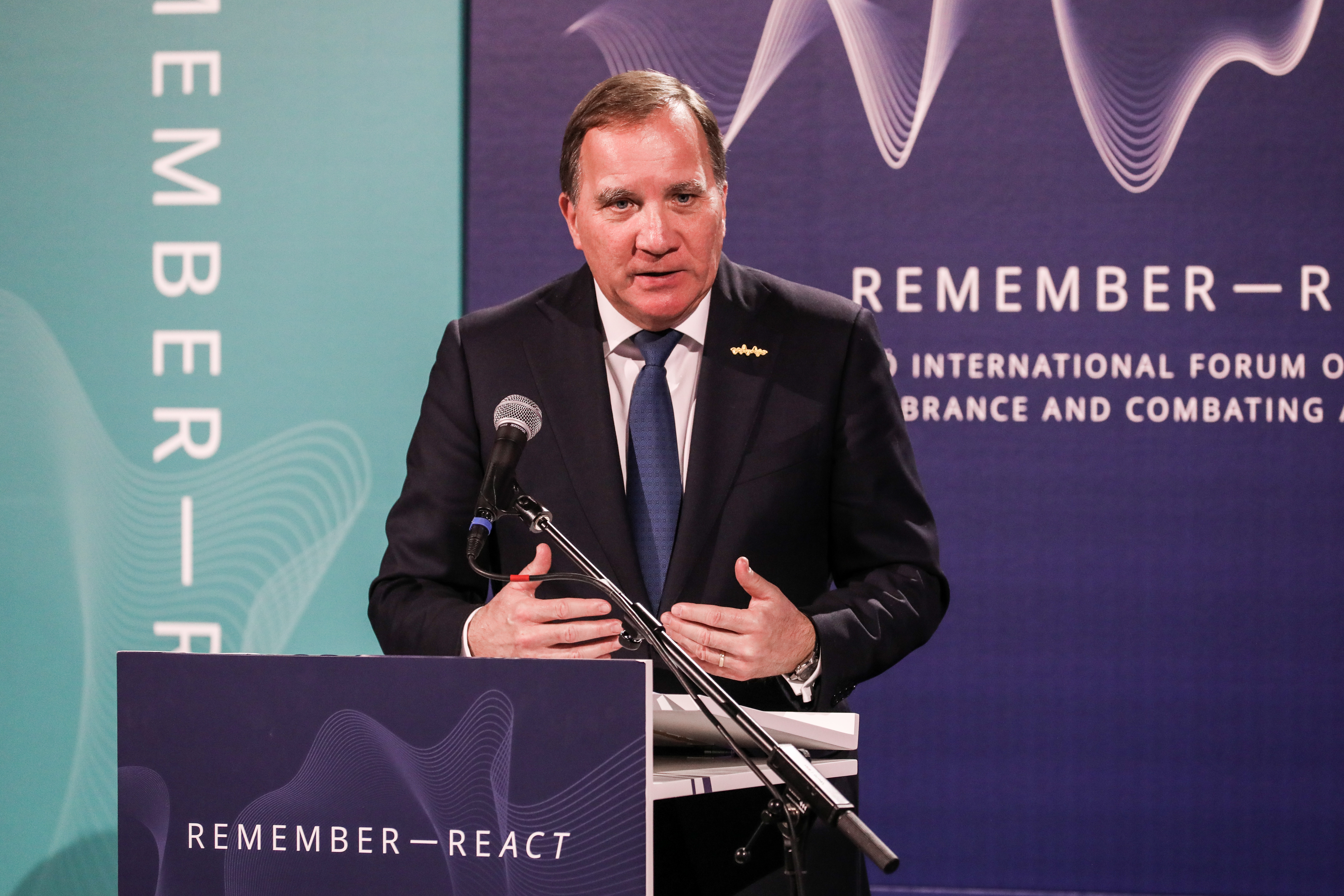
Prime Minister Stefan Löfven at the Malmö International Forum on Holocaust Remembrance and Combating Antisemitism, in Malmö on October 13, 2021. Photo: Ninni Andersson/Government offices of Sweden
Even though Sweden itself has witnessed numerous antisemitic incidents in recent years, the Swedish government has been recognized as a world leader in efforts to tackle the scourge globally. “Threats and hatred against Jews remain widespread in many societies and have unfortunately increased, not least through social media,” Swedish Education Minister Anna Ekström said in an interview with Haaretz. “We can and we must do more to combat antisemitism, counter Holocaust denial and distortion, and promote democratic values and respect for human rights,” she added.
Originally planned to coincide with the 20-year anniversary of the Stockholm International Forum, the coronavirus pandemic put the conference on hold for a year. The original forum in 2000 was initiated by then-Prime Minister Göran Persson, as part of his efforts to deal with young people’s lack of knowledge about the Holocaust and a rise in antisemitism. Internationally, Persson’s campaign led to the foundation of what is now known as the International Holocaust Remembrance Alliance (IHRA), which is best known for its working definition of what antisemitism is.
Persson himself wasn’t present at last week’s conference, but the honorary chairman and senior academic adviser at the original forum, Israeli Prof. Yehuda Bauer, was. In a powerful speech, Bauer, now 95, told delegates: “We remember because this is an extreme case of a general human disease. This is not a Jewish illness, though the Jews are the obvious first victims. Antisemitism is a cancer in the body politic of the world’s societies.” The forum’s program was defined as “action-orientated,” as world leaders and representatives of private and civil society organizations were asked to present pledges and concrete programs to promote Holocaust remembrance and combat antisemitism.
Professor Yehuda Bauer at the Malmö Forum. Photo: Mikael Sjöberg/Government offices of Sweden
Sweden’s incumbent premier, Löfven, told the conference: “We’re not looking for another declaration, we’re looking for a way to translate the principles of these [Stockholm Forum and IHRA] documents into reality. It’s our duty to continue to tell the stories of Holocaust survivors when they are no longer among us; it’s our duty to do whatever necessary to counter the forces that threaten human dignity. It’s our duty to remember and react,” he said.
“I’ll never forget that when I was there, I learned from Prof. Bauer – one of the most forceful minds I’ve ever met – that the easiest thing to do when you’re a teacher dealing with an expression of antisemitism in the classroom is to pretend you didn’t hear it,” she relayed. “The next easiest thing is to simply tell the student to leave. None of this works. The strongest tool against antisemitism is for the teacher to have the time, the resources, the courage and the support of school leadership to interact with the young person. This takes time, it’s difficult and challenging.”
‘The guts to fight’
Several leading Jewish organizations were present at the conference, including the American Jewish Committee, the Anti-Defamation League and B’nai B’rith. However, it was the World Jewish Congress, represented by President Ronald Lauder, which was particularly active. The night before the conference, it hosted an event in Malmö’s synagogue attended by Lauder, Löfven, Israeli minister Shai, and the leadership of Sweden’s and local Jewish communities. During the event Lauder said: “There is still so much to be done. I’m not naïve; I realize the hatred of Jews has been with us for 2,000 years and will never completely go away. But we can do everything in our power to keep this virus from spreading.”
Speaking to Haaretz, Lauder praised the Swedish initiative. “Prime Minister Löfven is superb,” he said. “This man is committed to fighting antisemitism. He knows how important it is for his country.” When asked if he believes there is a future for Jews in countries like Sweden and, specifically, cities like Malmö that have become breeding grounds for antisemitism, Lauder said: “There’s a great future [for Jews] in Sweden. It may take time in Malmö, but Stockholm is growing and I believe that we as Jews don’t give up, we fight back. We in the World Jewish Congress have the guts to fight. Other international Jewish organizations don’t have the same guts we do, but we’re out there fighting.”
Perhaps the best perspective to understand the Malmö forum was offered by Bauer. “For the Nazis, the Jews were the paramount enemy,” he told delegates in his speech. “This makes the Holocaust an unprecedented event. A genocide for ideological, anti-pragmatic reasons such as the Holocaust can be repeated, not only with Jews as victims but with anyone by anyone. The Holocaust becomes a universal issue precisely because it is specific. Because it happened to a specific people, for a specific reason, it could happen to others – and so it becomes a universal threat.”
One after another they took the witness stand, and in soft voices described what they endured in the camps China has built to incarcerate its Muslim citizens. A report from the tribunal that convened in London to decide one question: Is genocide being perpetrated against the Uyghur people?
David Stavrou, LONDON – “It was one of the darkest, most tragic days of my life,” the witness stated, referring to her arrest in March 2018. “There were already four big buses at the gate when I arrived. Some people had children, and police officers took the children away by force and took them to another bus to be sent somewhere else. As soon as you enter, there are two armed guards standing on the left and right. They have a machine that scans people. In another room, there were two police officers who searched everyone, and they ripped off all their clothes. An old woman was standing in front of me, about 70 years old. They tore off her skirt, leaving only her underwear. She tried to cover her breasts, the policeman did not allow her to do that… Her hijab was also viciously ripped off. I can’t forget that scene to this day. I didn’t have time to take my earrings off, they pulled them off so viciously that my ears started bleeding.”
The speaker was Tursunay Ziyawudun, 43. She gave her testimony last June before a people’s tribunal in London that was established to investigate the policy that the Chinese regime has been carrying out for years against citizens of the Uyghur minority in the region of Xinjiang. Ziyawudun’s account of her imprisonment makes for unbearable reading. She talked about female prisoners disappearing at night, some of whom did not return; about injections and pills that she and the other inmates were given regularly, which caused the disruption of the menstrual cycle, hallucinations and general confusion. There were also cases of brutal violence and rape by police. “I have no words to describe the inhuman cruelty of the violence,” she testified, adding, “I was raped by three of them together. I remember it very clearly. I can’t cry and I can’t die, I must see them pay for this. I am already a walking corpse, my soul and heart are dead.”
The descriptions of these atrocities, recounted time and again by the hundreds of witnesses who shared their stories, either in writing or in appearances before the tribunal are consistent with the allegations that have been voiced against China for some years. Human rights organizations and Western parliaments maintain that the Chinese regime is committing serious crimes against Uyghurs and members of other Muslim minorities in Xinjiang, in the country’s northwest. According to the allegations, the Chinese have coercively incarcerated more than a million persons under harsh conditions in “reeducation” camps, where they have subjected them to medical experiments, brainwashing, torture and rape. In addition, the Chinese leadership is accused of subjecting the population in the region to forced labor, of attempting to destroy the Uyghur culture and language, and of effectively turning the area as a whole into a vast prison, which it monitors with the aid of advanced technologies. And beyond even these outrages, human rights activists allege that the regime is also carrying out coerced abortions, separating children from their parents and murdering prisoners in order to harvest their organs.
Nonetheless, China is not paying a price of any sort. No international court is conducting proceedings against Beijing, the United Nations Security Council has not condemned its government, most countries continue to maintain normal diplomatic relations with China, and corporations worldwide haven’t stopped doing business with the regime. The Chinese, for their part, lash out against anyone who raises the subject, claiming that it is China that is being subjected to a campaign of vilification and fabricated propaganda, the aim of which is to harm the country.
The reasonable individual in the West, then, confronts a dilemma: Is this a case of a political campaign being waged against China through a cynical use of the suspicions often harbored about Beijing? Or are we witnessing a crime of historic dimensions to which the international community is responding with incomprehensible indifference? The organizers of the Uyghur Tribunal, an extraordinary civilian procedure, are out to discover the truth once and for all. The tribunal is intended to address the following questions: Is China perpetrating a crime against humanity, and have the Uyghur people become the victim of genocide?
These serious accusations against China are being addressed not in the International Criminal Court in The Hague or at the United Nations in New York, but in a medium-size auditorium in London. The tribunal held two four-day hearings this year, in June and in September, and plans to present its conclusions in December. The witnesses who testified before it are individuals who succeeded in escaping from China – and in overcoming their fear that it will avenge their testimony by harming their relatives. The only wish many of them have, it was clear in the London hall, was for their voice to be heard. They gave their testimony only after deciding that silence was no longer an option. Many stated that they had decided to speak, or cry out, for the sake of their spouses, their siblings or their parents, and the sake of their people in general. They spoke quietly and with restraint, but effectively were shouting for help: Save my sister, my father, my mother – save my people.
An additional tragic element hovered over the scene. In contrast to the witnesses’ expectations, the whole world was not watching. Even the hall itself was not full. Most of the September sessions were attended by about 50 people, most of them activists, experts or family members. There were few journalists or television cameras. Although the tribunal received a modicum of British and international media coverage, it vanished quickly in the shadow of the events in Afghanistan, and the ongoing pandemic and climate crises. There are simply not enough foreign news slots available.
Still, the witnesses seemed to have realistic expectations from the tribunal. “China is not a member of the ICC in The Hague, so it’s impossible to obtain justice for the Uyghurs,” Nyrole Elimä, 36, from Xinjiang, who now lives in Sweden, told Haaretz. “We are not like Israel, which was able to bring Eichmann to trial by itself. We will never have that [possibility], our genocide has no court, so when the most respected jurist in Britain and the professors and PhDs of the panel arrived, I wanted to tell them our story.”
Elimä was referring to Sir Geoffrey Nice, a barrister and former professor of law who led the prosecution of Slobodan Milošević, former president of Serbia, at the UN’s International Criminal Tribunal for the former Yugoslavia, in the years 1998-2006, and decided to take on this mission as well. The other eight members of the tribunal are British public figures from a range of fields (and not necessarily China experts) – law, medicine, business, human rights, education and culture – who have committed to maintain an impartial procedure. Also involved are researchers, interpreters and advisers who have been collecting testimony and other materials for more than a year. The tribunal has amassed hundreds of thousands of pages on the subject, including the stories of some 500 witnesses and explanations by about 100 experts from various fields. As such, it has become the repository of the most significant body of knowledge in the world on this subject.
Nevertheless, the tribunal, which was established as a private initiative and is funded entirely by donations, has no standing in international law and no powers of enforcement. It cannot arrest suspects, impose sanctions or punish anyone. All that its members can do is to strive to uncover the truth, in the hope that the international community will be ready to listen and to act accordingly. And there is another crucial difference between this tribunal and others like it. In contrast to the international proceedings conducted in the wake of World War II, and following the Yugoslavia conflicts and the genocide in Rwanda – the Uyghur Tribunal is being held in real time. The alleged crimes it is supposed to examine continue to be committed, even as the tribunal meets. This fact lends its work a sense of urgency and deep responsibility, even if not legal force.
,The Uyghur Tribunal, The September Hearings, Church House, London
‘Separatism, terrorism, extremism’
More than 25 million people live in the Xinjiang Uyghur Autonomous Region, as it is officially called. Of them about 40 percent are Han Chinese, the country’s largest, and dominant, ethnic group. The others are members of ethnic minorities, of which the Uyghur is the largest. In recent decades, the region, which today remains autonomous only in name, has undergone an industrialization process in the wake of massive investments by the regime, which also moved large numbers of Han Chinese into the region. These changes generated tension between the local population and the central government and led to separatist activity by groups of Uyghurs, including a number of terrorist attacks. In 2014, the regime declared a war against “separatism, terrorism and extremism” in the region. The conflict grew more acute in 2017, when the government’s representative in the region was replaced. The new Communist Party Committee Secretary of Xinjiang, Chen Quanguo, who for years had been in charge of suppressing the protest movement in Tibet, intensified the policing, monitoring and supervision of the local population.
Some of the witnesses who spoke to the tribunal described the radicalization of the regime’s actions vis-a-vis the population: the systematic destruction of mosques across the region, the demolition of Uyghur neighborhoods and villages under the guise of a war on poverty, and the forced transfer of the population to new neighborhoods in the cities, where they live under strict governmental surveillance, and are forced to work in factories. In the course of just a few years, the entire region became a police state. “I couldn’t recognize my native village,” said a Kazakhstan citizen who was born in Xinjiang and visited his relatives in 2017. “My family was afraid to talk to me.”
As the oppression in Xinjiang has become more acute, it has become dramatically more difficult to obtain firsthand information about developments on the ground. Reliable journalistic reporting from the region has been effectively nonexistent for some years. Any member of the press entering the region gets to see only what the authorities want to show them, so information flows from very limited sources: witnesses who manage to escape from the country, analyses of satellite images, information that appears (sometimes by mistake or inadvertently) in the local media, and leaked official documents that reach the Western media. Thus the broad mosaic of testimonies voiced in the tribunal is highly exceptional. The grimmest of them come from the men and women who were incarcerated in “reeducation” camps.
Many of the women who were imprisoned testified about being raped, about being forced to take medications and about medical examinations whose purpose was unstated. One of them is Gulbahar Jelilova, 57, who was imprisoned for 15 months on a charge of engaging in terrorist activity. She told about interrogations in which she was tied to a chair for 24 hours, during which, whenever she fell asleep, she would be awakened with an electric shock. When she refused to sign a confession, she was raped. “There was only one bed in the room with a bedcover and a table and chair,” Jelilova related in her testimony (given in Uyghur and translated into English by the tribunal). “They asked me to sit on the chair and they chained me to it. There were three people, one on computer, one translating and one interrogating. They asked me again to sign. I refused and said I need a lawyer. They said I had to sign it to get my freedom. One of the Chinese men removed his trousers and approached me and tried to put his penis in my mouth. I said, ‘Don’t you have a sister and mother?’… The other Chinese man was beating me.”
She also told the tribunal about the fates of some of the other women she was incarcerated with: mothers who gave birth in the camp and had their newborns taken from them, women whose arms were bound to their legs for extended periods, so that they could not stand erect, others who were taken to the “dark room” – a cage of one meter by one meter, beneath which water flows and where it is impossible to stand up. So crowded were the cells, Jelilova said, that the inmates were forced to sleep in shifts, because there wasn’t enough room for all of them to lie down at the same time. They had to relieve themselves standing up and with cameras constantly trained on them. Like many other witnesses, she too noted the meager food and moldy bread, and the effort at brainwashing by having to sing songs of praise to the party for hours on end.
“We were made to say things like ‘I love China’ or ‘I love [Chinese President] Xi Jinping,’” stated Gulzire Awulqanqizi, 42, from the city of Ghulja in Xinjiang, who spent time in four different camps in 2017 and 2018. “We had to write down everything, our feelings and our gratitude toward Xi Jinping. Once every week they would mark our writings, and they would tell us that if we failed to pass, we would be kept inside the camp our whole life.” She too was forced to take pills and endure inoculations that affected her cognitive abilities and disrupted her menstrual cycle. She was interrogated 19 times, beaten and forced to eat pork, which is forbidden to her as a Muslim. In some cases, she related, inmates were made to burn copies of the Koran.
In one of the camps, she was forced to carry out a particularly onerous task. “My duty was to sit next to the curtain, then when [a member of the] staff comes in with a woman, she writes her name in Chinese and I take her fingerprints, I help her take her clothes off, but not the clothing below the waist. I also had to restrain her hands with chains. I was not allowed to talk to her. Then a man enters the room, and I go sit silently next to the door, outside the room. When the man leaves the room, I take the woman for a shower. There was nothing I could do, I was forced… I would go on to do this task for six months.”
Abdusalem Muhammad, 44, related that when he and other men arrived in their camp, they were stripped naked and thrust into a small, freezing-cold cell. Sixteen men, handcuffed together in pairs, were thrust into a space of 2.5 square meters (27 sq. ft.), in which there wasn’t enough room to sleep. “There was no cover for the bucket which we used as a toilet. We had to smell from the bucket day and night, so we had runny noses or nasal infections,” he testified. He stated that the inmates were required to memorize Chinese poetry that ran on over many pages, and that those whose who failed to commit them to memory were punished. The punishments included savage beatings, sleep and food deprivation, and interrogations that lasted more than 48 hours. In one camp, to which Muhammad was sent in 2015, the prisoners were taken for cruel runs. “They called it a kind of exercise but it was another form of torture,” he told the tribunal. “There were 70-year-old ladies, they could not run, even walking was difficult for them, and sometimes they fell or tripped. At that moment, the police officers started to beat or kick [them], so they stood up and ran again.”
One witness said he saw a prisoner beaten to death; another related that in the middle of winter he was thrown handcuffed into a narrow, deep pit where he had water poured on him until he lost consciousness; and another spoke about unexplained blood tests he was forced to undergo. A key witness during the June sessions was a Chinese man who had served as a policeman in Xinjiang before leaving China in 2020. The police officer, Wang Leizhan, now lives in Germany. His testimony, in which he talked about the orders he was compelled to carry out, completes sections of the puzzle. He stated that he was one of 150,000 police officers who were recruited to work in the region and who received training in the political reeducation (he called it “brainwashing”) of the Uyghur population. Police barriers were placed every 500 meters in city streets, and in rural areas even every 200 meters. “All Uyghurs residents in Xinjiang had to provide the Chinese government with DNA samples, to enable continual monitoring of Uyghurs,” he related. “We arrested around 300,000 Uyghurs [because] they might have had a knife at home or because they were exposing their cultural identity, or they were somehow considered to have a different ideology. In some villages in Xinjiang, the whole population of a village was taken to the concentration camps.”
Leizhan testified that he saw prisoners being tortured. Before his eyes, prisoners were made to go down on their knees and were beaten, heads covered with a plastic bag and arms and legs bound, while a pipe funneled water into their mouth. He also witnessed torture by means of electric shocks administered to the genitals, saw hammers being used to break legs and also men being stripped and placed in freezing water, and he recounted how inmates were starved.
Another bit of information provided by the former police officer is especially important: “The children of many adults in the concentration camps have been taken into state orphanages, where they have been assimilated into Han Chinese culture.” Indeed, it emerges from testimony that the Chinese regime is pursuing a particularly brutal policy with regard to Uyghur children. This involves not only the separation of children from their parents but also coerced abortions. “My wife was pregnant for six months and the fetus was ripped out of her body,” Baqitali Nur said in a choking voice.
Rahima Mohammed Nuri, a nurse who worked in a maternity ward where she focused on abortion procedures, provided context for Nur’s account. In her testimony, which she delivered from Turkey, she confirmed that the regime does in fact carry out forced abortions on women, even if they are in advanced stages of pregnancy. A panel member asked whether there were cases in which pregnancy was terminated in the sixth or seventh month and viable living fetuses were delivered. Nuri replied in the affirmative, but added that the mothers received an injection before the infant emerged, so these infants died within 72 hours of birth.
What happens in the hall in London during the moments when testimony is given about the death of an infant or about gang rape? Not much, in fact. There is no sense of dramatic climax: the statements are translated, the social-media people post tweets, some people gape at the witness, others close their eyes. The floor is turned over to the next witness.
Long arm of the regime
It’s difficult to overstate the degree of courage shown by those who came here to tell their story. “I had a panic attack before I took the floor to speak,” says Nyrole Elimä; she was testifying in the name of her cousin, Mayila Yakufu, who was arrested when she tried to transfer money to her parents, who live in Australia. Yakufu was sent to a reeducation camp, where she was later hospitalized, and is currently incarcerated on a charge of financing terrorist activity. “While testifying,” Elimä recalled later, “ I didn’t turn my head, because I was afraid. I know that the Chinese government is checking all the time, I knew they were watching me and I felt as though they were standing next to me. But they left me no choice.”
The fear of the long arm of the Chinese regime is well founded, and even those who managed to flee to the West have cause for apprehension. Omer Rozi, who escaped from Xinjiang after being arrested and tortured, has lived in Norway for some years. “In January 2017,” by which time he was in Norway, “I got a call without a number displayed,” he testified. “I was told on the phone that I would meet my brother and sister. Then they hung up right away. Right after the phone hung up, I got a video call on WeChat. When I opened the WeChat video call my brother and sister were hanging. The police on the video call gave me four conditions [for their release].” The conditions included not approaching anyone else in the Uyghur diaspora and not donating to Uyghur organizations in Turkey. “The last thing I heard was my brother and sister screaming before they hung up. I have not heard anything since then.”
Similarly, Mehray Mezensof, 27, who testified via video link from Australia, related how fearful she was for the fate of her husband, from whom she hadn’t heard for more than a year. “He lives in constant fear,” she says, “always looking over his shoulder.” Relatives understood that he was sentenced to 25 years in prison.
“The witnesses who are speaking here are very strong,” I am told by Rahima Mahmut, a Uyghur activist who is assisting the tribunal as an interpreter. “But not everyone can be like that. Not everyone is able to speak, not even in front of the family. That is very common. Like many of the survivors of World War II, who didn’t tell anything.” Some witnesses who appeared before the tribunal received threatening calls from Chinese persons, and relatives begged them not to testify. She says she understands those who opted to be silent. Mahmut too has family in Xinjiang, including nine siblings. The last time she spoke with any of them was in 2017. They stopped answering and she stopped calling. She was afraid that getting calls from abroad might land them in danger. But she admits that she too was afraid to discover the truth. In one of the last conversations, she relates, one of her brothers told her, “Leave us in God’s hands.”
The Chinese are undertaking “far-reaching and relentless campaigns to silence, intimidate, harass and slander witness testimonies,” testified Laura Harth, from the human rights organization Safeguard Defenders. The Chinese authorities work on two planes, she says: by issuing international arrest warrants and launching judicial proceedings against Uyghurs in exile who could potential speak out about their experiences, and by threatening their families and other loved ones in China. Harth provided the tribunal with examples of cases in which people who told their stories in the West were accused of embezzlement, cheating on their partners, rape, drug abuse and abandoning their families.
China, which initially denied the existence of the camps, effectively replaced its policy of sweeping denial with a campaign to reshape the discourse. According to Beijing, the camps are used to combat religious extremism and also for professional training, and their residents have chosen to be there of their own free will. At some point the authorities claimed that the camps have served their purpose and the prisoners were released. A series of videos disseminated in China show survivors of camps heaping praise on the process they underwent. In other clips, relatives of witnesses condemn and deny the remarks of their family members. The same phrases are heard over and over in the videos by different families in different places, as if they were speaking from a script.
It turns out that even the expert witnesses, whether Chinese or not, who testified before the tribunal are taking a risk and that many of them suffer ongoing harassment. Muetter Iliqud, an Uyghur researcher in a project that documents the disappearance of Uyghurs, relates that in the days ahead of her presentation to the tribunal, many attempts were made to hack her Instagram, Facebook and WhatsApp accounts, and that she and her mother received phone calls from unidentified numbers. Recently her computer stopped working.
Julie Millsap, an American activist who testified about what is being done to Uyghur children, also showed me screenshots of anonymous Instagram, Twitter and Facebook accounts that harassed her. The accounts shared faked photographs of her supposedly cheating on her partner, with the caption, “We’ll show this to your husband.” The images, which were in fact sent to her husband, were also spammed on the Uyghur Congress livestream chat during her testimony to the tribunal.
‘Stepping into the future’
The dozens of professional experts who testified at the hearings – scholars, civil society activists, jurists and investigative reporters – rounded off the picture drawn by camp survivors and revealed snippets of information about what’s going on in one of the world’s most secretive regions. The American journalist Geoffrey Cain, who visited Xinjiang and conducted many interviews in the reporting for his recently published book “The Perfect Police State: An Undercover Odyssey into China’s Terrifying Surveillance Dystopia of the Future,” described an environment that might have been drawn from a work of science fiction. “When I visited North Korea, I felt like I was stepping into the past,” he said, “but when I got to Xinjiang I felt I was stepping into the future.”
Cain related that beyond the familiar means for gathering information about residents – such as the use of spies, interrogations and psychological pressure – the Chinese regime also employs an advanced technological system that collects vast amounts of information about each of the region’s inhabitants. This includes shopping and consumption habits, web surfing, downloaded apps, police and court reports, employment data, physical features, images from street cameras, information from gas stations, roadblocks and schools, and checks of digital calendars and of people’s whereabouts. This immense quantity of data, which is accumulated in part with the help of new systems of face and voice recognition, is forwarded directly to local authorities, who use it in order to decide, among other questions, whom to send to the camps.
The face-recognition technology is used in the service of the regime, but is developed by the Chinese high-tech industry. Another American researcher, Conor Healy, testified that the Chinese tech company Huawei took part in developing the “Uyghur alarm,” a monitoring system that identifies and classifies faces of passersby as Han or Uyghur. Three years ago, the company sought to patent the technology. According to this testimony, other merchandising firms, such as the cloud service of Alibaba and the surveillance giant Tiandy Technologies, are also engaged in ethnic recognition. Another Tiandy product is a “smart interrogation table,” which includes a touch screen, an electronic display of evidence and a system for recording interrogations – everything that’s needed to streamline the questioning of masses of detainees.
Tiandy Technologies’ “smart interrogation table,” offering everything needed to streamline the questioning of masses of detainees.Credit: IPVM
Illiqud, who works for the Uyghur Transitional Justice Database, who was not deterred from testifying despite the harassment of the Chinese regime, presented a comprehensive report about the incarceration situation in the country. Based on interviews, leaked policy documents, photographs and satellite images, the report details the types of camps, their location, size and number. According to the data she collected, there are several types of camps: for reeducation, incarceration, pretrial detention and work camps, the latter of which are like forced-labor farms. The report states that at least 1,347,000 persons were imprisoned in the reeducation camps [according to data which is collected since 2018], at least 422,000 were incarcerated in prisons, 486,000 in pretrial detention centers and 76,000 in work camps.
Ebrakit Otarbay, 48, was an inmate in one such work camp. He was sent to sew in a textile factory, where, he related, the conditions were a slight improvement over those in the reeducation camp. The food was better, though to get a meal the workers had to sing propaganda songs praising the communist regime. Cameras filmed them throughout their working day. His testimony reveals something of the way in which forced laborers in these camps become a chain in the global fashion industry. A report issued last year showed how big fashion firms in the West that employ local Chinese firms, are actually enjoying the products of forced labor.
“Normally they do not show us the brand of the clothes,” Otarbay testified. “The clothing brand was stitched by their own people. Once they showed us a brand, it was a small towel used by Nanhang [a Chinese airline] in China. Later, they scolded us for putting on the wrong brand [i.e., label] and asked us to remove them. Then we had meetings for a whole day saying that these things should not be told anywhere else. There were cameras watching us while we were working. We have not seen [the names of] any brands since that incident. We sewed pants in addition to making pants belts. Each of us used to sew different parts. One person sews pockets, another person sews the back and another one sews other parts.” Asked by a member of the tribunal whether he was paid for his work, Otarbay laughed.
‘Interested parties’
The tribunal’s work generally proceeded tranquilly, apart from isolated interference from the Chinese. During the September hearings, for example, the Chinese ambassador to Britain held a press conference in which he accused the tribunal of lying and claimed it was conducting a “pseudo-trial” and a “political manipulation aimed at discrediting China.” The ambassador also asked the British government to prevent the continuation of this “malicious behavior.” London did nothing, and as often happens, the Chinese outburst got the tribunal a few more headlines.
But what if there’s some truth to the Chinese claims? After all, if there is no official Chinese representative here, what makes the tribunal a proper judicial process? If there is no one to reply to the accusations, and if the tribunal lacks concrete authority, what meaning does it have? The most suitable person to respond to these questions, which challenge the very existence of the procedure, is the person who heads it: Sir Geoffrey Nice. In the middle of the third day of the proceedings I spoke to him in a side room off the main hall.
“The people who gathered here have no interest in the result, no special interest in the Uyghur people and no intention of making recommendations,” Sir Geoffrey said about the tribunal he established. “Our only wish is to answer a question that is not being asked by national or international bodies. We are ordinary non-specialist representatives of the general public who are investigating a subject that is not being discussed anywhere else, with the best means at the public’s disposal.”
He added, “For your readers, I am certain it will be easy to understand, without making excessive use of the example of Nazi Germany, that there were times at the end of the 1930s when information that could have been open to the public was concealed from the public by governments, by the media and even by the public’s disinclination to know. Proceedings of this sort, had they been carried out then, could perhaps have served a very good cause.”
For the sake of the historical perspective, is what you are hearing here similar to the information which might have been used to prevent the Holocaust of European Jewry?
“In a certain sense, yes. There’s no point in suggesting that comparisons close to the Holocaust can be made when, in truth, they can’t. For example, evidence about the suffering of the Uyghurs does not at present include evidence of mass killings. But when there is a failure to reveal something in time, or a lack of determination to know, or an attempt to conceal things from citizens, a procedure like a public tribunal has great value. What has changed since World War II, and even then only slowly, is that the world’s citizens are less willing to agree to silence for political reasons and are ready, perhaps, to take more part in procedures such as these and also to respect their results. The first procedure of this kind – the public tribunal on Vietnam of Lord Russell and Sartre [the British philosopher Bertrand Russell and the French philosopher Jean-Paul Sartre, in 1967] – attracted very little attention and did not have significant results. Things have progressed since then, not least because the United Nations created international criminal tribunals in the 1990s – for Rwanda and the former Yugoslavia – and the term ‘genocide’ entered into general use after not having been in use for a long time.”
Nice, who has taken part in three previous public tribunals, also addresses the question of the objectivity of the whole procedure and of the witnesses in particular. “I am not worried,” he says, “for the same reason that I was not worried that the Nazi hunters were almost always Jews. Would it be preferable, from the viewpoint of visibility, for the experts not to be affiliated with organizations of one kind or another? Possibly. Will we ever have experts of that kind? Probably not. It’s likely that a person who researches the suffering of a group will belong to that group or possess a strong interest in that group. I am quite sure that you will find that those who led the formal proceedings after the Nuremberg trials, as with the Eichmann trial, were all interested parties – and why not, actually?”
Do you think that a formal legal proceeding will ever be launched against China in regard to the Uyghurs?
“No one expected that the leaders of states would come to international judicial proceedings. No one expected that Burma would be taken to an international court, but then The Gambia arrived on the scene and changed that with creative legal thinking. [In 2019, the African country of The Gambia filed a case against Myanmar in the International Court of Justice over the latter’s treatment of its Rohingya population.] Of course, China is a country of vast power which wields influence over its neighbors, over other countries and over bodies such as the [UN’s] Human Rights Council, so that quite a bit of optimism is needed [to believe we will] see an international judicial proceeding actually happen. But things change. Even though there is no great likelihood of something parallel to the fall of the Berlin Wall and to the seizure and execution of [Romania’s] President Ceausescu, those things do happen. And the best way to make them happen is to do everything possible to bring the truth to light.”
The uncovering of the truth is also the ideal that is driving Aldo Zammit Borda, who heads the tribunal’s research and investigation unit. “People ask what is the point of people’s tribunals that possess no formal power or authority to punish,” says Dr. Zammit Borda, an associate professor in international law at City, University of London. “Speaking generally, as we have seen throughout history, there are countries that have great power, and their power can potentially be used not only to commit crimes within their area of jurisdiction, but also to shape the narrative about those crimes. They can forbid discussions in international bodies, so that the victims of these crimes suffer twice – once from the crime itself and a second time from the silencing of the crime, from the denial of its existence. A people’s tribunal conducting public hearings, even if it has no formal authority, is able in large measure to change and challenge that narrative. In cases where avenues for formal justice have been blocked, in the end, the victims have to choose between a tribunal like this, with the limited justice it can provide, or silence.”
But will revelation of the truth and reshaping of the narrative satisfy the witnesses who are appearing here? I ask Abduweli Ayup, an Uyghur intellectual who went through a number of camps in Xinjiang and now lives in Norway, how he felt when he stood before the members of the tribunal and told his story. “I felt that I was carrying tremendous responsibility,” he replies. “This is the place where it will be decided whether genocide is happening or not. This is a human issue, a world issue. I was afraid, but millions of people are in concentration camps and I am speaking on their behalf. I am not one person who is speaking, these are millions who are speaking. The question us: Who is listening? Who will take action?”
Ayup says he was disappointed when he saw that there were only about 50 people in the hall, when he appeared before the tribunal in June, but then recalled that millions more were watching and listening. He’s probably being overoptimistic. There was indeed live coverage of the hearings online, and there were people physically present who simply came in order to listen and to help, but they were few in number. One was Jonathan Gibson, a local, kippa-wearing 18-year-old who founded an interfaith organization called “Burst the Bubble UK.” He turned up at the hearings with several other youngsters who, together with him, organize campaigns against such wrongs as religious persecution and modern slavery. They came to support the Uyghurs’ struggle. I also spoke with Julia Granville, who came as part of a collective of psychotherapists who help witnesses process the brutal experiences they have undergone and support them through their testimonies. And occasionally people showed up who were simply curious, having heard about the issue on the news. But that’s it, more or less.
In December, the tribunal will reassemble at the Church House conference center in Westminster to inform the world of its judgment regarding whether crimes against humanity are being perpetrated in Xinjiang and whether the Chinese regime is implementing genocide against the Uyghurs. Provided, of course, that the world wants to know.
Outside the building, life goes on normally. At the entrance to the Underground station, a few dozen anti-vaxxers are demonstrating against the coronavirus vaccines. “Even one death is too many,” one of the signs says. Next to the statue of Churchill, a small man with a large bullhorn reminds passersby not to forget Jesus. Someone else, long-haired and unshaven, is demonstrating against the use of plastic bottles, and on the lawn between Parliament and Westminster Abbey a group of hunger strikers are protesting the Taliban takeover in Afghanistan. They’re of different backgrounds, ages, genders and nationalities, but they’re all intermingling, and they all have one thing in common: No one is turning around to check for the enemy behind their back.