The state of antisemitism in Sweden

As Sweden is marking 250 years of Jewish life, the reactions to the October 7th massacre, the war in Gaza and the tone of the rhetoric in the public debate are reasons to be concerned about Swedish antisemitism. But what is the true extent of this scourge, what is its impact on Sweden’s Jewish community, and how is it being addressed by the authorities? By placing these issues in a broader historical context, David Stavrou’s investigation, which we are publishing as part of our partnership with the DILCRAH, seeks to answer these questions.

Published in K. in English: https://k-larevue.com/en/sweden/ and in French: https://k-larevue.com/antisemitisme-suede/

In 1973 a young Moroccan army officer named Ahmed Rami arrived in Sweden asking for political asylum. He said he needed protection because he was part of an unsuccessful coup d’état in his homeland the previous summer. More than a decade later, after obtaining asylum in Sweden, Rami started broadcasting Radio Islam, a radio program which subsequently turned into a newspaper and later, a web-site. The focus of these enterprises became clear right at the beginning – it was not about Islam; it was about Jews. The radio program and the website featured some of antisemitism’s greatest hits; conspiracy theories about how Jews and Zionists control the world, Holocaust denial, Nazi propaganda, lists of influential Swedish Jews and Israel bashing. During the last three decades, Rami has been investigated, charged, convicted and fined for hate speech and hate crimes and his radio station was shut down by the authorities more than once. Still, now aged 78, Rami’s legacy lives on. He has published books, voiced support for Hezbollah and neo-Nazi groups, his website is still very much alive and the internet allows his work to continue.

Radio Islam is an important landmark in the history of Swedish antisemitism for several reasons. One of them is that the precedential trial which sent Rami to prison for six months also gave a small and relatively unknown Swedish organization called The Swedish Committee Against Antisemitism (SCAA, or SKMA in Swedish) an important role in the Swedish public arena. “SCAA is a religiously and politically unaffiliated NGO which was founded in 1983”, says Mathan Shastin Ravid, the organization’s office manager, “it was founded by a group of activists who wanted to raise awareness about antisemitism. It was a period with a clear wave of antisemitism in Sweden and other European countries during and after the Lebanon War in 1982. Antisemitism was not a new phenomenon in Sweden back then, but this was on a new scale, there were all these accusations with motives and images that targeted not only Israel, but Jews as a group. When the Radio Islam broadcasts started in the end of the eighties, it was clear to us that the radio station was a megaphone for anti-Jewish hatred and propaganda. On the basis of SCAA´s report to Sweden’s Chancellor of Justice, Rami was convicted of hate speech. But it was clear that in those days we stood pretty much alone. Not many people understood the problem, people did not want to talk about it and there were many known figures who came to Rami’s defence saying it was only criticism of Israel, not antisemitism”.

A lot has changed in Sweden since then and SCAA probably has an important part in the change. Shastin Ravid says that since the nineties, the organization has become more than just an activist watchdog. It now also focuses on education. “These days we stand on two legs”, he explains, “one of them is monitoring, information and advocacy, as we try to follow what is happening in Sweden and the world and follow the Swedish and international debate regarding antisemitism. We then react when we see antisemitism in different forms. The other leg is education. We have educational programs for different target groups such as teachers and pupils in Swedish schools, journalists and politicians. We also work with some governmental authorities like the police, which often lack a deeper knowledge of contemporary antisemitism and how it spreads. It is my understanding that there is more awareness in this area today than there was ten years ago and that positive things are happening as part of a higher level of knowledge and consciousness in general in Swedish society today when it comes to antisemitism. But there is still much work to do..”

When Shastin Ravid is asked for an up-to-date description of antisemitism in Sweden, he starts by saying that more research is needed to get a better understanding of the problem. That said, it is clear that in many ways Sweden is not different from other countries. “The development in Sweden is connected to global developments”, he says, “antisemitic conspiracy theories have been spread and legitimized by important political actors in recent years. In Europe we have for example seen it in countries like Hungary and Poland amongst right-wing nationalist parties and governments, but we have also seen it in other countries including the US where amongst others Donald Trump, Elon Musk and the MAGA movement have legitimized and spread antisemitic propaganda. This global phenomenon has affected Sweden too and has sparked hate speech and hate crimes. And then there is, of course, the strong global wave of antisemitism after Hamas’ attack in Israel on the 7th of October 2023 and the war in Gaza. It is not the first time an escalation of the Israel-Palestinian conflict triggers antisemitism in Sweden and other countries, but the level of propaganda, hate, threats and attacks against Jews has been unusually high.”

“Studies show that antisemitism in the form of negative beliefs and attitudes towards Jews exists, in varying degrees, in all Swedish society, in many different groups and milieus. Within Swedish mainstream politics, the problem has long been visible in the right-wing nationalist Sweden Democrats party. For years, the party has tried to portray itself as a party which opposes antisemitism and is pro-Israel, but antisemitism continues to be a problem in the party. We often find high- and low-level representatives of the party spreading antisemitic propaganda and we see many connections between the party and right-wing and even Nazi extremists. In addition, the Sweden-Democrats do not deal with antisemitism within their ranks unless they are exposed by the media, and even then, there are many cases of people within the party who have kept their jobs after they were exposed”. The party’s proclaimed “Zero Tolerance” policy towards racism and extremism, including antisemitism, Shastin Ravid says, is “a joke”.

“But the nationalist and populist right is just part of the problem. Antisemitism does, for example, also regularly appear within the pro-Palestine movement and parts of the Swedish left, where it is often related to Israel and the Israel-Palestinian conflict. In these circles there is sometimes a denial or an unwillingness to see the problem of antisemitism, sometimes rooted in the misperception that Jews are “white” and therefore cannot be victims of racism. In the last year, there has been a big debate in Sweden about the fact that several representatives of the Swedish Left Party have spread antisemitic propaganda, many times on social media. And when criticized, those party representatives have been backed by many others within and around the party who have denied that the propaganda is antisemitic. The SCAA and many others have strongly criticized all of this, and the fact that the party leadership many times has been slow to act and condemn the spread of such anti-Jewish racism and those party members who defend and excuse it.”

“And of course, movements linked to radical Islamism must also be taken into account”, Shastin Ravid adds. According to him, antisemitism is most virulent within those movements and Nazi and other right-wing extremist movements. “For all of them, antisemitism is an ideological foundation, a “worldview,” a way of understanding and describing events both locally and globally. Jews are constantly portrayed as conspirators and blamed for all the world’s ills”. Furthermore, Shastin Ravid adds, “antisemitism has long been a weapon of regimes in the Middle East, where it is deeply rooted, openly expressed, and legitimized. The spread of this type of propaganda via the internet by regimes such as Iran has contributed to the globalization of this hatred. Recently, it was revealed that the Iranian regime is suspected of having planned to murder Swedish Jews, among them Aron Verständig, the chair of the Official Council of Swedish Jewish Communities (Judiska Centralrådet). According to the Swedish Security Services (Säpo), Iran has also recruited Swedish criminal networks to carry out attacks against Israeli and Jewish targets. The Swedish National Centre for Terrorist Threat Assessment (NCT) has reported that the biggest terror threats in Sweden come from violent Islamists and right-wing extremists, which both have Jews and Jewish institutions as some of their primary targets”.

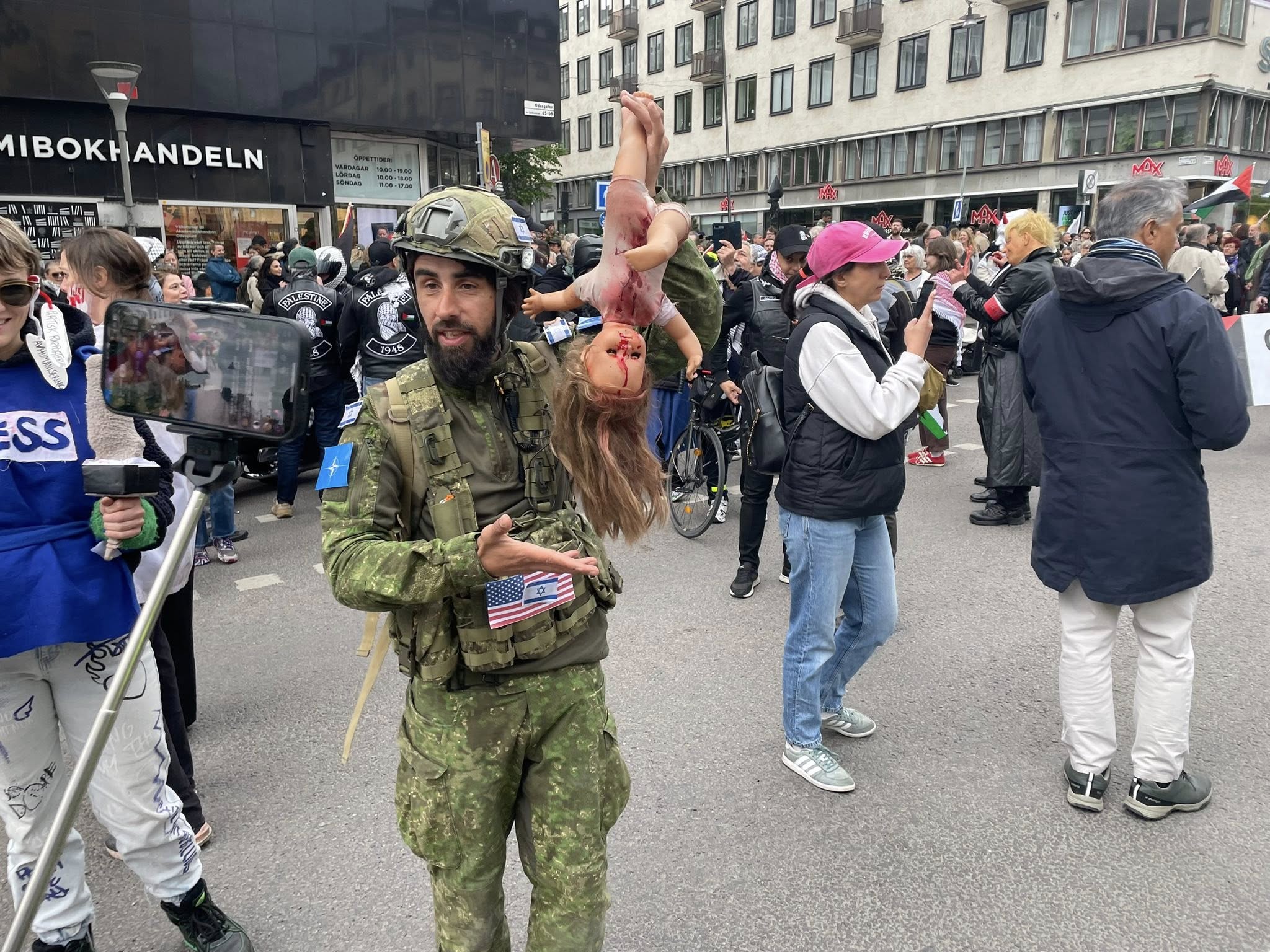
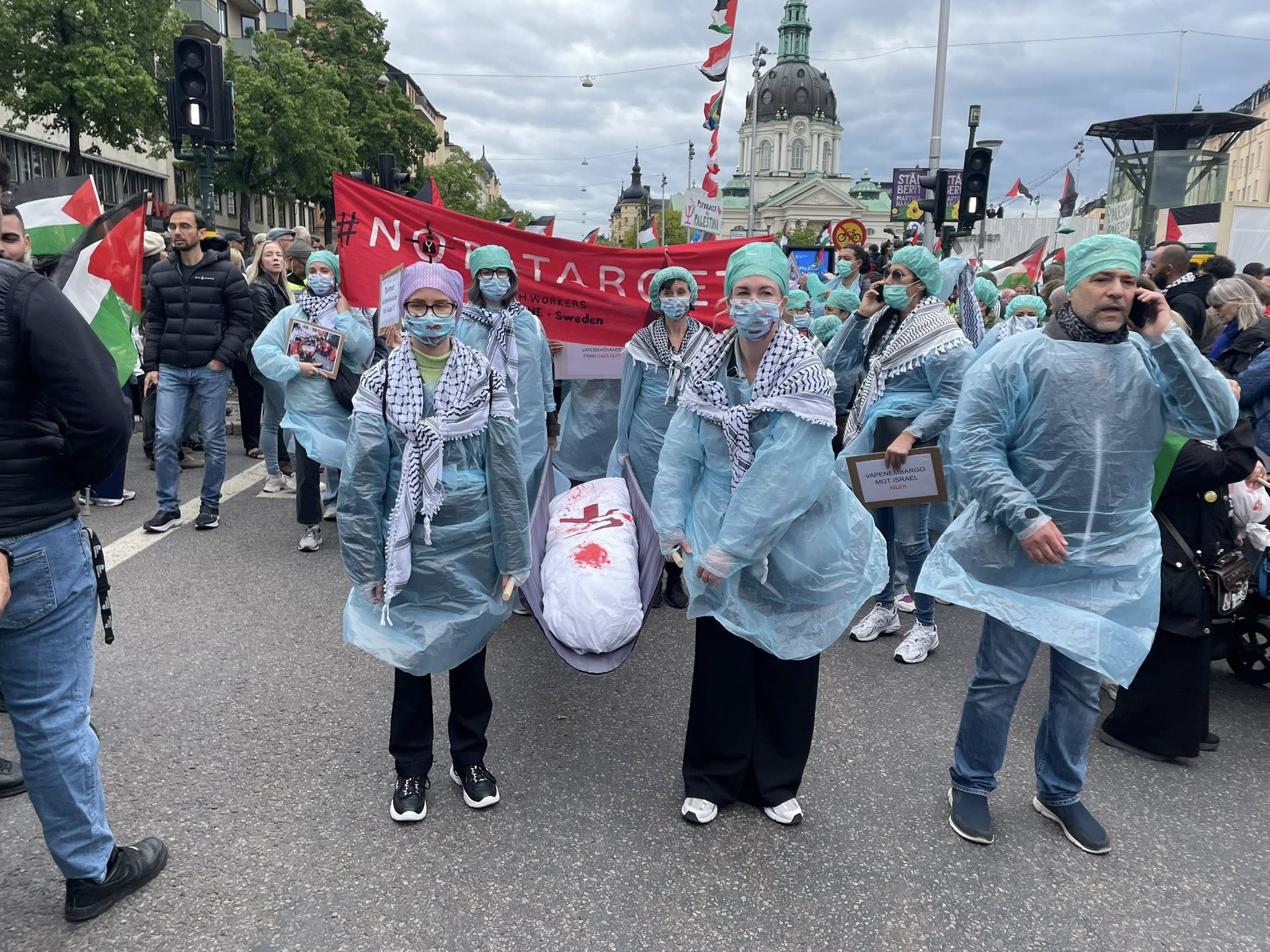
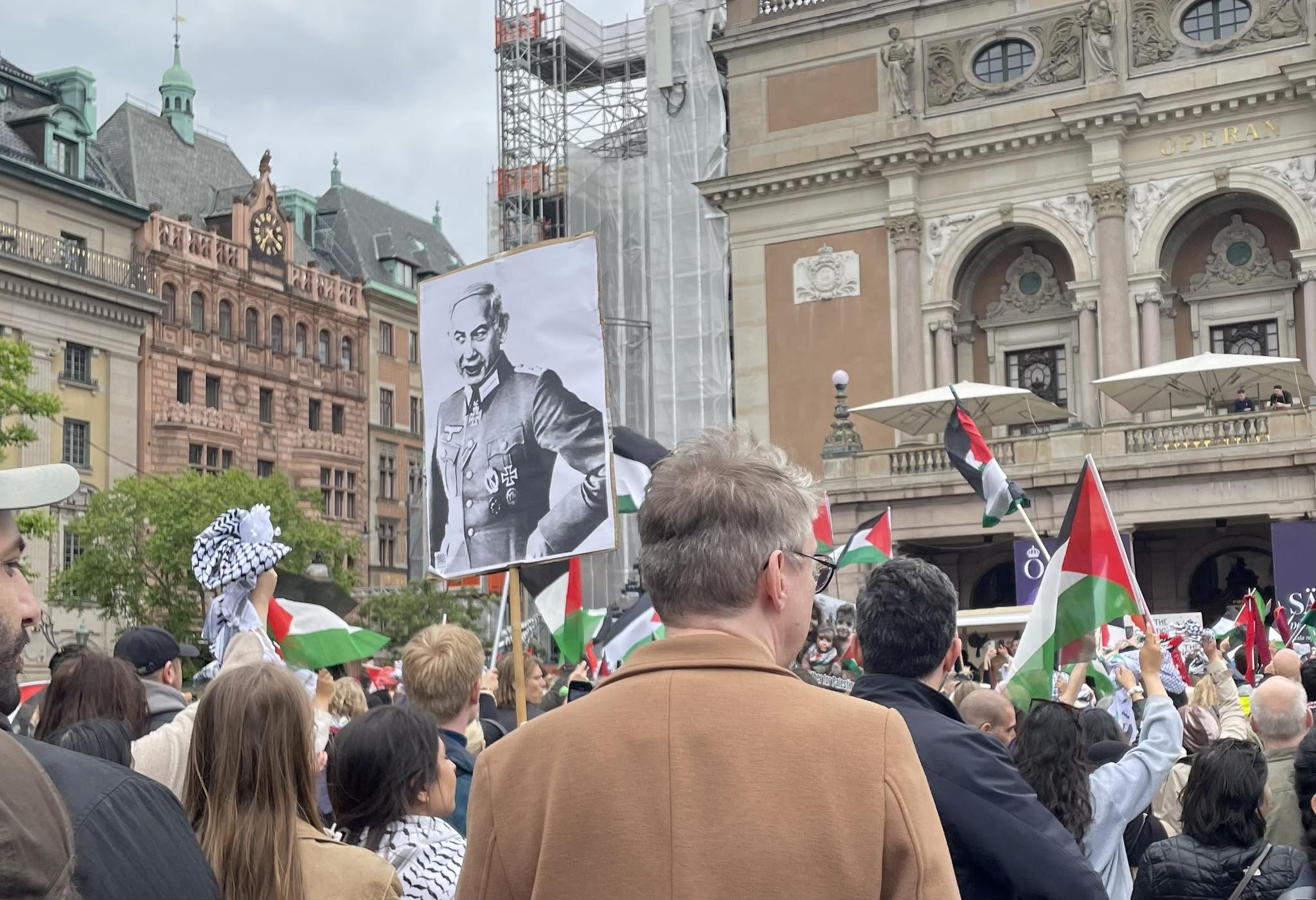
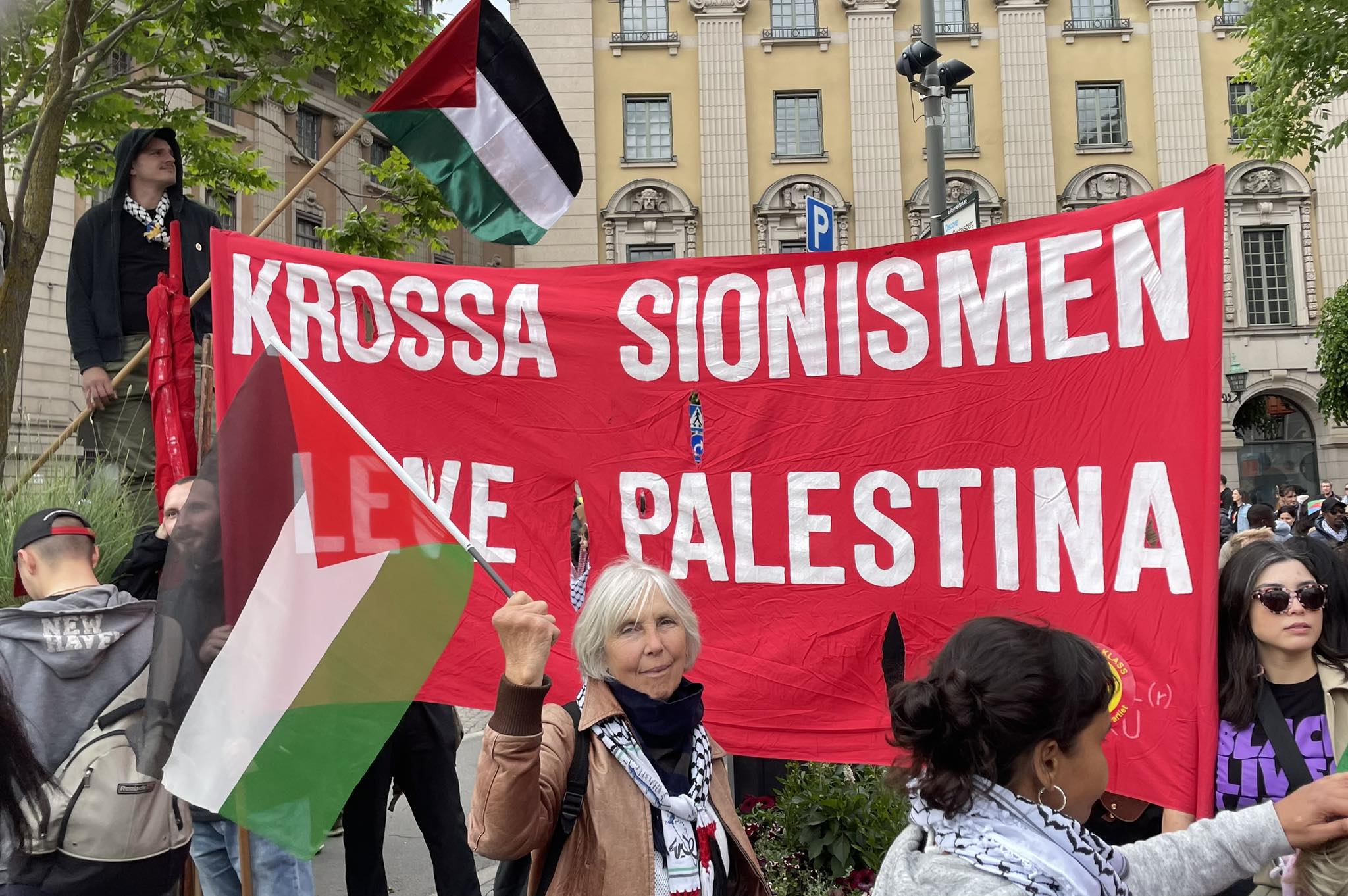
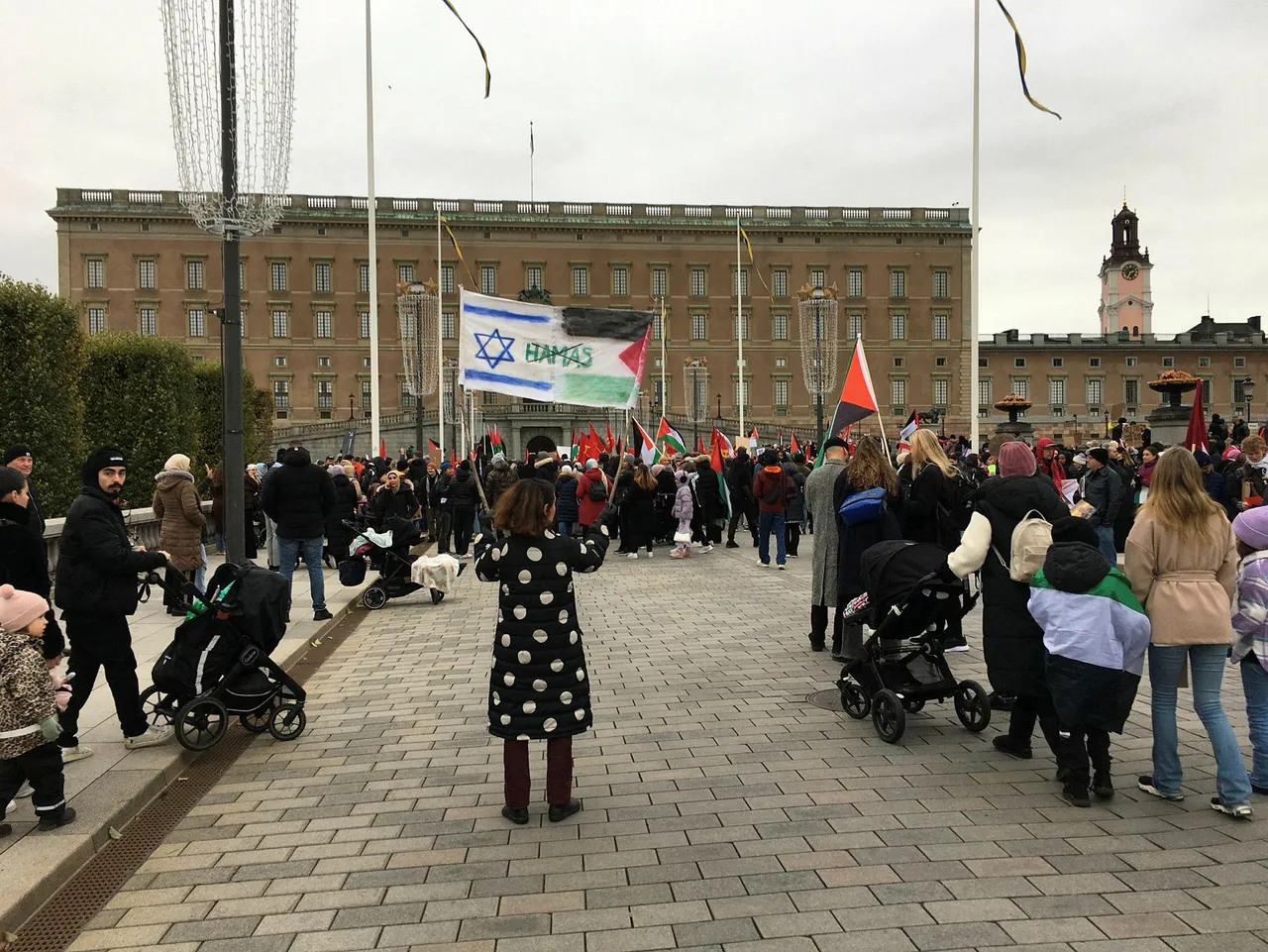
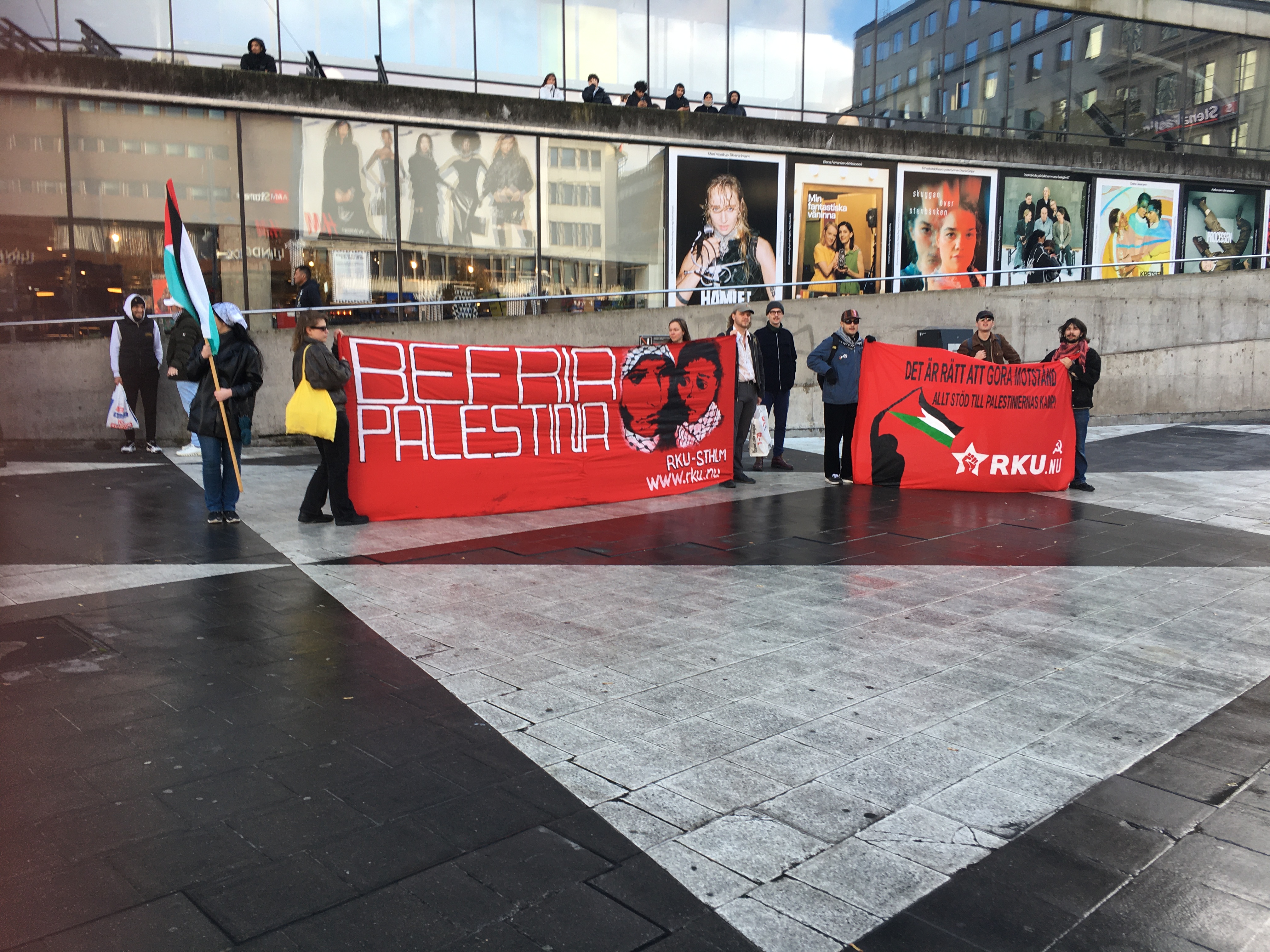
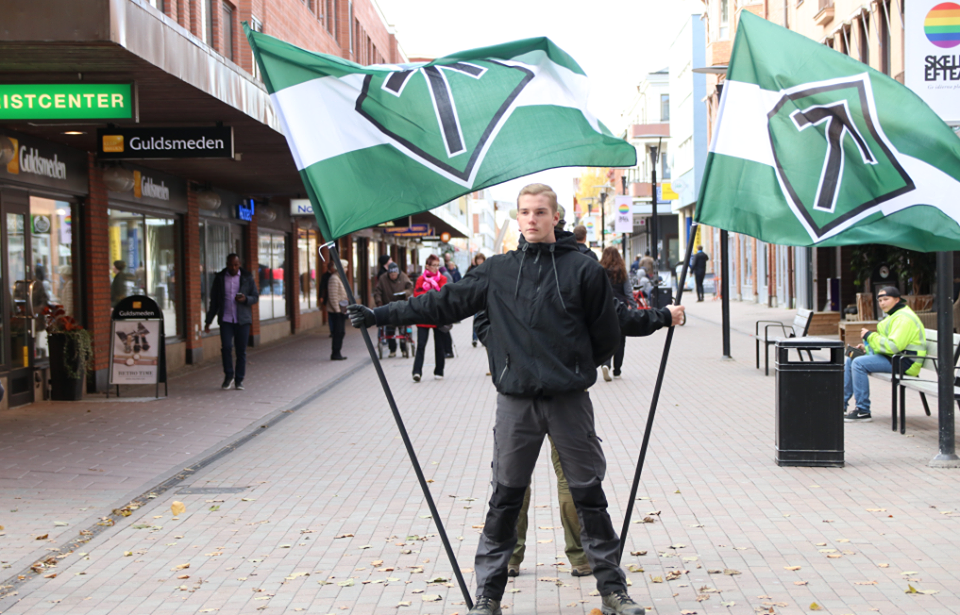
Even without physical violence, Swedish antisemitism is present in the public sphere and one of its main outlets are the numerous demonstrations in support of the Palestinians and denouncing the “genocide” in Gaza. The days right after October 7th, and before the Israeli ground attack on Gaza began, were a good example. While the massacre in southern Israel was still ongoing, there were a couple of spontaneous demonstrations in southern Sweden which included music, dancing and convoys of cars honking their horns in support of the Hamas attack. Right after that, in the course of one weekend in Stockholm, three different organizations demonstrated separately but with similar slogans. A part from the mainstream Pro-Palestinian movements, there were more radical organizations on the streets. One was Hizb ut-Tahrir, a radical Islamic group advocating the creation of a caliphate governed by Sharia law from Uzbekistan to Morocco, with a small branch in Sweden. It was granted permission to demonstrate despite being banned in several countries. Next came the Nordic Resistance Movement, a neo-Nazi group with a few hundred members who demonstrated in support of the Hamas attack. They were followed by the Revolutionary Communist Youth, which claims that Palestinians have the right to “fight by all means against the occupying power to liberate their land.” The latter described the October 7 attacks as an act of liberation that “caught the Zionists in their beds.” Both organizations, one neo-Nazi and the other Marxist-Leninist, support the Palestinian slogan calling for “crushing Zionism.”

Since then, there have been numerous demonstrations in Sweden, many of them on a weekly basis. These demonstrations are legal, the organizers deny that they feature antisemitic content and they are seen by many Swedes as legitimate opposition to Israel and solidarity with Palestinians. However, they often include slogans which are considered antisemitic by many such as supporting a “global intifada” and “crushing Zionism”, promoting antisemitic conspiracy theories and calling for a “Free Palestine from the River to the Sea”.  

Still, demonstrations are not the main concern when it comes to current Swedish antisemitism. There have been numerous reports of activists who have used school classes, universities and even pre-schools to spread radical anti-Israeli political propaganda which is seen by many as antisemitic, the culture world has been full of calls for boycotting Israel and ending cooperation with Israeli artists, the BDS movement which was hardly present in Sweden before the war has been publicly active in promoting boycotts against companies which they claim are complicit with Israel’s “illegal occupation and apartheid politics” and parts of Swedish academia have become hostile to Jewish and Israeli students. In Gothenburg University, for example, activists were allowed to take over the premises of the university’s art and design school and they distributed Hamas propaganda. In Stockholm, Lund and Uppsala there have been reports in Swedish media of pro-Palestinian encampments and so-called “liberated zones” which together with harsh rhetoric from members of senior university staff who are also political activists made students hide their Jewish identity and caused concerns about their safety and well-being.
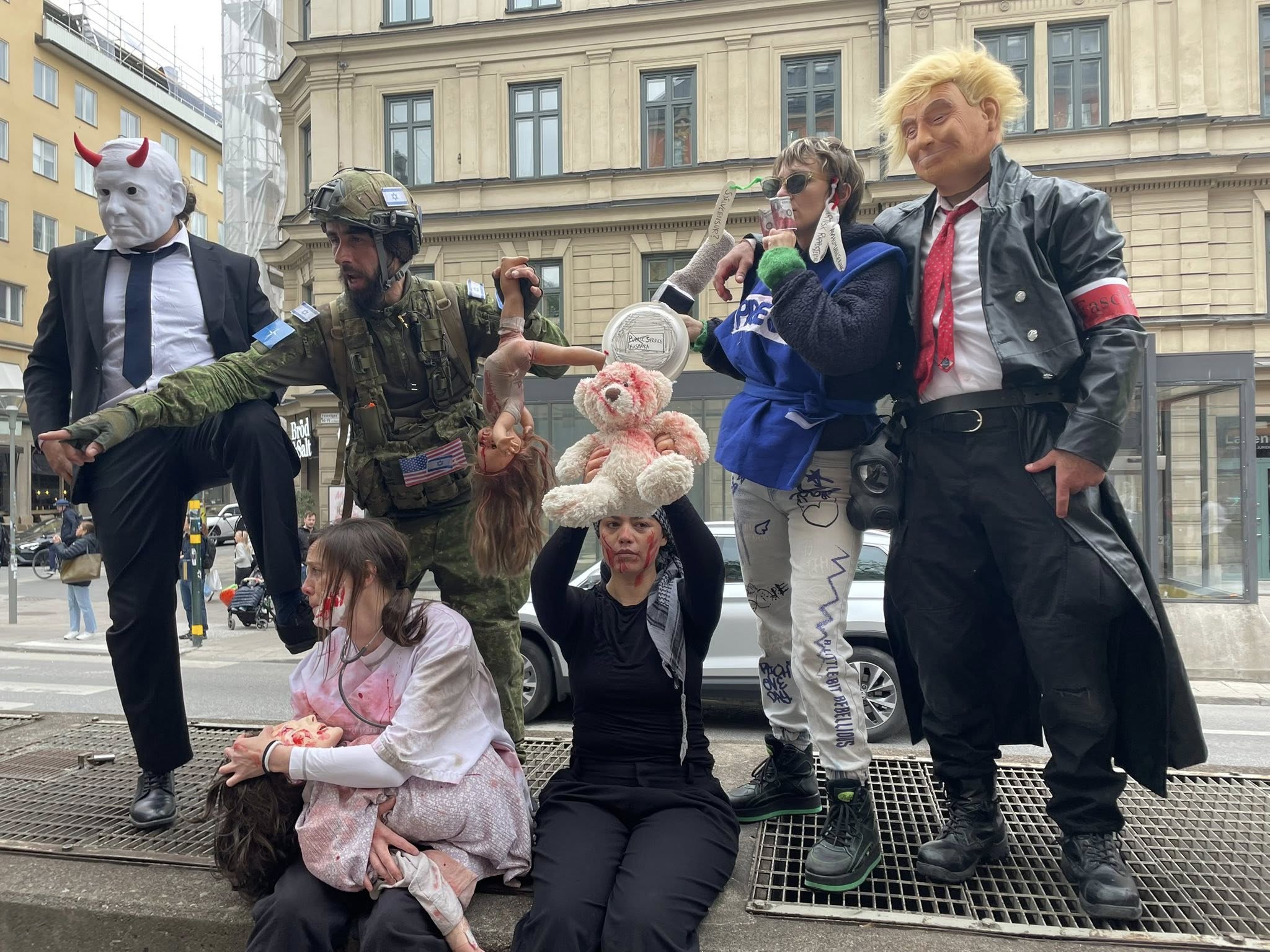
Demonstration in Stockholm, June 2025

How prevalent are antisemitic crimes?

“Many Jews in Sweden have experienced antisemitism in one way or another”, Shastin Ravid says, “we need more research, but studies have indicated that many Swedish Jews have been targeted by antisemitism and many of them have not reported these incidents. This is also true for other hate crimes, most of them are probably never reported to the police”. Some of the studies Shastin Ravid is referring to were made by the Swedish National Council for Crime Prevention (Brottsförebyggande rådet, Brå). They show that there is a small and inconsistent increase in the number of reported antisemitic hate crimes over the years, but some years there is a sharp rise. “These are often the years when the conflict between Israel and the Palestinians has escalated, like the last war in Gaza. According to a study from Brå, there was a sharp rise in reported antisemitic hate crimes during the last part of 2023, almost 5 times as many as during the same period the year before”.

But other global events may also have been important in this respect. “The pandemic, for example, brought at least two kinds of antisemitic effects”, Shastin Ravid says, “First, there were accusations against the Jews, who were blamed for starting the pandemic and for profiting from it. Then, there were parts of the anti-vaccination movement which instrumentalized and diminished the Holocaust, claiming that they are treated the same way as the Jews in Nazi Germany. The war in Ukraine also triggers antisemitism on a global scale as do the discussion about Quran burnings and the debate about migration and refugees which fuels the antisemitic so-called replacement theory. These days antisemitic propaganda is often spread online with code words replacing the word Jews. Instead, it is Zionists or Globalist or specific names like Soros or Rothschild. These words are used globally as symbols of a big Jewish conspiracy, and they are widely spread in Sweden too”. 

Another study Shastin Ravid speaks of was made by a government agency called The Living History Forum (Forum för Levande historia), which was founded in the beginning of the 2000s to “work for democracy and equality between all people, using lessons learned from the Holocaust”. According to Shastin Ravid, the study from 2020, showed that there had been a decline in antisemitic attitudes and notions over a period of 15 years, but that antisemitism still exists within different parts of the population. “I think that this is an important point to make”, he says, “the study showed that around 5 % of the respondents displayed antisemitic attitudes with a stronger intensity, which is a rather low figure compared to many other countries. However, if you broaden it and look at the group of people who agreed with one or more of the study’s antisemitic statements, the number is 34 %. This does not mean that 34 % can be said to be antisemitic, but it indicates that antisemitic ideas exist among a bigger part of the population than many think. We should not only focus on the most extreme groups. According to the study, higher levels of antisemitic beliefs correlated among other things with, and were more common amongst people who are: older, have lower levels of education and have a low trust in public institutions. Antisemitic beliefs were also more common among people who have sexist and anti-immigrant attitudes, people who sympathize with the Sweden Democrats party, people who were born outside Sweden or Europe, and people with a Muslim religious affiliation. Another interesting factor is that traditional and Holocaust related antisemitic beliefs tended to be slightly more common among men, and Israel-related antisemitic attitudes and notions tended to be slightly more common among women”. However, Shastin Ravid points out, the study is now a few years old, and many things have happened since that could affect the results of the next study, which is supposed to be published in 2026.

One group which is particularly exposed to antisemitic hatred is the group of school pupils and teachers who in many cases are scared to be open with their Jewish identity. “We have studies from among other places Malmö and Stockholm which show that there are serious problems with antisemitism in some Swedish schools. Sometimes it is related to the Israeli-Palestinian conflict, sometimes the word Jew is used as a curse and sometimes we see antisemitic conspiracy theories which fascinate youngsters. We also see jokes about the Holocaust, swastikas on benches or lockers, and Nazi salutes. Jewish pupils often feel that their teachers and schools do not take the matter of antisemitism seriously, and they say that there is a lack of knowledge and support. This is something that many Swedish youngsters have told us at the SCAA through the years”.

Sweden is home to the largest Jewish community in Scandinavia. It’s estimated that about 15,000 Jews live in the country which has a population of just over ten million. That said, there are probably many more Swedes who have a Jewish background, as Jewish immigration to Sweden dates back to the 18th and 19th centuries and many have married into Swedish families. The largest community in the country is the one in the capital Stockholm which has three synagogues, including the conservative Great Synagogue adjacent to the Raoul Wallenberg and Holocaust monuments and an office building which houses various Jewish organizations. A few minutes’ walk away, there’s a relatively new cultural centre called “Bajit” which houses a Jewish primary school, a Jewish kindergarten and a variety of Jewish activities for all ages, as well as a Kosher shop and a café. Smaller Jewish communities and associations exist in Malmö, Gothenburg and a couple of other smaller towns. Sweden’s Jewish communities are united under an umbrella organization, the Official Council of Swedish Jewish Communities (Judiska Centralrådet) which usually takes part in national discussions concerning Jewish life in the Swedish Parliament, Government and other authorities.

Since the problem of antisemitism isn’t new to Swedish society, it’s no surprise that in recent years the Swedish government has made many attempts to address it. After decades of ignoring the problem, dismissing and repressing it, recent Swedish governments have put it on their agenda and have tried many different approaches. Petra Kahn Nord who served as the World Jewish Congress’ representative in the Nordic countries, says that the current Swedish government appointed a special inter-ministerial task force in order to combat antisemitism and improve the conditions for Jewish life in Sweden. “This government task force was set up to be a ‘one point of contact’ authority, which is something we’ve suggested before”, she says, “it was founded in January 2023 and the first issue that it focused on was government funding for security for Jewish institutions like synagogues and schools. The second issue was, and still is, addressing antisemitism”. Kahn Nord explains that the previous government had the political will to secure security funding, but the budget mechanism didn’t really work. The current government, however, addressed the issue, increased funding and gave additional funding after October 7th. But protection against violent antisemitic incidents isn’t all that’s needed.

In 2021 Sweden hosted The Malmö International Forum on Holocaust Remembrance and Combating Antisemitism. The conference, hosted by then-Prime-Minister, Social-Democrat Stefan Löfven, asked the participating countries and organization to make concrete pledges that would strengthen Holocaust remembrance and tackle Holocaust distortion, Holocaust denial and contemporary antisemitism. The Malmö forum was seen by many as a natural continuation to the steps another Social-Democratic Prime-Minister, Göran Persson, made twenty years earlier. Persson founded what is now called the International Holocaust Remembrance Alliance (IHRA) and initiated the Stockholm International Forum on the Holocaust which brought together political leaders, state officials, religious leaders, survivors, educators, and historians from around the globe. When Löfven initiated the 2021 events, one of Sweden’s pledges was to form an inquiry on strengthening Jewish life in the country. The idea was that fighting antisemites is one thing, but making Jewish life flourish was another subject. One that has been neglected for many years.

This indeed happened and various issues which Jews in Sweden were concerned about were discussed seriously. These included the threats of illegalizing Jewish circumcision and banning the import of Kosher meat which were supported by some political parties. Another important issue was the status of Jewish schools in Sweden which doesn’t have almost any real private schools. There are so-called independent schools, including a couple of Jewish ones, within a charter system, but because of reports of radicalization in some of Sweden’s independent Muslim schools, new legislation was put in place which affected Jewish schools too. The new legislation imposed the definition of “denominational schools”, and with-it necessary restrictions, on existing Jewish schools. Another concern was an initiative to limit the establishment of new denominational schools. These were all concerns in the Swedish-Jewish pre-October 7th reality. Community leaders were saying then that “Swedish Jews may be able to survive a terror attack, but not legislation forbidding Brit Mila or Jewish schools”.

Today, after October 7th, it’s clear that the majority of political parties, and certainly the ones which are part of the Swedish Government, are committed to addressing these Jewish concerns. Antisemitism, however, is not necessarily a problem which the government can easily address since its origins are well-rooted and widespread in many parts of Swedish society. All recent Swedish governments have therefore realized that combating antisemitism is as complicated as it’s important. And it’s a work in progress. Petra Kahn Nord mentions two major shifts in the last few years. “First, before 2015 it was not acceptable to talk about antisemitism which came from immigrant groups from the Middle-East. This made members of the Jewish community feel abandoned. Sweden has now changed and it’s now possible to talk about it and deal with the problem”, Kahn Nord says, “the second shift has to do with the fact that the populist right-wing Sweden-Democrats party is supporting the government. So far, however, the party hasn’t caused any policy shifts aimed at the Jewish minority. But October 7th created a new reality. We’ve seen an increase in the number of antisemitic incidents in schools and universities, we’ve seen politicians, especially in the Swedish Left, who spread antisemitic propaganda and we’ve seen support for Hamas in demonstrations and online”. Kahn Nord says that schools and social media are a particular concern. “The problem in these arenas is serious”, she claims, “and it can’t be dealt with by using old “action plans” that previous governments suggested. Many of these plans, including pledges made in Malmö four years ago, focused on Holocaust education and educational strategies against racism in general, as opposed to antisemitism as a specific phenomenon. The Malmö Pledges, for example, included the pledge to establish a new Holocaust Museum in Stockholm (which has indeed been opened since then) and another to contribute 5.5 million SEK to the Auschwitz-Birkenau Foundation. “There’s a Swedish tendency to focus on dead Jews”, Petra Kahn Nord says, “perhaps now, especially after October 7th, it’s time to focus on the living ones”.

And indeed, when it comes to living Jews and real concrete Jewish communities, combating antisemitism and taking measures to improve Jewish depends on strong support and clear stands by governments. 

In Sweden, the subject of antisemitism has been on the agenda for decades and different governments have handled it in different ways. Today, the government minister who holds the relevant portfolio is Parisa Liljestrand, a forty-two-year-old minister from the center-right Moderate party. Liljestrand, immigrated to Sweden as a young child from Iran and worked as a teacher and school head-master before getting involved in local politics. In 2022 she received her first post on the national political scene and became Sweden’s Minister of Culture. In an interview conducted in her Stockholm office she explains that one of her responsibilities is addressing issues connected with Sweden’s five national minorities. The minorities and their languages, which are considered official minority languages in Sweden, were recognized in the year 2000 and they include Jews and Yiddish; Roma and Romani Chib; the Sami and the Sami language; the Swedish Finns and Finnish and the Tornedalers and their Meänkieli language.

 “Our government was appointed in October 2022 and the Prime Minister made it clear, as early as his first government statement, that strengthening Jewish life and working against antisemitism would be one of our priorities”, she says, “When we started our work, we decided that we need to understand what’s been done in Sweden today and to listen to the Jewish organizations which are active in Sweden. We wanted to understand what they think is needed. What we found out was that a lot of important work is being done, but there are things which still don’t work and there are things which are lacking. Sweden ranks well in global measurements of antisemitism, but there’s still widespread antisemitism in Sweden which we need to actively fight. This became even more evident after Hamas’s horrific attack on October 7, 2023. As in many other countries, we have seen the threat perception towards Swedish Jews increase, as has open antisemitism. The government takes this very seriously.

But it is not enough to work against antisemitism. We need to strengthen the possibility to live a free Jewish life, both in terms of Jewish culture and in terms of Jewish religious life. This is why we need to gather the work that’s done by different government ministries and by Jewish organizations. When we talked to the organizations, we found that it was sometimes hard to understand who’s responsible for what issue and it was important to make sure that things don’t end up in the wrong place. That’s why we founded the Government Task Force for Jewish Life as an inter-governmental work group which, beside the Prime Minister’s office, has eight more government offices represented in it”.

When asked if the fact that her government is supported by a party with roots in neo-Nazism doesn’t affect her attempts to fight antisemitism, Liljestrand tells a story of one of her meetings. “I met a Jewish father who told me about his son who went shopping while he was wearing a necklace with a Star of David. The father said that when the boy came to the cashier, the person who was working there told him that he was not welcome in the shop. This story really hurts. This can’t be our reality. This isn’t Sweden. We have a clear mission – making Sweden a free country to live in and supporting those groups who cannot live a de-facto free life here. So, I don’t feel the Sweden-Democrats are stopping me from doing this. I understand that there’s a concern, but I’m clear, and the government is clear in its message. One must remember that antisemitism is about gathering and capitalizing violence from various directions. That’s what makes it different from regular racism”. 
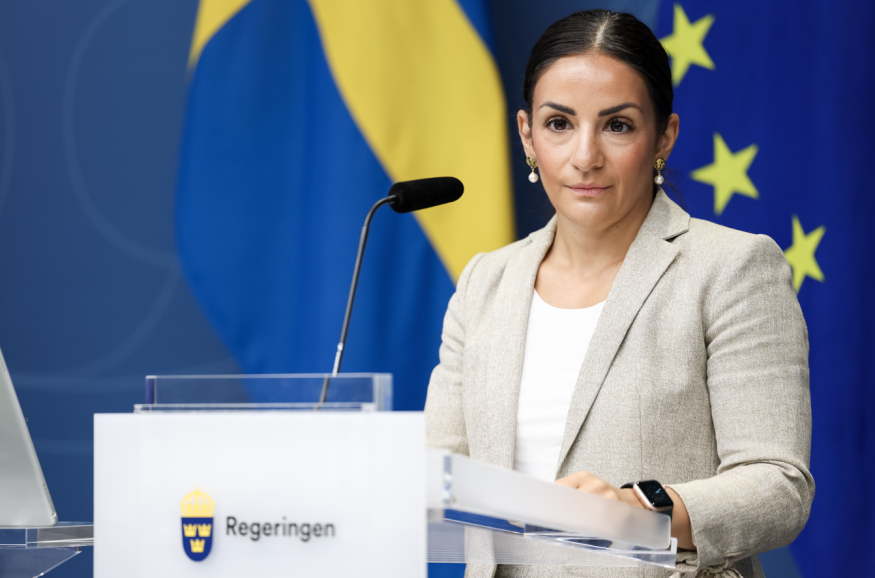
Parisa Liljestrand, Photo by Ninni Andersson Regeringskansliet

Part of the violence Liljestrand is talking about is online and much of it is aimed at young people who have to grow up with it. “It’s extremely serious when antisemitism becomes a natural part of day-to-day life and it isn’t limited to the physical space and instead it’s spread digitally”, Liljestrand says, “it’s worrying and we need to fight it and work towards the goal of not having another generation which is exposed to the same kind of difficulties living a Jewish life or the same kind of antisemitic hate which previous generations were exposed to”.

Liljestrand seems to be serious about this particular aspect of her job. “I myself, with my background, know exactly what it’s like to live in a society which treats you differently if you have a different skin color or if you have a different culture”, she says, “I know what it’s like to fight your way into society and have the will to be part of it while still keeping a part of your culture and heritage”.

When it comes to antisemitism and the struggle against it, Sweden is indeed an interesting case. For much of its post war history, antisemitism wasn’t taken very seriously. Neo-Nazi movements operated freely while the close ties to Nazi Germany were ignored. This came together with a widespread ignorance about the Holocaust, antisemitic attitudes within the Swedish elite and free import of antisemitism with large waves of immigration from other countries. Then, in the last couple of decades, all that changed. Sweden became a world leader of Holocaust education and combating antisemitism. At least that’s what it presents itself as being. But are the museums, task forces, international conferences, research projects and educational initiatives really working? 

On the one hand, it is clear that Sweden is much more aware of the problem and much better equipped to combat it than it has ever been. But any honest assessment of the situation must admit that, in many cases, Swedish schools and universities remain hostile dangerous places for Jewish students and teachers, who continue to suffer from harassment, social pressure and occasionally also violence, while teachers and principals avoid confronting the aggressors. It has been reported that in some schools, Shoah survivors haven’t been invited to share their stories because of the disrespect shown by some students. 

Outside the education system, other problems remain unresolved. Although physical violence against Jewish targets is not common in Sweden, it has occurred and, according to police and the press, it remains possible. Molotov cocktails have been thrown at Jewish cemeteries, funeral homes, and synagogues, the Israeki embassy has been attacked and other cases of physical and verbal assaults against Jews have been documented. 

The resurgence of pro-Palestinian demonstrations since October 7—where strongly antisemitic slogans, signs, and rhetoric have been documented—is also a cause for concern. The scale of the protests against singer Eden Golan’s participation in the Eurovision 2024 final in Malmö made international headlines, but the truth is that although those demonstrations may have been the biggest, they weren’t the most aggressive. 

For many Jews who live in Sweden it’s not about the size of the demonstration and not about the legitimate right to demonstrate. Anyone who’s uncomfortable with these demonstrations can just avoid them. The problem is that when Sweden’s Jews see thousands of people who are collectively calling Israel, which is an important part of their identity, the worse things in the world and promoting a very high level of hate, they know that in that crowd there may be familiar faces – perhaps their children’s pre-school teacher or their local clinic’s nurse or doctor. And it’s not only that. The separation that some of the demonstrators try to make between criticizing Israel and attacking Jews doesn’t always work. When demonstrators wanted to burn an Israeli flag in Malmö in November 2023, they didn’t get on a train and go to Israel’s embassy in Stockholm. They did it outside the local synagogue. A couple of months later protesters from a group called ”Together for Palestine” chanted anti-Israeli slogans at people who were entering Stockholm’s Great synagogue for a Holocaust Remembrance Day ceremony. Some of the people who encountered this were Holocaust survivors. The demonstrators demanded that Sweden’s Jews will denounce Israel and its war in Gaza. These events send a message that 250 years after Jews were officially allowed to live and create a community in Sweden, their legitimacy is now conditional. If they speak out against their historic homeland and its government, they are tolerated. If not, all hell may to break loose. 

A look at the Radio Islam website is a thought-provoking experience. It features lengthy texts about subjects like how Jews have controlled Sweden for centuries, how they “instrumentalize the Holocaust” and how racism, hatred and cruelty are the driving forces of the Torah and the Talmud. In a way this brings us full circle. Sweden has gone a long way fighting antisemitism since Radio Islam was persecuted back in the eighties. Since then, Swedish governments, Jewish organizations and civil society organizations have turned Sweden into a country known for its rigorous combat against antisemitism. However, with populist and racist political movements on the rise, with Islamist propaganda on and off-line, with an increasingly aggressive discourse against Israel and Zionism, demonstrations, boycotts, and burnings of flags and books on a weekly basis, it’s now clearer than ever that the fight against antisemitism still has a long way to go.

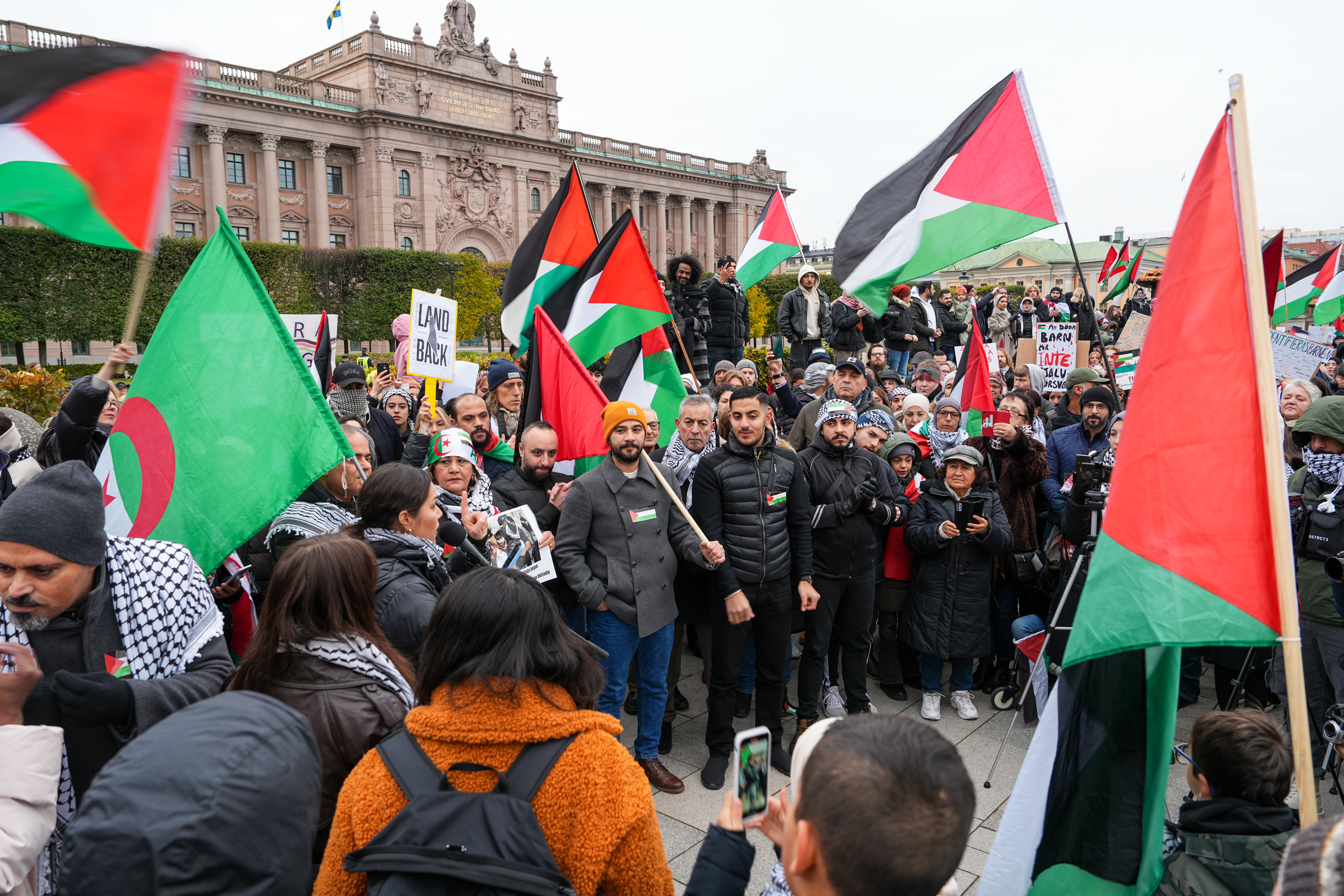
רצח שורף הקוראן עורר מחדש את המחלוקות בשאלת חופש הביטוי הנרחב בשוודיה

בשבוע שעבר נרצח סלוואן מומיקה, שבהזדמנויות שונות שרף ספרי קוראן במסגרת מחאה במספר מקומות בשוודיה. סגנית ראש הממשלה אבה בוש: "אם הוא היה מבקר באופן דומה את הנצרות, ההינדואיזם או היהדות — הוא היה חי כיום".

פורסם ב"הארץ": https://www.haaretz.co.il/news/world/europe/2025-02-06/ty-article/.premium/00000194-d7df-ddbc-a1dd-d7df15220000

הרצח שהתרחש ביום רביעי שעבר בעיר סודרטליה, כשלושים קילומטר מדרום־מערב לסטוקהולם, במידה רבה היה ידוע מראש. הקורבן היה סלוואן מומיקה, פליט עיראקי בן 38 ממוצא נוצרי־אשורי, שהגיע לשוודיה ב–2018 והתפרסם בעקבות הפגנות אנטי־מוסלמיות שארגן במדינה, ושבמהלכן שרף ספרי קוראן. מלבד הזעם בקרב הקהילה המוסלמית בשוודיה, מעשי שרפת הקוראן עוררו גם תגובות קיצוניות בעולם. במדינות מוסלמיות פרצו הפגנות סוערות, שגרירות שוודיה בעיראק הותקפה בידי המון זועם ונשיא טורקיה טען שזו אחת הסיבות שהוא מעכב את קבלת שוודיה לנאט"ו. בבלגיה אף נרצחו באוקטובר 2023 שני אוהדי כדורגל בידי אדם שהזדהה עם דאעש וטען שזהו מעשה נקמה בשוודים על רקע עוינותם לאיסלאם.

מטבע הדברים היו למומיקה אויבים רבים, והוא היה מסובך גם עם השלטונות בשוודיה, שכבר החליטו לגרשו מהמדינה, אך נאלצו להימנע מכך בשל האיום על חייו בעיראק. באותם ימים הוא אמר לטלוויזיה השוודית: "יש מחיר על ראשי ואני עלול למות בכל רגע. אחריות המשטרה היא להגן על חיי". פחות משנה וחצי אחר כך התממשה נבואתו. אמנם חמישה בני אדם נעצרו בעקבות הרצח, אך הם שוחררו למחרת ובעת כתיבת שורות אלו אין בידי המשטרה חשוד במעשה.

הרצח היה מזעזע במיוחד, מכיוון שהוא התרחש בעת שידור ישיר של מומיקה בטיקטוק. מומיקה אמר לעוקביו הצופים שהוא יוצא למרפסת לעשן. מיד אחר כך נשמעה ירייה והטלפון נשמט מידיו ונפל על הרצפה. אחר כך נשמעו עוד ארבע יריות. עוקבים שצפו בשידור האחרון של מומיקה סיפרו לתקשורת בשוודיה שהוא "הוצא להורג בכמה יריות". "אני חושבת שעברו 15 עד 25 דקות עד ששמעתי את המשטרה נכנסת לדירה", סיפרה אחת הצופות. "שמעתי איך השוטרים מדברים על דפיברילטורים ושואלים אם יש נשק בדירה, ואז השידור כבה".

הרצח היה יום לפני שמומיקה היה אמור לשמוע את גזר דינו בבית המשפט המחוזי בסטוקהולם, לאחר שהוא ושותפו לארבע מהפגנות שרפת הקוראן — אזרח שוודי ממוצא עיראקי ושמו סלוואן נאג'ם — הועמדו לדין באשמת הסתה. כמה ימים לאחר הרצח בוטל גזר דינו של מומיקה, אך נאג'ם הורשע ונגזרו עליו מאסר על תנאי וקנס. הוא מתכוון לערער לבית המשפט העליון והודיע לכלי תקשורת בשוודיה שהוא "הבא בתור להירצח", מכיוון שיש איומים רבים על חייו.

הרצח של מומיקה, גזר הדין של נג'אם והסעיף שבו הורשע מעוררים מחדש את הדיון הציבורי בשוודיה בשאלת גבולות חופש הביטוי. דיון זה מעורר עניין גם במדינות אחרות, מכיוון ששוודיה היא אחת המדינות שבהן יש לחופש הביטוי הגבלות מעטות מאוד בחוק. אין בה, למשל, חוקים נגד השחתת סמלים דתיים, שרפת דגלים או הפצת אידאולוגיות קיצוניות. חוקי היסוד במדינה מגינים על הבעת דעות, גם דעות קיצוניות כלפי דתות, וכן הם מעניקים מרחב חוקי גדול במיוחד לחופש ההתאגדות, לחופש ההפגנה ולחופש העיתונות. כך לא מנעו הרשויות בשוודיה הפגנות של תנועות נאו־נאציות (דוגמת "תנועת ההתנגדות הנורדית", NMR), אירועים של ארגונים איסלאמיסטיים (דוגמת "חזב א־תחריר"), וגם לא שרפה של ספרי קוראן.

עם זאת, בחוק העונשין של שוודיה יש סעיף האוסר הסתה באמצעות התבטאויות שמאיימות על "קבוצה אתנית או קבוצה אחרת של אנשים בהתבסס על גזע, צבע עור, מוצא לאומי או אתני, אמונה דתית, נטייה מינית או זהות מגדרית". זה הסעיף שבו הורשע נג'אם ושבו מומיקה עמד להיות מורשע.

בעיתון אפטונבלדט (היומון הנפוץ בשוודיה) כתב העיתונאי אוסיאן קנטוול שגזר הדין "סביר", ופירט: "המרחב לבקר דת באופן ענייני ומהימן במסגרת דיון פתוח גדול מאוד. וכן צריך לקבל את העובדה שיש מאמינים שעלולים לתפוס מסר ביקורתי כפוגע. בית המשפט קובע כי הצתת הקוראן כשלעצמה אינה עבירה פלילית, אך במהלך ההפגנות שצוינו בכתב האישום תואר הנביא מוחמד כחולה נפש, אנס, סרסור ופדופיל. ועוד נטען בהן כי ילדים נאנסים במסגדים וכי מוסלמים הם חרקים ותיקנים".

לעומתו, העיתונאי יאנה יוספסון אמר שהוא מופתע מהתפנית הדרמטית שהתחוללה בשוודיה: "ממדינה שבה המשטרה מגינה על זכותו של אדם לשרוף קוראן נהפכנו למדינה שבה, אם זה יקרה שוב, תעצור המשטרה את שורף הקוראן והוא יהיה צפוי למאסר. אני לא הייתי שורף קוראן ולא אהבתי שעשו זאת, אבל הייתי גאה בזכות הניתנת בשוודיה לעשות כך".

היומון אקספרסן ציטט בהקשר זה את דברי אבה בוש, סגנית ראש הממשלה ושרת האנרגיה: "אילו היה סלוואן מומיקה מבקר את הנצרות באופן דומה, אני משוכנעת שהוא היה חי היום. אילו הוא היה מבקר את היהדות, הוא היה חי היום. אילו הוא היה מתבטא ככה בנוגע להינדואיזם, הוא היה חי היום". בוש כינתה את החגיגות שנראו ברשתות החברתיות בעקבות מותו של מומיקה "מבחילות", והוסיפה ש"אם לא ננצח במאבק הערכים הזה, לא נזהה את שוודיה בעוד כמה שנים. אחת הפעולות החשובות כעת היא האפשרות לבטל אזרחות לבני אדם שפועלים בחומרה. אני חושבת ששרפת הקוראן היא דבר נורא, פוגעני, ואינני רואה בכך מעשה מכובד. אבל גם אינני חושבת שצריך למות בגלל זה".

ראש הממשלה אולף קריסטרסון אמר במסיבת עיתונאים שהוא אינו פוסל את ההנחה שגורם זר מעורב ברצח, והצהיר: "השירותים החשאיים מעורבים לעומק בחקירה".

בימים שבהם שרפו מומיקה ונג'אם ספרי קוראן בשוודיה, העלתה המדינה את רמת כוננות הטרור בה לארבע בסולם של חמש. מאז התרחשו כמה תקריות המעוררות חשש למעורבות של גורמים מדינתיים זרים באירועי חבלה וטרור בשוודיה. בכלל זה הועלה חשד שגורמים איראניים יזמו — בעזרת קשרים עם גורמי פשיעה בשוודיה — ירי על שגרירות ישראל בסטוקהולם. הרדיו הממלכתי של שוודיה חשף לפני כשנה שאיראן תכננה לרצוח מנהיגים יהודים בולטים במדינה על ידי שני סוכנים שהוחדרו אליה בזהות בדויה ובמסווה של פליטים.

אירועים אלו, נוסף על גל פשיעה מאורגנת, קמפיינים של דיס־אינפורמציה וחשד ל"מלחמה היברידית" שמפעילה רוסיה בדרך של פגיעה בכבלי תקשורת בים הבלטי ותקיפות סייבר, יוצרים חשש ביטחוני ומתח גאופוליטי במדינה שנהנתה מעשורים רבים של תחושת ביטחון. על רקע זה נהפכו פועלו של מומיקה ומותו האלים להרבה יותר משיעור אזרחות על גבולות חופש הביטוי, ולגורם מערער נוסף בטלטלה שעוברת על שוודיה בשנים האחרונות.

Should Swedish Teachers be Forcing Their Activism on School Children

Don't teachers know that getting school and pre-school children involved in their "support Palestine" is against Swedish school laws and regulation?

Published in Svenska Dagbladet: https://www.svd.se/a/rPW3RA/kulturdebatt-ska-forskolebarn-patvingas-politisk-aktivism

It was a regular day at a regular Stockholm pre-school. The children arrived in the morning and after the parents rushed off to work, they got busy making cute creations using paint and beads. But this day had a special theme – the bracelets the children made were all in the colors of the Palestinian flag, as were the hand prints that they put on white sheets of paper titled "Support Palestine". According to a social media post, the pre-school was also involved in raising money for the Sewedish Palestinagrupperna NGO.

This wasn't just a local initiative. It turns out that a self-titled "preschool teacher and lecturer who fights to strengthen the preschool's mission", who has tens of thousands of followers on social media, has been giving ideas and inspiration for what he called "pre-schools for Palestine day". The content itself was hardly impressive, but it made an impression on some pre-school teachers who decided to impose their political activism on 4 and 5-year-olds. In Jönköping, for example, a couple of pre-school teachers got children to draw watermelons to "show love and solidarity with Palestine". in Upplands-Bro, a pre-school teacher claimed on social media that "the children have been given beads and crafts in the colors of the Palestinian flag" and went on to say that the children will ask their parents to buy food for Palestinians and let Palestinians live in their homes.

Where is all this coming from? Surely, Swedish educators know that political activism in schools is opposed to the school law. In order to understand the phenomena, I went to a teacher's union meeting dedicated to a discussion about the union's policy concerning Gaza. Since the teachers attending the meeting, some of them wearing so-called Palestinasjals, didn't know who I was, they spoke freely about their concerns.

One spoke passionately about the disgrace of Swedish teachers supporting the Nazis in the 1940s. She then said "in twenty years someone will write – 'my teachers were silent!' I don't want to bear that shame". Another spoke about the cowardly silence in Swedish schools and said that many teachers are willing to speak out and show civil courage. The use of "civil courage" is interesting here. Civil courage means that there's a price for your actions. Otherwise, why is it courage? Raoul Wallenberg saved tens of thousands of Jews in Budapest 1944. The price – death in a KGB prison. Nelson Mandela fought for equality in apartheid South-Africa. The price – 27 years in prison. Miss Gunilla promotes Hamas narratives. The price – a reasonable salary from the Municipality of Stockholm funded by Swedish tax payers. There is, of course, a real price too, but it's not paid by the teachers. It's paid by children who feel unsafe and unwelcome when they encounter pro-Palestinian activism where there supposed to feel protected and appreciated.

In the union meeting, however, the teachers claimed that it's not about being pro-Palestinian, it's about values. "we have the Children's Rights Convention in our curriculum, human rights, children's rights", one of the said, "children are being slaughtered, burned to death in tents, and we cannot even make a statement". This claim is worth addressing since human rights are, and should be, part of the school plan. But since the world is a complicated place, school programs stick to values, history and social sciences and generally avoid ongoing, political conflicts. If schools would deal with this war, they'd have to deal with others. There are active genocides, civil wars and massacres going on in dozens of countries and still, Swedish schools don't dedicate their resources to Tigrayans, Darfurians, Curds, Uyghurs and Rohingya people and they certainly didn't discuss the victims of the October 7th massacre in Israel. Should Gaza be an exception just because it's a fashionable topic in Swedish activist circles? Even if the Palestinians were defenseless victims of a one-sided genocide and even if drawing watermelons could somehow save them, the result of turning Swedish schools into a political Hyde-Park will be even less time left for mathematics, Swedish, arts and science. Do Swedish students really excel in these subjects so much that they can allow themselves this righteous indulgence?

But even if they did, focusing on Gaza would be problematic. The current war in Israel and Gaza has victims on both sides. Israeli children as well as Palestinians were killed, Israeli teen-agers were raped and kidnapped, Israeli students also lost their homes and became orphans and their schools are being bombed and destroyed too. Swedish activists who publicly "support Gaza", don't see this as an equally important issue. The teacher's union leadership even explained that solidarity help funds only go to UNRWA because Israel "can take care of itself". This comes from believing in a specific narrative: Israel is a colonialist state based on ethnic cleansing of indigenous Palestinians who are now victims of a genocide.

There are, however, competing narratives. For example: the Jewish national movement (aka Zionism) and the Palestinian national movement both have justified claims on the same territory and they're involved in a bloody conflict which can only be solved by compromise. And here's another: Iran is using its Palestinian and Lebanese proxies in order to annihilate Jews while it's engaging in an influence campaign in Europe which is designed to acquire western allies (such as Swedish teachers) who'll support its antisemitic genocidal aggression. The battle between these narratives is important, it's what politics are all about, and it should take place in many places, but not in schools, and aiming at 4-year-olds is a particularly cheap shot.

And finally, there's antisemitism. A Malmö school report (2021), a Stockholm school report (2022) and a government report (2024) all clearly show that Jewish students and Jewish teachers in Swedish schools are victims of antisemitism and that one of the reasons for this is that the Israeli-Palestinian conflict is present in classrooms and schoolyards. Does anybody seriously believe that even more of it will help addressing antisemitism? Of course not. But fighting antisemitism isn't as fashionable as it used to be, and it's not only about schools anymore.

It's happening everywhere. Political activists preach against indifference and demand that teachers, nurses, midwives, and social-workers "stand up for Palestine". That's all very well, but here's another option; perhaps teachers can stand up for their students, midwives can stand up for future mothers and nurses for their patients. Political activists can arrange demonstrations, write op-eds and promote the "global intifada" in their spare time, just like people with similar hobbies burn the Quran or shave their heads and march for "white power" after work and not during office hours. At the end of the union meeting, one of the teachers said: "I'm a child of the revolution. I came to Sweden from Iran and the revolution there started from the teachers". Sweden's teachers can exercise their freedom of speech because they live in a democracy, but considering the results of the revolution in Iran, perhaps it's best if they do it as far away from children as possible.

!Say it: Yes, I condemn Hamas

The discourse within the Swedish and European left is important even if you're not part of it and the insane embrace of Hamas by so-called left-wing radicals, climate change fighters, human rights activists and western intellectuals and academics must be challenged.

Originally published in Swedish in Parabol: https://www.parabol.press/andreas-malm-har-fel-om-hamas/

Imagine this powerful image: in a country which is slowly being taken over by right-wing nationalists, it's becoming harder to speak truth to power and to speak up for the underdog and the repressed. But then, from the trenches of the opposition, rises a fearless figure. He knows he'll be arrested and tortured if he's caught crying out, and so he does what intellectuals from resistance movements allways do under tyrannical regimes. He uses sarcasm, he sharpens his pencil and cleverly plays with words to produce a text which is radical and subversive, but at the same time meticulously designed not to be flagged down by the authorities. That way the avant-garde academic doesn’t get in trouble with the all-powerful secret service henchmen who are hunting down traitors.

Sweden 2024. While a war is going on in Gaza and in Israel, the whole political elite is powerfully supporting Israel. It's blue and white from left to right and it's not allowed to speak up for the Palestinians. And then, a single voice of a brave dissident rings out. He wrote a text. It's called "I Condemn Hamas" and it's brilliantly designed by a rhetorical trick – the title is mainstream and boring, everyone condemns Hamas. The content seems to be the same, but under the surface lies the explosive message – it's the exact opposite of condemning Hamas, it's actually supporting it (Malm, Anders, Jag Fördömer Hamas, Parabol, 01/11-23). At last the opposition has a voice – Andreas Malm has weighed in. It's a powerful text and a powerful image. The only problem is that none of it is true.

Malm's claim is clear – everyone's condemning Hamas, mainstream media, politicians and public discourse in general. He, on the other hand, thinks this is false. Hamas may have killed civilians, kidnapped children and burned down residential buildings on October 7th, but according to him this isn't unique. It's all been done before by Israel. Malm doesn't claim this directly. He does it by sarcasm. The same kind of sarcasm is pointed at the Swedish discourse. "In Sweden there are strikingly few who have condemned Hamas in the past few days. Those who have done it have only done it once, so that we now wonder if it was really meant honestly", he writes creating an illusion which is the exact opposite of the truth. In fact, Sweden is one of the countries in which the Hamas did surprisingly well. At least for an organization which is internationally recognized as a terror organization.

Hamas supporters have spoken openly in conferences and seminars in Sweden, money has been raised for Hamas freely in Sweden; just in the last few months there have been dozens of pro-Palestinian demonstrations with speeches supporting Hamas or at least not condemning them including demonstrations celebrating the events of October 7th on the day they happened. Unlike other countries, these demonstrations are not only legal, they're supported by some of the political elite and many in the media, in the cultural world and in civil society. Malm's style implies that Swedish publicists have to condemn Hamas or they'll be cancelled. Nothing could be further from the truth. In fact, Malm himself is a writer who has supported Hamas publicly in several newspapers, magazines and publications. As far as I know, he's yet to be arrested, censored or fired. In Sweden it’s allowed to burn the Koran, join parties which support North-Korea and have Neo-Nazi marches on Yom-Kippur. No one's preventing anyone from supporting Hamas. Indeed, I recently met Hamas supporters in Sergels Torg. They were members of two perfectly legal Swedish movements, RKU, the revolutionary communist youth movement and NMR, the friendly neighborhood neo-Nazis. Who knows, perhaps Andreas Malm himself was there supporting them both.

However, the Swedish context is only the beginning of Malm's mistake. The claim that the massacre on October 7th was more of the same, that it was Palestinians retaliating with the same kind of violence Israel uses, is worth studying. "What happened on Black Saturday, October 7th was something new in the history of the Israeli-Palestinian conflict", Malm writes using his smug self-satisfied irony, "it redraws the political and moral map of the Middle East for good. Gunmen stormed into communities and shot children to death with rifles. They did not care at all about the age of the victims. Hundreds of civilians were killed – people with no connection to any military activity, murdered simply because of their identity. Entire families disappeared". If this wasn't so true, it would be real cutting-edge political satire. But Malm's satire, is in fact the sad truth. Nothing like October 7th ever happened before in this conflict. Israelis and Palestinians never killed so many people in one attack or in one day. Not in Kafar Qasim (1956), not in Deir Yassin and Tantura (1948), not in Hebron (1996) and not in the bombings of Gaza in previous years. There were never so many acts of torture and violence against civilians, never so many people kidnaped and never such brutality. And yes, October 7th did redraw the political and moral map of the Middle-East for good. I couldn't have said it better myself.

Israel made many mistakes in the last few decades; like any other army it has committed war crimes during conflict, some of its civilians, especially in the West-Bank are violent extremists and its occupation of the West-Bank continues to be a hindrance to peace in the Middle-East. But October 7th was unique. It's not only about the brutality or the number of victims. The really scary number is the number of the people who committed the crimes. Unlike 9/11 which was executed by a small Jihadist vanguard of 19 Al-Quade operatives, and unlike Utøya which was the work of one (Andreas Malm cracks a little clever joke making the comparison), October 7th was carried out by about 3,000 people. Many of were sipplied with written instructions about how to murder, torture and kidnap civilians, some were also provided with drugs and with body cameras. This wasn’t a spontaneous, heat of the moment action. It was a planned strategy. On October 7th the world saw a society capable of drafting 3,000 people who were 100 percent committed to murder.

Andreas Malm perhaps hasn't heard the story told by David Tahar, father of Adir Tahar, an Israeli soldier who was killed on October 7th. Tahar told Israeli Chanel 14 that before the funeral he insisted on seeing his son's body even though army officials advised against it. The reason was that apparently after he was killed Hamas fighters decapitated Adir and took his head back home to Gaza. A few weeks later, after receiving intelligence from captured terrorists, an Israeli military unit retrieved the head. It was hidden in a bag with some tennis balls and a few documents inside an ice-cream shop freezer in Gaza. Apparently the head was up for sale. The price was 10,000 US Dollars. I know there are many who don't believe Israeli media and think that Zionists fathers are so perverted that they can make up this kind of story for propaganda purposes. So here's another one. This time from the New York Times.

Sapir, a 24-year-old accountant who attended the rave party near Kibbutz Reim on October 7th gave a testimony which was reliable enough for the NYT which told the story of what she saw from her hiding place (Gettleman, Schwartz and Sella, "Screams Without Words": How Hamas Weaponized Sexual Violence on Oct. 7", The New York Times, 28/12-23). Sapir says she saw "a young woman, blood running down her back, pants pushed down to her knees. One man pulled her by the hair and made her bend over. Another penetrated her. Every time she flinched, he plunged a knife into her back. Sapir said she watched another woman "shredded into pieces". While one terrorist raped her another pulled out a box cutter and sliced off her breast. "One continues to rape her", she said, "the other throws her breast to someone else, and they play with it, throw it, and it falls on the road". She said the men sliced her face and then the woman fell out of view. Around the same time, she said, she saw three other women raped and terrorists carrying the severed heads of three more women.

These are just two testimonies from October 7th. There are thousands more. One could always claim, as Malm does in earlier texts, that all this violence should be seen in context. But this kind of violence has no context. If it was really about freedom, or fighting the occupation there would be no need for mass rape, kidnapping babies and removing body parts. The atrocities, the rockets, the tunnels and the complete subordination of Gazans to Hamas militants are all far darker and more sinister than Malm's theories. It's not the price paid for Israel's colonialism. If for no other reason, because this isn't colonialism. Israel isn't Algeria.

According to Malm, the conflict between Israel and the Palestinians isn't a war between two indigenous peoples which have a legitimate claim to the same territory and therefore are engaged in a violent conflict. Instead, there is one legitimate native nation and for over a century it has been fighting an occupation by invaders who came from other countries as colonizers. The invaders are supported by imperialist powers and they are now committing genocide. This kind of aggression according to Malm must be, should be and always has been resisted with violence. In fact, Malm's latest text is one of many in Parabol making the same claim.

These texts rarely even mention the events of October 7th which I would suggest is a sign of total moral bankruptcy. But that's me and I may be biased. The problem here is different, it's about intellectual honesty. The description of the Israeli-Palestinian conflict as a story of a colonial power murdering the natives is incredibly shallow and misleading. It's perfectly ok to oppose Israel's policies (as I do myself most of the time), it's perfectly ok to name-drop Edward Said and Franz Fanon, make comparisons to Apartheid South-Africa and quote Israeli officials making outrageous genocidal statements which can then be quoted at the ICJ in the Hague. But people who have studied the region, as I guess Malm has, know very well that Jews, not only Palestinians are natives to it. And no, I'm not referring to Jesus and Abraham. Biblical stories cannot be a base for international geo-politics. I'm referring to facts completely ignored by the whole post-colonial discourse.

Take Gaza, for example, in the place where Rimal, the political center of Gaza City used to stand, a synagogue was built in the year 508 AD. We know that the figure in the center of the ancient mosaic which was found there is King David. How do we know this? Because his name is written there. In Hebrew. Gaza has a long bloody history – Romans, Christian Crusaders, Arab armies, the Egyptians, Napolean's army, the Ottomans and the British Mandate all controlled Gaza. During this history, Jews lived in Gaza, they didn't arrive in ships in the 1940s. They were there during the time of the Romans, 2,000 years ago, they were there in the Middle-Ages and during the time of Islamic rule, then again in the 14th and 15th century and under the rule of the Ottoman empire. Some were still there even after WW 2.

As in many other areas in the region, for thousands of years, Jews thrived and declined in Gaza, they were expelled and fled, they killed and were killed, built and destroyed, returned, immigrated and emigrated. Arabs in the region have a similar, though somewhat shorter, story (I'm referring to them as Arabs, because the name Palestinians wasn't used in the way that we use it today until after WW2). The story of the region being a land inhabited by indigenous Palestinians who were attacked by American, European and Russian Jews arriving from abroad after the Holocaust and kicking out the natives is a fairytale. Concepts like colonialism and indigenous peoples aren't abstract. Unfashionable as it may seem, these things have actual meanings beyond TikTok clips made by demonstrators wearing fashionable red, white and green scarfs. They can be discussed in terms of archeological findings, origin and descent, historical continuity of settlements, language and culture, collective ancestral ties to a territory and to natural resources, self-identification, experiences of subjugation and discrimination and so on. It may be frustrating, but when it comes to Israel, to the West-Bank and to Gaza, both Jews and Palestinians are natives. They're all a combination of immigrants and people who are decedents of families who haven't left for generations. And they've all suffered from violence, massacres, displacement and trauma.

And there's another similarity between the Jewish national movement (aka Zionism) and the Palestinian one. They both have a genocidal wing. These are the people on both sides who don't accept the idea of territorial compromise in order to achieve peace. The people who are willing to go as far as killing or expelling the other group in its entirety. They're usually religious fanatics, they're extremely violent, they totally oppose democracy and human rights, they're willing to kill and die for the cause and they've always been around. On the Jewish side, they began to become a serious threat after Israel's 1967 victory with the rise of the settler movement in the occupied West-Bank. These days they're becoming stronger, they're getting closer to government circles, but they're still far from being anywhere near a majority in Israeli society.

On the Palestinian side, things seem to be worse. If on the Zionist side there was a right-wing revisionist leader, Zeev Jabotinsky, who had a connection with Mussolini in the 30s, the leader of the Arab nationalists in Palestine at the time, Haj Amin al-Husseini, spent WW2 in Berlin and in Rome, he collaborated with the Nazis and the Fascists, he personally met Hitler, Himmler and Mussolini and was a supporter of the "Final Solution of the Jewish Problem". Al-Husseini was just the beginning. The Palestinian National movement has always had an active and extremely popular genocidal side to it. It's not because of Israel, because it started many years before Israel even existed. And it's not unimportant because what we saw on October 7th was a direct result of the same kind of ideology.

That's what's really amazing about Andreas Malm's text. Hamas is the genocidal wing of the Palestinian national movement and its ideological roots go all the way back to Nazi Germany. Although it was seen as a traditional grassroot, social and religious movement when it was founded in the 80s, it's now a modern, extreme right-wing movement combining Jihadism, high-tech disinformation campaigns, a financial empire of global investments, leaders who live a life of luxury outside the region, modern weapon systems and powerful alliances with the world's most tyrannical regimes. Anyone imagining the Hamas as a young David standing up to the Israeli Goliath is living in a naïve lullaby.

But Andreas Malm isn't naïve. He knows very well that the geo-political realities show that Hamas and indeed the Palestinian national movement is far more complicated than just a victim of western colonialism. He knows about the Israeli disengagement from Gaza in 2005 which means there was no occupation of Gaza for almost two decades. He knows that the blockade on Gaza is just as much an Egyptian policy as it is an Israeli one and that many Arab countries want Israel to destroy Hamas. He knows that the Hamas charter is an antisemitic and fundamentalist text. He knows that Hamas has crushed the secular Palestinian national movement in Gaza and that it sees the Palestinian Fatah movement as an enemy which is almost as bad as Israel. He knows about Hamas' brutal war against the Palestinian Authority and he knows about the unprecedented Hamas military buildup and take-over of civil society in Gaza.

The reason that I know that Malm knows all this is because of other texts that he wrote. Reading them one learns a lot about his way of seeing the world, though I must admit, it's sometimes a confusing task. Although he seems well versed in Middle-Eastern politics, when it comes to moral statements and political conclusions, his considerations are so complicated, it's hard to keep track. Although Israel is always wrong (that's the constant) when it comes to Palestinians, Arab states and Islamic super powers, the target is painted around the dart after it's been thrown.

In a text he wrote a few years ago (Malm, Andreas, "Därför Hamas", Expressen, 15/01-09) he claims one can have two thoughts at the same time, like the Palestinian left which allies itself tactically with Hamas but at the same time supports the opposition in Iran while the opposition in Iran is fighting the Iranian regime at the same time the Iranian regime is funding Hamas. It's ok if you need to read the last sentence again.

Malm's reasoning is not that unique. He supports Hamas and its fight against what he called the "corrupt Fatah politicians" and Mahmoud Abbas, who's an Israeli and American "marionet". If this sounds familiar it's because this is exactly the same logic used by Israeli PM Netanyahu who for years has been undermining the Fatah controlled Palestinian Authority by allowing Hamas to stay in power in Gaza so that he wouldn't have to take real steps towards a two-state solution. Surprisingly enough, Malm and Netanyahu are on the same side. They'll both do anything to avoid compromise and consolidation.

In another text from 2009 Malm referred to Hamas as a liberation movement which is "forced to resort to every possible form of resistance" (Malm, Andreas, "Vi bör följa Iran och stödja Hamas i kampen mot Israels folkmordspolitik", Newsmill, 04/01-09). In the same text he quoted Nir Rosen, who claimed that "Attacking civilians is the last, most desperate and basic method of resistance when confronting overwhelming odds and imminent eradication" (Rosen, Nir, "Gaza: the logic of colonial power", The Guardian, 29/12-08). Malm is entitled to write these kind of statements even if they encourage violence and are fascist in nature. I only hope that most Swedes, including those who support the Palestinians, can see beyond this tragic war mongering, since it's clear to anyone what this means politically. Hamas will continue murdering Israelis; Israel will have to retaliate and will do so forcefully – and more Palestinians will be killed. If there's anything that hasn't changed in the last few decades it's this dynamic.

Hamas is not the only problem. In another text Malm openly supported Hezbollah (Malm, Andreas, "Därför Ska Vi Stödja Hezbollah", 11/08-2006), an Islamic movement funded, trained and inspired by the Iranian Ayatollahs and their Islamic Revolutionary Guard Corps, which was involved in suicide attacks, political assassinations, bombing of civilians and hijackings in Lebanon and other countries. I don't know how Malm manages to pull off being a left wing radical and supporting two of the most conservative, fascist, chauvinist, fundamentalist, hierarchical, anti-democratic, homophobic and xenophobic movements in the history of the known universe, but I know that explanations along the lines of "I can't be expected to condemn actions taken by the weak and oppressed” can't work anymore after the massacre of October 7th which was a tectonic, world-changing event. Not condemning it, or in Malm's case, condemning it sarcastically, means supporting it.

This period isn't easy for the global political left. Just like in the 1950s when left-wing activists, politicians and intellectuals had to decide whether to stay faithful to the Stalinist flagship even after it was exposed as a sadistic killing machine of gulags and mock trials, today's left must decide if its alliance with the dictators, Jihadists and militants from Gaza, Teheran, Beirut and Doha is more important than its ideals. Those who have the courage to choose their ideals and abandon their old murderous  allies will not have Andreas Malm's problem. They will be able to proudly say "yes, I condemn Hamas".

'We Know Where You Live': Swedish Jews Don't Feel Safe Since Israel-Hamas War

Students stay home from class or attend and suffer abuse, protesters call for Israel’s erasure, and radical Islamist groups operate unfettered. Sweden’s Jewish community fears for its safety against the backdrop of the war and mass killings in Gaza.

Published in Haaretz: https://www.haaretz.com/world-news/europe/2023-11-02/ty-article-magazine/.premium/israel-hamas-war-has-shaken-swedish-jews-sense-of-security/0000018b-9081-d7a8-afcf-baa356450000

STOCKHOLM – It’s unclear whether Swedes are aware of what the country’s Jewish community has been facing – their neighbors, coworkers, customers, and teachers. The community has been in a state of anxiety since the Hamas terrorist attack on October 7 and the start of Israeli strikes in the Gaza Strip. Swedish Jews fear for their safety, and it seems the authorities aren’t grasping the urgency of the situation.

A stark example occurred at the Hillel Jewish School in downtown Stockholm on

October 13. Threats by Hamas political leader Khaled Meshal to spark an international “day of rage” circulated through social media. Parents, many of them in mourning and worried about family and friends in Israel, wrote in private WhatsApp groups that the school’s regular security was inadequate. Some volunteered to watch the surroundings outside the school, and the local police stationed a patrol car nearby for a few hours.

Nonetheless, conversations with parents indicate that in some classes, at least half the students stayed home from school on October 13. Those who attended were strongly advised to avoid displaying Jewish symbols and refrain from speaking Hebrew.

The Swedish government has shown overwhelming support for Israel, and many Israelis and Jews have received personal messages of support and concern from their social circles. Nevertheless, reports are building up of concerning incidents in recent weeks.

A pro-Palestinian demonstration in front of the Swedish Parliament, October 2023. Photo: Hugh Gordon

A., a former Israeli who lives in Sweden, kept his shop closed on the same Friday, feeling he can’t protect himself and his customers. Another Israeli living in the country encountered violence on the Stockholm Metro after speaking Hebrew on his phone.

Another incident occurred to a man from southern Sweden whose mother is Jewish but who is not religious and does not display Jewish symbols. He describes receiving seven calls from an unknown number this week. A voice told him, “We know where you live. You should watch behind you when leaving home.” It added that he “should no longer live in the city.”

When he contacted the police, he was met with disappointment. They told him that there was nothing they could do because the call came from an unknown number. The police would only intervene if he could provide the caller’s name, an impossible demand for someone receiving an anonymous threat.

Multiple reports have also emerged of students receiving harassment over the Gaza war. The mother of a 16-year-old boy from a Jewish family who goes to a large high school in Goteborg gave one disturbing account. She says a girl stood up in class and shouted, “Slaughter, rape, and torture all the Jews” at her son. The teacher did not react, stop the girl, or report her to the principal, the mother says. The other students also stayed silent. She said they're now considering a transfer to another school.

Two classmates asked a Jewish boy in an elementary school in southern Sweden who he supported in the war. The boy, aged 10, replied that he supported Israel. The two others drew a crossed-out Israeli flag, crumpled it up, and threw it at him, saying, “We hate Israel.” The teacher present in the classroom did nothing until the student’s mother contacted him.

Such attacks and threats have been seen throughout Sweden, with the common denominator being that the victims were Jewish or Israeli.

Swedish academics have also been targeted. A renowned scholar in western Sweden was emailed threats after daring to publicly condemn the October 7 attacks. The head of one department at Uppsala University wrote a social media post stating, “Hamas gave Netanyahu and his radical right partners what they wanted.” Elsewhere, he wrote: “In 1940 and 1941, Hitler developed a plan to systematically starve 30 million Ukrainians, Russians, and Slavs. In 2023, Netanyahu is executing his ‘starvation plan’ in Gaza!”

A Jewish protester, Joanna Istner Byman, at a pro-Palestinian demonstration in Stockholm, this week.Credit: David Stavrou

The cultural world has also been rife with tension. Seven hundred cultural figures published a petition urging an end to the “brutal violence in Gaza” and the end of “military, political, and financial support for Israel.” The petition did not mention Hamas’ terrorist attack, its victims, or the Israeli hostages in Gaza. Well-known Swedish environmental activist Greta Thunberg has taken several opportunities to express support for the Palestinians in recent days, omitting any mention of the Palestinian acts of terrorism last month or the Israeli victims.

The war between Israel and Hamas has reverberated throughout the public sphere in Sweden. Numerous demonstrations have been held since the war began, both pro-Palestinian and pro-Israeli. On the evening of October 7, hours after Hamas went door-to-door to brutalize and kill Israelis, thousands of people, including women and children, participated in rallies across the country. These featured music, dancing, and convoys of cars honking their horns to show support for the Hamas attack.

Even larger and fiercer demonstrations have been held in the subsequent three weeks. At these pro-Palestinian demonstrations, Israel is accused of genocide and ethnic cleansing in the Gaza Strip and there are calls to erase Israel from the map. “From the river to the sea, Palestine will be free,” cried the demonstrators in Sweden. The protests have also seen increasingly widespread calls for an “intifada.”

One of the pro-Palestinian demonstrations was organized by Hizb ut-Tahrir, a radical Islamic group advocating for the creation of a caliphate ruled by Sharia law, which has a small branch in Sweden. It received permission for the demonstration despite being banned in several countries. Demonstrators called for a caliphate stretching from Uzbekistan to Morocco, a war between Islam and the non-Muslim world, and the liberation of “all of Palestine” through military force.

Most of the demonstrations held in Sweden since the war began have been organized by local organizations backing the Palestinians. One weekend in Stockholm's central Sergel Square saw three different organizations demonstrating separately, but with similar slogans. Beside the Palestinian organization, the neo-Nazi Nordic Resistance Movement, which has a few hundred members, was one of them, the Revolutionary Communist Youth, which argues that Palestinians have a right “to fight with every means against the occupying power to liberate their lands" was another. The latter described the October 7 attacks as an act of liberation that “caught the Zionists in their beds.”

The two organizations, one neo-Nazi and the other Marxist-Leninist, both endorse the Palestinian cry to “crush Zionism.” Another demonstration held in Stockholm’s main square a week later drew more than 5,000 people. Speeches by Palestinians and Swedish leftists called for “an intifada until victory” as they waved Palestinian flags, horrifying images from Gaza, and signs condemning the government’s support for Israel. None of the speakers at the pro-Palestinian demonstrations mentioned the Hamas attacks.

A demonstration in solidarity with Palestinians in the Gaza Strip, in Stockholm, Sweden, October 2023.Credit: Hugh Gordon

Mikail Yuksel, leader of the Nuance Party, which defines itself as the representative of Sweden’s minorities, with an emphasis on immigrants, posted on X (formerly Twitter) that he had participated in a pro-Palestinian demonstration in Stockholm. Yuksel, born in Turkey and now a Stockholm resident, was once a member of Sweden’s Center Party. He was expelled for his ties with the Grey Wolves radical Islamic movement.

On October 7, Yuksel called for the removal of Hamas from the list of terrorist organizations. When Haaretz asked him about this, he replied, “If Hamas is considered a terrorist organization, it is impossible to hold a dialogue with it and reach an arrangement. So long as they are considered terrorists, we isolate and radicalize them. We are in favor of talking with them to reach a settlement.”

He added, “It’s no secret that we are a pro-Palestinian party. Israel is recognized by the UN as an occupying power, which commits war crimes and is an apartheid state. Israel must be stopped, and Netanyahu should be brought to trial at the International Criminal Court.”

Asked about the crimes committed by Hamas, Yuksel replied, “An occupied people have the right to use military force. Violence against civilians is not permitted to any of the sides. Everyone must lay down their arms and not point them against civilians to solve the dispute.”

While speaking with Haaretz, Yuksel condemned the attacks on civilians on October 7 as well as the “continuous Israeli attacks on Gaza.” His position is notable, as no Muslim organization in Sweden has condemned the attacks, including entities that previously cooperated with Sweden’s Jewish community and groups.

One pro-Palestinian demonstrator, prominent Muslim leader Rashid Musa, went as far as writing a sarcastic article mocking demands for condemnation in the national tabloid Expressen. “I, Rashid Musa, as a spokesman for 1.3 billion people worldwide, condemn the Hamas, condemn hummus, condemn Hassan, and [Swedish football club] Hammarby.”

Magnus Ranstorp, a prominent Swedish researcher on domestic Salafi-jihadism, terrorism, and radical groups, is concerned about more than just antisemitic slogans at the demonstrations and incidents at schools and workplaces. He says this could escalate to physical threats against Jewish and Israeli targets. A lecturer and strategic advisor at the Swedish Defense University, Ranstorp says two parallel crises are affecting Sweden’s security.

“The first is related to the burning of Koran books and a false campaign regarding the alleged kidnapping of Muslim children by Swedish welfare services,” he says. “This crisis has put Sweden in the crosshairs of organizations such as al-Qaeda, ISIS, and al-Shabab.

“The second crisis is the conflict between Israel and Hamas,” he continues. He says that according to the Swedish Security Service, there were about 2,000 Salafi-jihadists in various Swedish cities in 2017 who had a definite potential for violent activity.

In the cities of Malmö and Helsingborg, large Palestinian communities include families with members previously convicted of terrorist activities in Germany. Malmö is home to Scandinavia’s largest mosque, built recently with the help of millions of euros from Qatar. It is also home to civil society organizations like Group 194. Despite receiving municipal funding, the Swedish Palestinian group endorses terrorism, spreads antisemitism, and has connections to the Popular Front for the Liberation of Palestine, which was involved in the October 7 attacks.

It also recently emerged that the Left Party had used taxpayer money to support a project related to the PFLP through an organization run by its Danish counterpart. Meanwhile, in May, a large Palestinian European conference was held in Malmö with the participation of Amin Abu Rashid, a Dutch Palestinian leader linked to Hamas.

Although the Left Party canceled its participation in the conference when it learned that Abu Rashid would be present, a member of the Social Democratic Party, Jamal el-Haj, ignored a prohibition by party leaders and participated. El-Haj is a member of parliament, and some say he was saved from being kicked out of the party because of his substantial political base.

Ranstorp notes the case of Die Wahre Religion (“The True Religion”), an organization outlawed in Germany. It was banned in part because some of the people connected to it volunteered and joined the ranks of ISIS. Nevertheless, it operated freely as a legitimate Swedish organization that promoted an educational project on Koran reading.

In another case, a Swedish activist named Ahmad Qadan raised money for ISIS and Tahrir al-Sham (formerly Jabhat-al-Nusra) and was sentenced to a few months in jail. It seems that his imprisonment didn’t change much. On October 7, he posted a video on social media of Israelis fleeing Hamas gunmen together with a quote from the Koran, “I will fill the hearts of the unbelievers with fear.”

The international organization Islamic Relief, founded in the U.K. in the 1980s, also has an official Swedish branch. The organization enjoys considerable financial support from the Swedish government and engages in humanitarian activities. Various governments, including the Israeli one, say it’s associated with the Muslim Brotherhood, however. According to Ranstorp, Sweden is an important European center for Islamic Relief and, therefore, the Muslim Brotherhood in Europe.

Ranstorp and others have spoken of this for years. Although politicians’ approach has changed somewhat, some say Swedish authorities and public opinion still don’t appreciate how grave things are. Swedish money ends up financing terrorism, and Middle Eastern money is invested in organizations that pose a risk to Sweden. The law allows public activities that threaten the country’s stability and security bodies.

In response to a query by Haaretz, the security service refused to estimate of current number of jihadi activists and organizations in Sweden. Asked about specific organizations, a spokesperson replied: “The Swedish Security Service does not go into details describing our operational activities. We follow violent extremists and assess the threat to prevent terrorist acts and other security threatening activities. We follow individuals and do not target organizations.”

Regarding the protection of Jewish institutions in Stockholm, the police said, “What security measures we implement, if and when we implement them, and in what way, is something we do not publicize.”

Despite several requests, Swedish Justice Minister Gunnar Strommer, who oversees the police, prosecutions, and the courts, declined to grant an interview to Haaretz.

Hizb ut-Tahrir in Sweden and the Palestine Solidarity Association of Sweden (Palestinagrupperna) did not respond to Haaretz's requests for comment. Greta Thunberg also showed no enthusiasm for speaking with Haaretz about the subject. When she was offered an interview in which she could clarify her position, a spokesman said, “Greta is not holding interviews at this time.”

איומים וגילויי אנטישמיות: המלחמה מערערת את תחושת הביטחון של יהודי שוודיה

מתלמידים שלא מגיעים ללימודים לכאלה שהגיעו וסובלים מהתעמרויות, מהפגנות פרו־פלסטיניות סוערות ועד לארגונים איסלאמיסטיים קיצוניים שפועלים באין מפריע. עדויות שהגיעו לידי "הארץ" מציירות תמונה מטרידה של קהילה יהודית שחוששת לביטחונה על רקע מלחמת ישראל־חמאס.

פורסם ב"הארץ": https://www.haaretz.co.il/news/world/europe/2023-10-31/ty-article-magazine/.premium/0000018b-85aa-dd28-a7df-95bf2fb30000

לא ברור אם תושבי שוודיה יודעים מה עובר בימים אלה על חברי הקהילה היהודית במדינה, בין שמדובר בשכנים, עמיתים לעבודה, לקוחות או מורים שלהם. מאז מתקפת הטרור של חמאס בישראל ב–7 באוקטובר ותחילת ההפצצות הישראליות ברצועת עזה, יהודי שוודיה עוברים ימים לא פשוטים וחוששים לביטחונם ונראה שהרשויות לא מכירות בחומרת המצב.

בבית הספר היהודי "הלל" שבמרכז סטוקהולם, למשל, היו אובדי עצות ביום שישי 13 באוקטובר. ברשתות החברתיות הופצו אז איומים של בכיר חמאס חאלד משעל על "יום זעם" בינלאומי, וההורים — רבים מהם מוכי אבל ודאגה לקרובים ומכרים בישראל — כתבו בקבוצות וואטסאפ פנימיות שהאבטחה הרגילה בבית הספר לא מספיקה. חלק מההורים התנדבו לעמוד ברחוב ליד בית הספר ולפקוח עיניים והמשטרה המקומית הציבה ניידת במקום בחלק משעות היום. עם זאת, משיחות עם הורים עולה שבחלק מהכיתות חצי מהילדים ואף יותר לא הגיעו לשיעורים באותו יום. אלה שכן הגיעו קיבלו המלצות ברורות — להסתיר סממנים יהודיים ולא לדבר עברית.

אף שממשלת שוודיה התייצבה באופן גורף לצד ישראל ולמרות שברמה האישית ישראלים ויהודים רבים קיבלו הודעות תמיכה ודאגה מהמעגלים החברתיים שלהם, לידי "הארץ" הגיעו עדויות רבות על תקריות מדאיגות שאירעו במדינה בשבועות האחרונים.

ישראלי שגר בשוודיה נקלע לתקרית אלימה ברכבת התחתית של סטוקהולם, לאחר שנשמע מדבר בטלפון בעברית. א', ישראלי לשעבר שמתגורר בשוודיה, לא פתח את החנות שלו לאחר שהרגיש שהוא לא יכול להגן על עצמו ועל לקוחותיו. ישראלי אחר שגר במדינה נקלע לתקרית אלימה ברכבת התחתית של סטוקהולם לאחר שנשמע מדבר בטלפון בעברית. אדם נוסף מדרום שוודיה שאמו יהודייה, אך הוא עצמו אינו דתי ולא לובש סממנים יהודיים, סיפר שקיבל שבע שיחות טלפון ממספר לא מזוהה בהן נאמר לו כי "יודעים היכן הוא גר", כדאי לו להסתכל לאחור כשהוא יוצא מהבית ושהוא "לא יוכל להתגורר יותר בעיר". כשפנה למשטרה נאמר לו שאין מה לעשות משום שהשיחות הגיעו ממספר חסוי, ושהמשטרה תפעל רק אם יוכל למסור לה את שם התוקף, דבר אבסורדי משום שהוא בכלל לא מכיר אותו.

ישנן גם עדויות רבות על התעמרויות בתלמידים בבתי ספר בשוודיה על רקע המצב בישראל ובעזה. אמו של נער בן 16 ממשפחה יהודית שלומד בתיכון גדול בעיר גטבורג סיפרה ל"הארץ" כי נערה בכיתה קמה וצעקה על בנה במהלך שיעור: "לשחוט, לאנוס ולענות את כל היהודים". המורה בכיתה לא הגיב, לא עצר את התלמידה וגם לא דיווח עליה להנהלת בית הספר. התלמידים האחרים גם שתקו ולא עשו דבר, ואמו של הנער מסרה שהיא מתכוונת להעבירו לבית ספר אחר.

ציירו בכיתה דגל ישראל וסימנו עליו איקס

ילד יהודי אחר מבית ספר יסודי בדרום שוודיה נשאל על ידי שני חברים לכיתה במי הוא תומך במלחמה. אחרי שהילד בן העשר ענה שהוא בעד ישראל, שני חבריו לכיתה ציירו דגל ישראל, סימנו עליו איקס, קימטו אותו וזרקו אותו כשהם קוראים: "שונאים את ישראל". גם במקרה זה המורה שלימד בכיתה לא עשה דבר עד לפניית אמו של התלמיד אליו. תקיפות ואיומים מסוג זה נרשמו בכמה מקומות בשוודיה, והמכנה המשותף לכולם היה שהמותקפים היו יהודים או ישראלים.

המלחמה בין ישראל לחמאס לא פסחה גם על האקדמיה השוודית. אקדמאית בכירה במערב המדינה קיבלה איום בדואר האלקטרוני לאחר שהעזה לצאת בפומבי נגד מתקפת חמאס ב–7 באוקטובר. באוניברסיטת אופסלה פרסם ראש מחלקה בכיר פוסט ברשת חברתית שבו טען כי "חמאס נתן לנתניהו ולשותפיו מהימין הקיצוני את מה שהם ביקשו". במקום אחר כתב: "ב–1940 וב–1941 היטלר פיתח תוכנית להרעבה שיטתית של 30 מיליון אוקראינים, רוסים וסלאבים. ב–2023, נתניהו מוציא לפועל 'תוכנית הרעבה' בעזה!".

בזירה אחרת בשוודיה הרוחות גם סוערות. 700 אנשי תרבות פרסמו עצומה הקוראת להפסקת "האלימות הברוטלית נגד העם בעזה" ולהפסקת "התמיכה הצבאית, הפוליטית והכלכלית לישראל". בעצומה לא היה זכר למתקפת הטרור של חמאס, לקורבנות הישראלים או לחטופים בעזה. גם פעילת הסביבה השוודית הידועה, גרטה תונברג, הביעה בכמה הזדמנויות בימים האחרונים את תמיכתה בפלסטינים ללא כל אזכור של הטרור הפלסטיני והקורבנות הישראלים.

המפגינה יואנה איסטהר-בימן, מול ארמון המלוכה בסטוקהולם, אוקטובר, 2023. צילום: דיויד סטברו

השפעות המלחמה בין ישראל לחמאס ניכרות בשבועות האחרונים גם בכיכרות וברחובות ברחבי שוודיה. מאז פרוץ המלחמה נערכו הפגנות רבות לאות הזדהות עם הפלסטינים וכן כמה הפגנות הזדהות עם ישראל. בערב 7 באוקטובר השתתפו אלפי בני אדם, בהם ילדים ונשים, בהפגנות ברחבי המדינה שכללו מוזיקה, ריקודים ושיירות של מכוניות שצפרו לאות תמיכה במתקפת חמאס. בשלושת השבועות שחלפו מאז נערכו הפגנות סוערות יותר ורבות משתתפים ביחס לעבר. במהלך ההפגנות הפרו־פלסטיניות נשמעו האשמות שישראל מבצעת רצח עם וטיהור אתני ברצועת עזה, וכן קריאה למחיקת ישראל מהמפה. "מהים ועד הנהר, פלסטין תהיה חופשית", קראו המפגינים בשוודיה וקריאה נוספת שהפכה יותר ויותר רווחת בהפגנות היא בעד "אינתיפאדה".

הפגנה פרו-פלסטינית בסטוקהולם, אוקטובר 2023, צילום:  Hugh Gordon

ארגון איסלאמי קיצוני מאחורי מחאה פרו־פלסטינית

אחת ההפגנות הפרו־פלסטיניות אורגנה על ידי ארגון "חיזב אל־תחריר", ארגון איסלאמי קיצוני שתומך בהקמת חליפות איסלאמית והחלת חוקי שריעה ושיש לו סניף קטן בשוודיה. במדינות רבות בעולם הוצא הארגון מחוץ לחוק, אבל בשוודיה הוא קיבל אישור לערוך הפגנה שבה נשמעו קריאות להקים חליפות איסלאמית מאוזבקיסטאן ועד מרוקו, לצאת למלחמה בין האיסלאם לשאר העולם, ולשחרר בכוח צבאי את "פלסטין כולה".

רוב ההפגנות שנערכו בשוודיה מאז פרוץ המלחמה אורגנו על ידי ארגונים מקומיים שתומכים בפלסטינים. בהפגנה אחת שנערכה בסטוקהולם השתתפו חברי "תנועת ההתנגדות הנורדית" (NMR), ארגון ניאו־נאצי מוכר עם כמה מאות חברים, וחברי "הנוער הקומוניסטי המהפכני" (RKU), ארגון הטוען שיש לפלסטינים זכות "להילחם בכל אמצעי בכוח הכובש כדי לשחרר את אדמתם". ארגון RKU גם מתאר את מתקפת 7 באוקטובר כמהלך לשחרור מהכלא הגדול שהוא רצועת עזה, ש"תפס את הציונים במיטתם".

שתי התנועות, הניאו־נאצית והמרקסיסטית־לניניסטית, הביעו תמיכה בסיסמה הפלסטינית "רסקו את הציונות". בהפגנה אחרת שנערכה בכיכר המרכזית של סטוקהולם השתתפו יותר מ–5,000 בני אדם. הנואמים בהפגנה, חלקם פלסטינים וחלקם אנשי שמאל שוודים, קראו ל"אינתיפאדה עד הניצחון" כשהם מניפים דגלי פלסטין, תמונות זוועה מעזה וכרזות נגד הממשלה השוודית התומכת בישראל. באף אחד מהנאומים שנשמעו בהפגנות הפרו־פלסטיניות לא הוזכרה מתקפת חמאס בישראל שבה נהרגו כ–1,300 בני אדם.

מפגיני הנוער המהפכני הקומוניסטי, RKU (למעלה), תנועת ההתנגדות הנורדית, NMR (באמצע) וחיזב אל-תחריר (למטה). סטוקהולם, אוקטובר 2023. צילום: דיויד סטברו.

מיקאיל יוקסיל, מנהיג מפלגת "נואנס" — שמגדירה את עצמה כמייצגת מיעוטים בשוודיה עם דגש על אוכלוסיות מהגרים — עדכן בחשבון הטוויטר שלו שגם הוא היה בין ההמונים בהפגנה פרו־פלסטינית בסטוקהולם. יוקסיל נולד בטורקיה ומתגורר כיום בסטוקהולם. בעבר הוא היה חבר מפלגת המרכז השוודית, אך הוצא משורותיה בגלל קשריו עם התנועה הלאומנית האיסלאמית "הזאבים האפורים". ב–7 באוקטובר הוא פרסם הודעה הקוראת להסיר את חמאס מרשימת ארגוני הטרור. לשאלת "הארץ" בנוגע לקריאתו, ענה יוקסיל: "אם חמאס נחשב כארגון טרור, לא ניתן לקיים איתו דיאלוג ולהגיע להסדר. כל עוד הם נחשבים טרוריסטים, אנחנו מבדלים אותם וגורמים לרדיקליזציה. אנחנו בעד לדבר איתם כדי להגיע להסדר". יוקסיל הוסיף ש"זה לא סוד שאנחנו מפלגה פרו־פלסטינית. ישראל מוכרת על ידי האו"ם ככוח כובש שמבצע פשעי מלחמה וכמדינת אפרטהייד. צריך לעצור את ישראל ולהביא את נתניהו למשפט בבית הדין הפלילי הבינלאומי".

כאשר נשאל יוקסיל על הפשעים שביצע חמאס, הוא השיב כי "לעם נכבש יש זכות להשתמש בכוח צבאי. אלימות נגד אזרחים איננה מותרת לאף אחד מהצדדים. צריך שכולם יניחו את הנשק ולא יכוונו אותו נגד אזרחים כדי למצוא פתרון לסכסוך".

יוקסיל גינה בשיחה עם "הארץ" את המתקפה על אזרחים ב–7 באוקטובר וגם את "התקיפות הישראליות הנמשכות בעזה". בעניין זה הוא חריג מאוד. אף ארגון מוסלמי בשוודיה לא גינה את מתקפת הטרור של חמאס, כולל ארגונים ששיתפו בעבר פעולה עם הקהילות היהודיות וארגונים יהודיים בשוודיה. אחד ממשתתפי ההפגנות הפרו־פלסטיניות, המנהיג המוסלמי המוכר ראשיד מוסא, אף כתב מאמר ציני ביומון הנפוץ "אקספרסן" בנושא הגינויים. "אני, ראשיד מוסא, כדובר של 1.3 מיליארד אנשים ברחבי העולם" הוא כתב, "מגנה ליתר ביטחון את החמאס, מגנה חומוס, מגנה את חסן ואת המרבי (קבוצת כדורגל שוודית, ד"ס)".

מפגיניפ פרו-פלסטינים מול הפרלמנט השוודי בסטוקהולם. צילום: Hugh Gordon

מגנוס רנסטורפ, אחד המומחים המובילים בשוודיה לג'יהאד הסלפי, ארגוני טרור וארגונים רדיקליים הפועלים בשוודיה, מודאג מהאפשרות שהתקריות בבתי הספר ובמקומות העבודה, וכן הקריאות האנטישמיות בהפגנות יגלשו לפסים אלימים נגד יהודים במדינה. רנסטורפ, מרצה ויועץ אסטרטגי באוניברסיטה השוודית לביטחון, אמר ל"הארץ" שיש כיום שני משברים מקבילים שמשפיעים על הביטחון בשוודיה. "המשבר הראשון קשור לשריפות ספרי קוראן ולקמפיין שקרי בנוגע לחטיפתם לכאורה של ילדים מוסלמים על ידי שירותי הרווחה בשוודיה. המשבר הזה שם את שוודיה על הכוונת של ארגונים כמו אל–קאעידה, דאעש וא–שבאב", אמר רנסטורפ. "המשבר השני הוא הסכסוך בין ישראל לחמאס". לדברי המומחה, שירות הביטחון החשאי של שוודיה פרסם ב–2017 שבמדינה שוהים כ–2,000 פעילי ג'יהאד סלפי שבהחלט מהווים פוטנציאל לפעילות אלימה בערים רבות.

איפה הרשויות?

בערים השוודיות מאלמו והלסינבורג מתגוררת אוכלוסייה פלסטינית גדולה שכוללת משפחות שכמה מבניהן הורשעו בפעילות טרור בגרמניה. במאלמו, עיר שנבנה בה לפני כמה שנים המסגד הגדול ביותר בסקנדינביה בעלות מיליוני אירו במימון קטאר, פועלים גם ארגוני חברה אזרחית כמו "קבוצת 194". מדובר בארגון חברתי שוודי-פלסטיני שעל אף שזכה לתקצוב עירוני פרסם התבטאויות אנטישמיות ותומכות טרור ברשתות חברתיות והיה קשור לחזית העממית לשחרור פלסטין, ארגון טרור שלוחמיו הצטרפו למתקפת 7 באוקטובר בישראל.

לאחרונה נחשף שמפלגת השמאל השוודית העבירה כספי משלמי מסים לפרויקט הקשור לחזית העממית דרך ארגון של מפלגת השמאל בדנמרק. במאי האחרון נערך במאלמו כנס פלסטיני–אירופי גדול בהשתתפות אמין אבו-ראשיד, מנהיג פלסטיני-הולנדי המזוהה עם חמאס. מפלגת השמאל השוודית אמנם ביטלה את השתתפותה בכנס כשנודע שאבו-ראשיד יהיה בו, אבל חבר במפלגה הסוציאל-דמוקרטית, ג'מאל אל-חאג', השתתף בו אף שהנהגת מפלגתו אסרה עליו לעשות זאת. אל–חאג' מכהן כחבר פרלמנט ויש הטוענים שהוא לא הוצא משורות המפלגה בגלל הבייס הפוליטי הגדול שלו.

לפי רנסטורפ, ארגון בשם Die Wahre Religion ("הדת האמיתית") שהוצא מחוץ לחוק בגרמניה, בין השאר משום שאנשים שהיו קשורים אליו התנדבו לדאעש, פעל בחופשיות כארגון שוודי לגיטימי בפרויקט חינוכי של קריאת קוראן. כמו כן, פעיל שוודי בשם אחמד קאדאן שגייס כסף עבור דאעש וג'בהת פתח א-שאם (לשעבר ג'בהת א-נוסרה) נידון לשישה חודשי מאסר. אף שהוא נעצר בעבר נראה שההרתעה השוודית לא הייתה יעילה לגביו. ב-7 באוקטובר הוא פרסם פוסט ברשת חברתית ובו סרטון של ישראלים בורחים מירי אנשי חמאס ולצדו ציטוט מהקוראן שבו נאמר "אמלא את לבבות הכופרים בפחד".

בשוודיה גם פועל סניף של ארגון הסיוע ההומניטרי Islamic Relief שנוסד בשנות ה-80 באנגליה ונהנה מתמיכה כספית גדולה של המדינה. כמה ממשלות בעולם, בהן ישראל, טוענות שהארגון קשור לתנועת "האחים המוסלמים". רנסטורפ הסביר ששוודיה נחשבת למרכז חשוב של Islamic Relief ולכן גם של "האחים המוסלמים" באירופה. למרות אזהרות רנסטורפ ואחרים במשך שנים, יש הטוענים שהרשויות בשוודיה והציבור הכללי עדיין לא מכירים בחומרת המצב — שכסף שוודי מוצא את דרכו למימון טרור, שכסף מהמזרח התיכון מושקע במערכות המסכנות את שוודיה, ושחוקי המדינה מתירים לקיים פעילויות ציבוריות המערערות את היציבות ורשויות הביטחון.

בתשובה לשאלת "הארץ" סירבה המשטרה החשאית השוודית לתת הערכה לגבי המספר העדכני של פעילים וארגונים ג'יהאדיסטיים בשוודיה. בתשובה לשאלות על ארגונים ספציפיים שפועלים במדינה ענה דובר מטעם הארגון ש"שירות הביטחון השוודי לא נכנס לפרטים המתארים את הפעילות המבצעית שלו. אנו עוקבים אחר קיצונים אלימים ומעריכים את האיום למניעת פעולות טרור ופעילויות מאיימות אחרות שמאיימות על הביטחון. אנו עוקבים אחרי אנשים פרטיים ולא מכוונים לארגונים".

בתשובה לשאלות שנשלחו אליה בנוגע להגנת מוסדות יהודיים בסטוקהולם, משטרת סטוקהולם השיבה: "אנחנו לא מפרסמים באילו אמצעי אבטחה אנחנו משתמשים, אם ומתי אנחנו מיישמים אותם, ובאיזה אופן". שר המשפטים השוודי, גונאר סטרומר, האחראי על המשטרה, מערכת התביעה ובתי-המשפט, לא נעתר לבקשת "הארץ" לראיין אותו.

ארגון "חיזב אל-תחריר" בשוודיה וקואליציית הארגונים הפלסטיניים השוודיים "הקבוצות הפלסטיניות" לא ענו לפניית "הארץ" להגיב לכתבה. גם פעילת האקלים תונברג לא הביעה התלהבות לדבר עם "הארץ" בנושא זה וכאשר הוצע לה לקיים ראיון שבו תוכל להבהיר את עמדתה, נמסר מטעמה ש"גרטה לא משתתפת בראיונות בשלב זה".

A Ray of Northern Light

Against the backdrop of a surge of anti-Semitism in Sweden, a former neo-Nazi and a former Israeli teamed up to try and turn the tide.

Published in Haaretz: https://www.haaretz.com/world-news/.premium.MAGAZINE-what-drove-this-swede-to-quit-his-neo-nazi-cult-and-fight-anti-semitism-instead-1.8693123

STOCKHOLM – “I don’t know if you know who I am, so I will start by pointing out that until about a year ago, I was an active member of the Nazi organization the Nordic Resistance Movement,” the message that Carinne Sjoberg found in her email in-box last month stated, by way of introduction. Sjoberg, a former Israeli who lives in the northeastern Swedish city of Umeå, was surprised by the message from a local teenager named Hugo Edlund, but it was clear to her why she had been chosen to receive it. A resident of Sweden since the 1980s, she is a member of the city council of Umeå, a city of 90,000 people, only a few dozen of whom are Jews. About a decade ago, Sjoberg, who is a teacher by training, and several associates established a small Jewish cultural center in the city. The center conducted educational and other community activities with the aim of reviving Jewish life in the area and acquainting the local public with Jewish customs. Jews and non-Jews alike attended the events, which included activities to mark the Jewish holidays, dialogue encounters, lectures and exhibitions.

The center was a success, but at a certain stage, during 2017, it came under a shadow. It was here that Hugo Edlund entered the picture, albeit indirectly. “One day I found stickers pasted on the center’s windows, with messages like ‘Beware of mixing with foreigners,’” Sjoberg relates. “A photograph of Hitler covered the Star of David on the sign above the door. Afterward, people were observed taking pictures of the area in front of the center and of the cars in the parking lot. We took that as a threat. We didn’t have a fence, there were no security guards. People began to feel stressed.”

Behind the ominous activity was the Nordic Resistance Movement – and worse was to come, Sjoberg says. “They even got to my house. Flyers with quotes from ‘Mein Kampf’ appeared in my mailbox.” In some cases, members of the neo-Nazi organization approached Sjoberg physically. In November 2017, she recalls, “when I concluded my remarks as the representative of the Jewish community in the memorial ceremony for Kristallnacht, I found myself surrounded by a human wall. Local politicians and others had formed a [protective] circle around me. At first, I didn’t understand why, but then it turned out that neo-Nazis had been there all along. Afterward, a police vehicle began to follow me around.”

Sjoberg, a member of the Liberals (a center-right party), says the developments did not frighten her, but attendance at the center dwindled: “Sons and daughters of Holocaust survivors said there was no one to protect them and simply stopped coming. Parents were afraid to send children, and some said that maybe we should lower our profile in order not to draw fire. My view was that there was no point to the activities if they had to be done in secret.” In the end, in May 2018, Sjoberg says, it was decided to terminate the activity of the Jewish center. It was against this background that Hugo Edlund’s email arrived. Even more surprising was how its text continued: “A while ago I decided to leave the organization, because I reached the conclusion that it is destructive and has elements of a cult. That is my past, and today I am ashamed of it.” He added that even though he had not been involved in the activity against Sjoberg, he was distressed by the organization’s actions and was now trying to change and to act more positively and productively. “My personal apology is the first thing I want to send,” he wrote. “Besides that, I would like to know if you would agree to meet and talk.” Sjoberg used her contacts in the local police and the municipal government to ascertain that Edlund’s message was genuine and that she was not in danger. When she was satisfied with its authenticity, she accepted his invitation to meet.

“It was a good meeting,” she says. “I had nothing personal against him. My heart ached for him and for the fact that there are so many others like him.” Sjoberg says she learned from Edlund that the Nordic Resistance Movement, which is active not only in Sweden, but also in Norway and Finland, attempts to recruit teens from schools in Umeå. “They simply take advantage of their naivete,” she says. “Hugo is a good boy, nice and not aggressive. The neo-Nazis find kids like that and recruit them into their ranks. The society turns a blind eye. In the end, if the adults don’t address manifestations of anti-Semitism and [they continue to] ignore racism – it should be no surprise that youth are easily recruited into organizations like this.”

הוגו אדלונד וקארין שוברג. "זה לא מאבק למען היהודים בלבד", אומרת שוברג

Edlund and Sjuberg. Photo: Kristoffer Pettersson

‘Grotesque  “Holocaust” lie’

The Jewish community in Umeå is not an isolated case: The Jews of Sweden have been coping with overt anti-Semitism for the past decade. Some of the most widely reported assaults occurred in 2017: Molotov cocktails thrown at a synagogue in Gothenburg while a youth activity was underway inside, extreme anti-Semitic slogans shouted out during a pro-Palestinian rally in Malmö, and a march of neo-Nazis through the center of Gothenburg on Yom Kippur that year. Around the same time, firebombs were thrown at Malmö’s Jewish cemetery, which had also been targeted in previous years, as part of a string of attacks on Jews and Jewish institutions in the city. The Swedish National Council for Crime Prevention last year published a report on hate crimes in the country. In 2018, the report stated, there were 7,090 reported hate crimes (up 11 percent compared to 2016 and 29 percent more than in 2013). The biggest rise was recorded in anti-Semitic hate crimes: 280, a surge of 53 percent from 2016. In addition to actual cases of physical violence, many reports have recently appeared in Sweden about a threatening atmosphere, harassment and verbal abuse of Jews.

One case that was widely reported in the Swedish and international media involves a Jewish physician in Karolinska Hospital in Stockholm. In an interview with Haaretz last week, the physician said that he and his Jewish colleagues suffered for years “systematic discrimination and injustice” from their department head: “The head of the department created a hostile working atmosphere, published anti-Semitic cartoons in the social networks and made anti-Semitic remarks in the workplace.” The doctor also related that his superiors and other senior figures in Karolinska had tried to cover up the matter, a claim that was confirmed in January in a report issued by the Swedish Ombudsman’s Office.

Additionally, on the “Big Brother” reality show here, two contestants were thrown off the program for expressing anti-Semitic sentiments during small talk about jobs. When one of them mentioned his Jewish boss; the other responded that she hated Jews. A third contestant, who wasn’t removed, had tattoos of Nazi symbols. Concurrently, a neo-Nazi was sentenced to a six-month prison term for harassing two journalists and a senior lawyer and for sending threatening anti-Semitic messages to all three women. It’s against this background that the neo-Nazi "Nordic Resistance Movement" ("Nordiska Motstandsrorelsen", or NMR, in Swedish) operates. Officially founded in 2016 on the basis of a previous organization, "The Swedish Resistance Movement", it is the latest in a chain of neo-Nazi movements and parties that have been active in Sweden since the 1930s. It is also active in neighboring Norway and Finland. The NRM proclaims admiration of Hitler, disseminates anti-Semitic conspiracy theories, uses Nazi terminology and cultivates hatred of a host of enemies: gays, migrants, Jews, Muslims and anyone who’s suspected of advocating feminism, globalization, multiculturalism and democracy. Many in the movement have a history of violence, crime and prison time, but there’s a political arm as well. The party received only 0.03 percent of the vote in the 2018 general election in Sweden, but two of its representatives won seats on two of country’s municipal councils. In recent years, under the aegis of the laws of freedom of expression and freedom of assembly, the movement has held marches and demonstrations throughout Sweden. In many cases these develop into violent confrontations with the police and with counter-demonstrators.

Hugo Edlund, who’s now 18, joined the movement when he was 15. His texts still appear in his name on the movement’s website. At one stage he referred to those fighting against the organization: “This has included psychologists who try to ‘cure’ us of our worldview, police who play us films of the grotesque ‘Holocaust’ lie, interviews with social services, parents who arrange meetings with ‘defectors,’ Reds who leave us threatening messages, pressure from the Swedish Security Service, expulsion from the armed forces, and so on. The list is long” (from the organization’s English language website). “At first, I didn’t take an interest in ideology,” he says now. “I was drawn to the visual side – the flags, the uniform, the shields. The struggle against the police also attracted us, and so did the fact that the organization had a lot of opponents. NRM members see it as a rebellious organization, interesting and cool, which is what made me and a childhood friend start to follow them.”

What did you actually do in the movement? What is the character of the activity?

“The truth is that most of the time it’s just sitting and talking. There’s more internal than external activity. Every week there was a social encounter; we would meet in someone’s house and talk. Once a month there was a meeting in the basement of the district chief, and many times afterward there was an activity such as a demonstration or handing out flyers. Sometimes we would read something or study the movement’s platform.”

The movement’s platform explicitly invokes the term National Socialism and an array of symbols that are evocative of the 1930s. It is replete with racist doctrine (a call to limit immigration to “ethnic northern Europeans”), anti-Semitic conspiracy theories (the need for an all-out struggle against the “global Zionist elite”), Nordic nationalism (a call for unification of the Nordic countries and an immediate withdrawal from the European Union, which is considered an enemy of the people), evocations of fascism (a strong state for the people) and patriotic romanticism (preserving the Nordic essence, being in harmony with the laws of nature, doing compulsory military service and arming the general public).

How many of you were there, and what was your common denominator? Who were your partners in the activities?

“In our city, there were seven-eight active members, maybe 25 in the district. Most of them were older, there were only two women. There was a feeling of belonging and of deep partnership. There was an atmosphere that said we needed to defend ourselves, and of course not talk to the police. The district chief would laugh and say, ‘If you talk to the police, we’ll shoot you.’”

Hugo Edlund. Photo: Kristoffer Pettersson.

Did things become violent?

“I wasn’t involved in violent incidents, but there were cases like that. Two of the older members, for example, were tried for assaulting someone – I think he was black. We talked about those things. For example, when someone from the movement beat up a 16-year-old boy in the election campaign, we talked about that in the meeting and praised him. “The first time I personally encountered a violent situation, I froze. It was in the Umeå Pride Parade, when we were attacked by activists from the other side. We told the police we didn’t want to file a complaint – the word in the movement is that the police work in the service of the Jews.”

What else did they say about the Jews?

 “They talked a lot about the Jews. There are lots of conspiracy theories about how the Jews are promoting an agenda that is turning Europe multicultural and into a kind of ‘bland bloc.’ The idea was that the Jews want to mix the races, and in that way destroy the white race. They said that the Jews influenced society through their property – the banks and the media. There was also criticism of specific Jews. The moment a Jew was involved in something, there was prejudice [against him] and they looked for a hidden agenda. For example, they said that when the ‘Jewess Carinne Sjoberg’ whined and closed the Jewish center, the only reason she did it was to appear in the media.”

Easily offended

“It is difficult to say with certainty how the level of anti-Semitism develops in Sweden,” says Mathan Shastin Ravid, of the Swedish Committee Against Antisemitism. “Research on the subject is limited and we don’t have extensive studies on the development of anti-Semitic notions and attitudes over time. What can be said is that anti-Semitism is more evident and more visible throughout society in recent years.” He adds that studies show that many Jews in Sweden are loath to show signs of their Jewishness in public. No few Jews have encountered anti-Semitic incidents, he notes. “At the same time,” he says, “awareness has risen. Anti-Semitism is more present in the public debate than it was 10 years ago. More decision makers and commentators refer to the subject and publicly condemn anti-Semitism, and that is important.”

Still, many cases go unreported. Several months ago, a young Jewish woman from the south of Sweden opened an Instagram account in which young Jews in Malmö have shared their experiences. They tell about being cursed, spat at and threatened, receiving hate letters, finding swastikas painted on doors and walls, and in some cases being beaten. The assailants were often migrants or second-generation migrants from Muslim countries in the Middle East and Africa. Periods during which the Israeli-Palestinian conflict intensified were particularly prone to anti-Semitic hate crimes. But Malmö is not alone. “Get your stinking Jewish hands off my products,” a saleswoman in a Stockholm store told a young Jewish man, according to his testimony. A young Swedish woman of Jewish origin noted that in a high-school history class, “when we talked about the Holocaust and the teacher said that the Nazis didn’t succeed in annihilating all the Jews, I heard two of my classmates behind me whisper, ‘Too bad.’ One of them said another time that the Jews are disgusting and have to disappear from Sweden.” A Jewish teacher in a school in southern Sweden recalls an email she received from her school principal. “The message contained an anti-Semitic caricature in which two Jews are shown killing a Christian child. I complained to my union, but nothing was done. The reaction of other staff members was a thunderous silence, and in the end the principal also canceled the funding for one of my projects.” When the teacher called her union’s headquarters in Stockholm, the response was disappointing: “You Jews are quick to take offense,” the official on the phone said. “What do you want, money?”

According to Mathan Shastin Ravid, physical danger for Jews in Sweden definitely exists, primarily from the far-right movements and from radical Islamists. At the same time, anti-Semitic viewpoints, anti-Semitic rhetoric and conspiracy theories are infiltrating broader circles of society. “It is important to understand that anti-Semitism is not only present on the extreme political margins,” he says. “It is also present in society’s mainstream. It’s more common than people think it is and it should be taken very seriously.” The Swedish government maintains that it is committed to combatting anti-Semitism. Recently, the government has indeed supported educational and cultural activities, as well as public diplomacy, on the subject, and upgrading the ability of the law enforcement system and the police to combat racist organizations and ensure the security of institutions that are liable to be victimized by hate crimes. Symbolic measures are also being taken. For example, members of the Swedish parliament visited Auschwitz, and the country’s education ministry is cooperating with Yad Vashem, the Holocaust memorial in Jerusalem, on developing curricula.

Nevertheless, the problem remains far from being resolved. On the last International Holocaust Day, this past January, Carinne Sjoberg organized an event for ninth-graders in Umeå. The event itself has been held for a number of years, with the participation of about a thousand students and teachers. There are talks and speeches, along with other content related to the Holocaust and its lessons. This year, Sjoberg encountered students who laughed, made retching noises and cursed during the event. “When I began my remarks, they interrupted so much that I couldn’t finish speaking,” she relates. “No one did anything, and the event was simply halted. Even worse, some local politicians said that maybe the event shouldn’t be held in the future, since it makes the young people behave like that. Some of the teachers also don’t want it anymore, because it’s a lot of work and is quite costly. I find that hard to accept.

“First they caused the Jewish center to shut down, and now they’ll terminate this educational project, too? That will be another victory for the neo-Nazis, while the city’s leadership behaves like the three monkeys: See nothing, hear nothing, say nothing.”

Getting out

Hugo Edlund’s period of membership in the Nordic Resistance Movement drew to an end in 2019. “In the past two years, two indictments were filed against me,” he relates. “One was for a hate crime because of things I circulated against Jews on Twitter. I was sentenced to community service work for youth and a fine. The second time I was convicted of a hate crime and also for graffiti – I spray-painted swastikas and symbols of the movement in different places in the city. I was sentenced to community service work and a fine again, plus payment of compensation.”

אדלונד מחזיק דגלים של NMR במרכז אומיאו קרדיט_מתוך האוסף הפרטי של הוגו אדלונד (1)

Edlund during his NRM days.

You were still a minor then, living with your family. How did your parents react?

“I didn’t tell them that I was a member of the Nordic Resistance Movement. They found out by surprise when I took part in activity against the Gay Pride Parade in Luleå [a small city in northern Sweden]. They knew about my opinions and my ideology, but not about my connection with the organization. One of my older brothers broke off relations with me, and the family was confused and didn’t know what to make of me. My parents tried everything. They tried to cut off the internet, to prevent political conversations in the house and to stop me from going to activities. But it came to a point where they simply despaired, because they felt there was nothing they could do.”

What finally made you decide to leave?

“It was a lengthy process, with all kinds of stages. For example, when the police came to my house at 5 A.M. to do a search. I realized that I didn’t have a regular life, I didn’t feel good, there was a social stigma on me and I wasn’t doing the things a regular person does. It was like living in a bubble. I didn’t go to school; I tried to work, but I left that, too, and I stopped even caring about the money. My whole focus was on the movement. “There are stages in membership in an organization like that. The first stage takes you from online activity alone to active membership, and in the second stage you become more extreme. It’s a destructive environment, and there’s a good chance you’ll start committing crimes and closing off doors to yourself. Gradually you lose friends, job possibilities and studies. In the end I understood that and I decided to leave.”

Edlund’s friends, in particular two who were close to him and whom he had recruited to the movement, reacted aggressively to his departure. One evening last October they came to his house and hit him during an argument about returning the movement’s uniform. Two months later, the two were tried for assault and convicted, sentenced to do community service work and ordered to pay compensation to Edlund – who is aware that his former comrades might go on persecuting him. Still, he is determined to embark on a new path. “Now I am completely free of that past,” he says. “I am finishing my schooling. I am also working on a project, in cooperation with Carinne. The project is about the far right, and that is also what I want to do in the future. I want to make a contribution to society and I don’t want other young people to follow the same path that I once did.” Edlund has passed on information about the Nordic Resistance Movement to an NGO that monitors and analyzes the activity of extreme-right movements in Sweden. His aspiration is to work with youth and contribute to the efforts to prevent radicalization. His meeting with Carinne Sjoberg, following the message he sent, was only the first. They are now in regular contact and are both participating in the struggle against racist political extremism and against anti-Semitism in Sweden. “It’s not a struggle for the sake of the Jews alone,” Sjoberg says. “It’s a battle for democracy that’s important for everyone. It’s a struggle for the right to be what we want to be and to live the life we choose to live.”

המכתב של הוגו

"אני רוצה להיפגש", כתב חבר לשעבר בארגון הנאצי למנהלת המרכז היהודי והיא הסכימה. על רקע העלייה בתקריות האנטישמיות בשוודיה, סיפורם המפתיע של הוגו אדלונד וקארין שוברג יכול אולי להעניק קמצוץ של תקווה.

התפרסם במוסף"הארץ": https://www.haaretz.co.il/magazine/.premium-MAGAZINE-1.8663342

"אני לא יודע אם את יודעת מי אני ולכן אפתח בכך שאציין שעד לפני כשנה הייתי חבר פעיל בארגון הנאצי "תנועת ההתנגדות הנורדית". כך נפתחה ההודעה שקיבלה קארין שוברג לתיבת המייל שלה בתחילת פברואר, "לפני זמן מה בחרתי לעזוב את הארגון מכיוון שהגעתי למסקנה שהוא הרסני ובעל מאפיינים של כת. זהו העבר שלי והיום אני מתבייש בו". שוברג, יהודייה וישראלית לשעבר המתגוררת בעיר אומיאו שבצפון שוודיה, הופתעה אמנם מההודעה שנשלחה ע"י צעיר מקומי בשם הוגו אדלונד, אך היא ידעה בדיוק מדוע היא היתה הכתובת. היא היגרה לשוודיה בשנות השמונים וכיום היא מכהנת כחברה במועצת העיר בת כ-90,000 התושבים מטעם המפלגה הליברלית. בעיר חיים עשרות בודדות של יהודים בלבד ולפני כעשור שוברג, יחד עם מספר שותפות, הקימה בה מרכז תרבות יהודי קטן. מטרת המרכז היתה קיום פעילויות קהילתיות, חינוכיות והסברתיות שנועדו להחיות את החיים היהודיים ולחשוף את הציבור בעיר ליהדות. באירועים, שכללו פעילויות בחגים, מפגשי שיח, הרצאות ותערוכות, השתתפו יהודים ולא יהודים כאחד.

למרות שהפעילות עצמה היתה מוצלחת, בשלב מסוים הוטל עליה צל. כאן נכנס לתמונה, גם אם לא באופן ישיר, הוגו אדלונד. "זה התחיל בזה שיום אחד מצאנו מדבקות על החלונות", מספרת שוברג, "הן כללו כתובות כמו "היזהרו מהתערבבות עם זרים" ותמונה של היטלר שכיסתה את מגן-הדוד בשלט הכניסה. אחר כך נצפו אנשים חשודים שעמדו בחוץ וצילמו את כלי-הרכב בחניה. זה התפרש כאיום. לא היתה לנו גדר, לא היתה שמירה ואנשים נכנסו ללחץ. אחד מחברי הקהילה סיפר שהאיומים הגיעו גם למקום העבודה שלו ושרכבו נפרץ מבלי שנלקח ממנו דבר (וזאת למרות שהיה בו ציוד יקר)". מאחורי האיומים עמדו חברי "תנועת ההתנגדות הנורדית" ושוברג אומרת שזו היתה רק ההתחלה. "מסתבר שהם הגיעו עד אלי הביתה", היא מספרת, "בתיבת הדואר שלי הופיעו פלאיירים רבים. הם היו מסריחים מסיגריות והיו בהם ציטוטים מ"מיין קאמפ". כשבדקתי אם השכנים קיבלו גם הם פלאיירים התברר שלא. הדפים היו מיועדים רק אלי ואליהם התווספו גם תמונות של היטלר שהודבקו בכניסה לבית". היו גם הזדמנויות שחברי התנועה הניאו-נאצית התקרבו פיזית אל שוברג. "כשסיימתי לשאת דברים כנציגת הקהילה היהודית בעצרת זיכרון לזכר ליל הבדולח ב-2017, שמתי לב שאני מוקפת במעין חומה אנושית", מספרת שוברג, "פוליטיקאים מקומיים וגברים נוספים כמו סוככו עלי. תחילה לא הבנתי למה אבל אז הסתבר שהניאו-נאצים היו שם כל הזמן. אח"כ גם נצמדה אלי ניידת משטרה".

שוברג טוענת שבאופן אישי היא לא היתה מבוהלת, אך חברי הקהילה האחרים פחדו והפסיקו להגיע לפעילויות. "היו בינינו בנים ובנות של ניצולי שואה שאמרו שאין מי שיגן עליהם ופשוט הפסיקו לבוא. היו הורים שפחדו על ילדיהם והיו שטענו שאולי היינו צריכים להוריד פרופיל כדי לא למשוך אש. מבחינתי לא היתה לפעילות טעם אם היא צריכה להיעשות בהיחבא". בסופו של דבר, מספרת שוברג, הוחלט לסיים את פעילות המרכז היהודי והפוליטיקה המקומית שהיתה מפוחדת ומבוהלת ועשתה הכל כדי להימנע מפרסום שלילי ומקונפליקטים לא הצילה את המצב. הקהילה היהודית היחידה בשוודיה מצפון לסטוקהולם נסגרה ולא פתחה שוב את שעריה.

על רקע זה הגיעה הודעתו של הוגו אדלונד לשוברג. בהודעה הוא סיפר שלמרות שהוא לא היה מעורב בפעילות הספציפית נגד שוברג הוא מתבייש בדברים שחברי תנועתו עשו והוא מנסה כעת להשתנות ולעשות עם עצמו משהו חיובי ופרודוקטיבי. "התנצלותי האישית היא הדבר הראשון שאני רוצה להעביר", הוא כתב בסיום ההודעה, "חוץ מזה, הייתי רוצה לדעת אם תסכימי להיפגש ולדבר". "תחילה היו לי קצת חשדות", מספרת שוברג, "זו לא הפעם הראשונה שאני מקבלת הודעות מוזרות". מכיוון שיש לה קשרים במשטרה ובשלטון המקומי, היא ידעה עם מי לדבר כדי לוודא שסיפורו של אדלונד הוא אמיתי ושהיא לא נתונה לסכנה. כשהיתה בטוחה שהכל כשורה היא השיבה לאדלונד בחיוב והם אכן נפגשו. "הפגישה היתה טובה", היא מספרת, "לא היה לי משהו אישי נגדו. כאב לי הלב עליו ועל זה שיש עוד הרבה כמוהו". שוברג מספרת שהיא למדה מאדלונד על כך ש"תנועת ההתנגדות הנורדית" מגייסת בני-נוער בתוך בתי-הספר באומיאו ויש שמועות שזה קורה אפילו בקבוצת הוקי-קרח מקומית. "הם פשוט מנצלים את החברה' התמימים האלו", היא אומרת, "הוגו הוא ילד טוב, בחור נחמד ולא אגרסיבי והניאו-נאצים מוצאים בחורים כאלו ומגייסים אותם לשורותיהם כאשר החברה הכללית מעלימה עיין. בסופו של דבר, אם המבוגרים לא מתמודדים עם תופעות של אנטישמיות ומתעלמים מגזענות, אין להתפלא שהנוער מתגייס בקלות לארגונים כאלו".

הוגו אדלונד וקארין שוברג. "זה לא מאבק למען היהודים בלבד", אומרת שוברג

הוגו אדלונד וקארין שוברג. צילום: Kristoffer Pettersson

"תנועת ההתנגדות הנורדית" (Nordiska Motståndsrörelsen או NMR בקיצור) היא תנועה ניאו-נאצית שנוסדה רשמית ב-2016 על בסיס תנועה קודמת, "תנועת ההתנגדות השוודית", שנוסדה בסוף שנות התשעים. בנוסף לשוודיה, פעילה התנועה גם במדינות שכנות כמו נורבגיה ופינלנד והיא מהווה חוליה בשרשרת של תנועות ומפלגות ניאו-נאציות שפעלו בשוודיה כבר משנות השלושים של המאה הקודמת. הארגון מהלל את היטלר, מפיץ תיאוריות קשר אנטישמיות, משתמש בטרמינולוגיה נאצית ומטפח רשימה ארוכה של אויבים: הומוסקסואלים, מהגרים, יהודים, מוסלמים וכל מי שחשוד בתמיכה בפמיניזם, גלובליזציה, רב-תרבותיות ודמוקרטיה. למרות שלחברים רבים בתנועה יש היסטוריה של אלימות, עבריינות וישיבה בכלא, ולמרות שפעילויות רבות שלה מסתיימות בעימותים עם המשטרה, לתנועה יש גם זרוע פוליטית. בבחירות הכלליות של 2018 היא זכתה אמנם רק ל-0.03% מהקולות אך שניים מנציגיה זכו למושב במועצה של רשויות מוניציפליות בשוודיה. בשנים האחרונות מקיימים חברי התנועה, בחסות חוקי חופש הדיבור וההתאגדות בשוודיה, מצעדים והפגנות ברחבי המדינה. אירועים אלו מתפתחים פעמים רבות לעימותים אלימים עם המשטרה ומפגיני נגד.

הוגו אדלונד הוא אכן בחור נעים דיבור וסימפטי. הוא צעיר מאוד, תלמיד תיכון בן 18 בלבד. ניכר שהוא ניחן באינטליגנציה ובעל כישורים חברתיים. הוא גדל במשפחה רגילה ביישוב קטן, קרוב לעיר אומיאו, בחברת שני אחים גדולים וחברים רבים. הקשר שלו ל-NMR התחיל עוד לפני שגויס לשורות התנועה. "כשהייתי בן 12 התקיים באומיאו אירוע שמשך הרבה תשומת לב", הוא מספר בשיחה עם "הארץ", "זו היתה הפגנה של "תנועת ההתנגדות השוודית" במרכז העיר. היתה שם אלימות, נזרקו בקבוקים והמשטרה עצרה אנשים. לא דיברתי על זה בבית אבל בין החברים, בבי"ס, דיברנו על זה. אז עוד לא התעניינתי באידאולוגיה, אבל נמשכתי לעניין הוויזואלי – הדגלים, המדים, המגנים. גם ההתנגדות למשטרה והעובדה שהיו להם הרבה מתנגדים משכו אותנו. בקרב החברים ה-NMR נחשב לארגון מרדני, מעניין ומגניב וזה הביא אותי וחבר ילדות נוסף שלי להתחיל לעקוב אחרי אתר האינטרנט שלהם". אדלונד מספר שלקח זמן עד שהוא עבר משלב האינטרנט לחברות ממשית בתנועה. "כשהייתי בן 15 הגשתי בקשת הצטרפות", הוא מספר, "אחרי זמן מה התקשר אלי ראש הסניף המקומי והזמין אותי לפגישת היכרות. בפגישה עצמה, שהתקיימה במסעדה מקומית, היו מספר אנשים, כולם מבוגרים. סתם ישבנו ודיברנו, לא היה שם משהו משמעותי במיוחד ובסוף קיבלתי פלאיירים לחלוקה שלקחתי הביתה ושכחתי בארון. לאחר כמה שבועות התקשר אלי ראש המחוז של התנועה והצמיד לי איש קשר שהיה אמור לנסוע איתי לפגישה בעיר סמוכה וכך אמנם עשינו. במעמד הזה חתמתי על טופס ההצטרפות. כך הפכתי לחבר רשמי בתנועה".

לאחר ההצטרפות, מה בעצם עשיתם? מה אופי הפעילות בתנועה?

"האמת היא שרוב הזמן סתם יושבים ומדברים. יש יותר פעילות פנימית מפעילות המופנית החוצה. כל שבוע היה מפגש חברתי. היינו יושבים אצל מישהו בבית ומדברים. פעם בחודש היה מפגש במרתף של ראש המחוז ואחריה היתה הרבה פעמים פעילות כמו הפגנה או חלוקת פלאיירים. לפעמים היינו קוראים משהו או לומדים את מצע התנועה". עיון במצע התנועה מגלה שימוש מפורש במושג נציונאל-סוציאליזם ובשלל סממנים המזכירים את שנות השלושים. יש בו תורת גזע (הגירה ל"בעלי אתניות צפון-אירופית" בלבד), תיאוריות קשר אנטישמיות (מאבק בכל האמצעים ב"אליטה הציונית הגלובאלית"), לאומנות נורדית (קריאה לאיחוד של המדינות הנורדיות ופרישה מיידית מהאיחוד האירופי, אויב העמים), ניחוחות של פשיזם (מדינה חזקה למען העם) ורומנטיקה פטריוטית (הגנה על הטבע הנורדי והרמוניה עם חוקי הטבע, גיוס חובה וחימוש כלל האוכלוסייה).

מה היה טיב הקשר בין חברי התנועה? מי היו השותפים שלך לפעילות?

"בעיר שלנו היו -7-8 חברים פעילים, במחוז היו אולי 25. הרוב היו מבוגרים, מתוכם רק שתי נשים. היתה תחושה של חברות ושותפות עמוקה. היתה גם אווירה שאנחנו צריכים להגן על עצמנו, וכמובן לא לדבר עם המשטרה. ראש המחוז היה צוחק ואומר: "אם תדברו עם המשטרה, נירה בכם". היו איתי בתנועה שני חברים קרובים. אחד מהם, זה שהתחיל להתעניין בתנועה יחד איתי, היה חבר ילדות שאני מכיר עוד מימי גן הילדים. אנחנו מאותו מקום, הכרנו אחד את השני כל החיים ואני הוא זה שגייס אותו לתנועה. עוד לפני זה, גייסתי חבר נוסף, שאותו אני מכיר כשלוש שנים. הוא הפך, יחד איתי, לאחד מאלו שמארגנים פעילויות. היינו טובים בזה, היה בינינו קשר טוב, הרגשנו שאנחנו רדיקלים יותר מהאחרים ורצינו שיקרו יותר דברים".

מתוך האוסף הפרטי של הוגו אדלונד

הפגנה של הארגון וסטיקר שהדביקו

אדלונד בימים שבהם היה חבר בארגון

מתוך אוסף התמונות של אדלונד

אדלונד מספר על פעילויות שונות שהוא היה הרוח החיה מאחוריהן. הם הפגינו, חילקו פלאיירים וריססו כתובות גרפיטי. זו היתה בעיקר הפצת תעמולה פוליטית ואידאולוגית – דגלי, סמלי וסיסמאות התנועה נגד "הבוגדים בעם", נגד תומכי הגלובליזציה ונגד הגירה. הוגו וחבריו צעדו לצד מצעד הגאווה המקומי על מנת למחות, לתעד ולהרתיע את המשתתפים והם גם ארגנו מעין מחנה קיץ, "מחנה המאבק", הם קראו לו, שהיה מיועד לתת לבני נוער מקומיים מפלט ממה שמציעה להם החברה הנורמטיבית. הטקסטים של אדלונד מופיעים עדיין באתר האינטרנט של התנועה. "אני מדבר על פסיכולוגים שאמורים לרפא אותנו מהשקפת העולם שלנו", כך הוא כתב לפני כשנה על המבוגרים המנסים להילחם בו ובחבריו, "אני מדבר על המשטרה שמראה לנו סרטים על השקר הגרוטסקי שנקרא "השואה", על השיחות עם שירותי הרווחה, על הורים שמארגנים פגישות עם מרצים שפרשו מהתנועה, על מכתבים משמאלנים, על לחץ משירותי הביטחון והרשימה עוד ארוכה". בהמשך הדברים הוא מצטט חבר תנועה מסניף אחר: "לנו בני הנוער יש הרבה מה לתרום למאבק החירות של עמנו. אנחנו גם מהפכנים יותר וגם יש לנו את היתרון החברתי של מפגש יומיומי עם בני נוער בבית-הספר ולכן אפשרות להפיץ את הנציונל-סוציאליזם ולגייס חברים חדשים".

האם הדברים הגיעו לידי אלימות?

"אני לא הייתי מעורב בתקריות אלימות אבל היו תקריות שאחרים היו מעורבים בהן. שניים מהבוגרים יותר, למשל, נשפטו באשמת תקיפה של אדם, אני חושב שהוא היה שחור, בפאב מקומי. היה על זה דיבור במפגש החודשי של המחוז אחרי התקרית. היינו מדברים תמיד על דברים כאלו שהתרחשו והיו אקטואליים. למשל כשחבר אחר הרביץ לנער בן 16 תוך כדי קמפיין הבחירות, דיברנו על זה בפגישה ושיבחנו אותו. בפעם הראשונה שאני אישית נתקלתי בסיטואציה אלימה קפאתי. זה היה במצעד הגאווה של אומיאו כשהותקפנו ע"י אקטיביסטים מהצד השני. לא ידעתי מה לעשות, פשוט קפאתי וכתוצאה מכך גם האדם שהתקיף אותי קפא. חברי הטוב, לעומת זאת, הלך מכות עם האדם שתקף אותו, אבל כשהמשטרה שאלה אם אנחנו רוצים להגיש תלונה אמרנו שלא. המשטרה, כך אמרו בתנועה, עובדת בשירות היהודים".

מה עוד היו אומרים בתנועה על יהודים?

"היו מדברים הרבה על יהודים. היו הרבה תיאוריות קשר על כך שיהודים מקדמים סדר-יום שהופך את אירופה לרב-תרבותית ולמעין "גוש אפור". הכוונה היתה שהיהודים רוצים לערבב גזעים ולהשמיד כך את הגזע הלבן. בתנועה אמרו שהיהודים משפיעים על החברה דרך הרכוש שלהם, הבנקים ואמצעי התקשורת, שנותנים להם השפעה פוליטית. והיתה גם ביקורת על יהודים ספציפיים. ברגע שהיה איזשהו יהודי מעורב במשהו, מייד ציינו את זה, מייד היתה דעה קדומה וחיפשו סדר-יום סמוי. למשל, היה דיבור אצלנו שכש"היהודייה קארין שוברג" התבכיינה וסגרה את המרכז היהודי, היא עשתה את זה רק בכדי להופיע בתקשורת".

הוגו אדלונד. צילום: Kristoffer Pettersson

סיפורה של הקהילה היהודית באומיאו הוא חלק מהתמונה הכללית של הקהילות היהודיות בשוודיה שעשרת השנים האחרונות לא היו קלות בעבורן. תקריות אנטישמיות בדרגות שונות של חומרה התרחשו בכל רחבי המדינה, כאשר חלקן מתפרסמות בעולם והופכות את שוודיה למדינה הידועה כבעייתית ביחס ליהודיה. יש אמנם רבים הטוענים ששוודיה היא עדיין מדינה בטוחה יחסית ליהודים. ע"פ טענה זו, האנטישמיות במדינה איננה נפוצה, היא איננה מקובלת חברתית והרשויות עושות את הנדרש כדי לטפל בה. יש בטענה זו מידה רבה של צדק וישנם יהודים וישראלים רבים החיים בשוודיה המוכנים להישבע שהם לא נתקלים באנטישמיות כלל. עם זאת, קשה להתווכח עם העובדה שבשנים האחרונות ובמיוחד בחודשים האחרונים השיח הציבורי במדינה נדרש שוב ושוב לסוגיית האנטישמיות ותקריות אנטישמיות רבות עולות לכותרות.

התקריות הידועות יותר של שלושת השנים האחרונות החלו ב-2017 וכללו השלכת בקבוקי תבערה על ביהכ"נס בגוטנבורג בזמן שנערכה בו פעילות לבני-נוער, קריאות אנטישמיות קיצוניות בהפגנה פרו-פלסטינית במאלמו וצעדה של ניאו-נאצים שהתקיימה במרכז גוטנברג ביום-כיפור. באותה תקופה נזרקו בקבוקי תבערה גם על בית-העלמין היהודי במאלמו, שהותקף גם בשנים קודמות כחלק מרצף אירועים של תקיפת יהודים ומוסדות יהודיים בעיר. יו"ר מועצת הקהילות היהודיות בשוודיה, אהרון וורשטנדיג, אמר בראיון ל"הארץ" בינואר ש"בשנים האחרונות אנחנו רואים עלייה במספר פשעי השנאה האנטישמיים בשוודיה. זו יכולה להיות בריונות ברשתות חברתיות ובמקרים מסוימים, גם אם לא נפוצים מאוד, גם תקיפות פיזיות".

ואכן, מעבר למקרים הידועים של אלימות פיזית התפרסמו בשוודיה לאחרונה גם מקרים רבים של אווירה מאיימת, הטרדות והתעמרות ביהודים. מקרה אחד שהתפרסם בהרחבה בתקשורת השוודית והבינלאומית הוא זה של ההתעמרות ברופא יהודי בביה"ח קרולינסקה שבסטוקהולם. בראיון ל"הארץ" השבוע אמר הרופא שהוא ועמיתיו היהודיים סבלו במשך שנים מ"קיפוח ואפליה שיטתיים" מצד מנהל המחלקה שלהם. "מנהל המחלקה יצר סביבת עבודה עוינת, פרסם קריקטורות אנטישמיות ברשתות חברתיות והעיר הערות אנטישמיות במקום העבודה". הרופא גם סיפר שמנהליו ובכירים בקרולינסקה ניסו לטייח את המקרה, טענה שזכתה בסוף ינואר לאישור בדו"ח של נציבות תלונות הציבור בשוודיה.

במקביל לפרשות אלו עסקה התקשורת השוודית בשבועות האחרונים בפרשות נוספות של גילויים אנטישמיים. בתוכנית "האח הגדול" הודחו שני משתתפים שהביעו השקפות אנטישמיות תוך כדי שיחה סתמית על מקום עבודה. כאשר האחד סיפר על המנהלת היהודייה שלו, ענתה השנייה, משתתפת בת 24, שהיא "שונאת יהודים". משתתף אחר, שלא הודח, נחשף כאשר סמלים נאצים מקועקעים על גופו. באותם ימים ממש נגזרו שישה חודשי מאסר על ניאו-נאצי שהטריד ואיים על שתי עיתונאיות ועל עורכת-דין בכירה באמצעות מאות הודעות בעלות מסרים אנטישמיים. שבוע לפני אירוע "האח הגדול" הותקפה תושבת שוודיה, יהודייה וישראלית במוצאה, ע"י שלושה גברים בעיר קטנה בדרום-מזרח המדינה. ע"פ היומון השוודי אפטונבלדט, האישה, שענדה תליון מגן-דוד ויצאה מחנות כאשר היא מדברת עברית בטלפון, הותקפה ע"י השלושה שקרעו ממנה את השרשרת, דחפו אותה ופצעו אותה תוך כדי קריאות "שרמוטה" ו-"שתישרף ישראל".

"קשה לומר בוודאות כיצד רמת האנטישמיות בשוודיה מתפתחת", אומר מתן שסטין רביד, מהמועצה השוודית נגד אנטישמיות, "המחקר בנושא מוגבל ואין לנו מחקרים נרחבים על התפתחות הגישות במשך הזמן. מה שניתן לומר הוא שאנטישמיות היא ברורה יותר ובולטת יותר בכל רחבי החברה בשנים האחרונות. אנחנו עדים לתעמולה אנטישמית פתוחה ואגרסיבית יותר בסביבות פוליטיות קיצוניות והתפשטות נרחבת ברשתות חברתיות". שסטין רביד מדבר על כך שהאנטישמיות מחמירה בעתות של החרפה בקונפליקט הישראלי-פלסטיני, שמחקרים מראים שיהודים רבים בשוודיה חוששים מהצגת סממנים יהודיים בפומבי ושרבים נתקלו בתקריות אנטישמיות מסוגים שונים. "במקביל לכך", הוא מוסיף, "המודעות לבעיה עלתה. האנטישמיות נוכחת יותר בדיון הציבורי משהיתה לפני עשר שנים, יותר מקבלי החלטות ופרשנים מתייחסים לאנטישמיות ומוקיעים אותה וזו התפתחות חשובה".

המועצה הלאומית השוודית למניעת פשיעה (BRÅ) פרסמה בשנה שעברה דו"ח מצב של פשעי השנאה בשוודיה. ע"פ דו"ח זה התרחשו ב-2018 כ-7090 פשעי שנאה מדווחים בשוודיה (עלייה של 11% מ-2016 ושל 29% מאז 2013). מתוך אלפי מקרים אלו העלייה הגדולה ביותר נרשמה בפשעי השנאה בעלי הרקע האנטישמי. כ-280 מקרים נרשמו ב-2018, עלייה של 53% מאז 2016. ישנן, ע"פ הדו"ח, קבוצות אוכלוסייה שסבלו מיותר פשעי שנאה באותה שנה כמו להט"בים (756 מקרים, החמרה של 37%) ומוסלמים (562, החמרה של 28%) אך באופן יחסי אין ספק שההחמרה הגדולה ביותר נרשמה במקרים בעלי רקע אנטישמי. מרבית המקרים (כ-45%) היו הפצת כללית של שנאה, כאשר מרבית מקרים אלו התרחשו ברחבי האינטרנט, כ-34% מהמקרים היו מקרי תקיפה ואיומים (דוגמת איומים לרצח בטלפון, מכתבי איומים המגיעים לתיבות דואר או הצקה והטרדה במקומות ציבוריים), כ-8% מפשעי השנאה היו מקרי וונדליזם וגרפיטי, לאלו התווספו כ-8% של מקרי לשון הרע ו-2% פשעי שנאה של אלימות פיזית חמורה.

זוהי תמונת מצב עגומה למדי אך יש לזכור שהיא חלקית מאוד היות וישנם מקרים רבים שאינם מדווחים כלל. צעירה מדרום שוודיה שסיפרה לעיתונות השוודית שבמשך שנים לא העזה לספר לאיש שהיא יהודייה בגלל האווירה המאיימת בבית-הספר, פתחה לפני מספר חודשים חשבון אינסטגרם שבו צעירים יהודים במאלמו שיתפו את חוויותיהם. מדובר בסיפורים על קללות, יריקות, איומים, מכתבי שטנה, צלבי קרס שצוירו על דלתות וקירות ולעיתים גם מכות. אבל מאלמו אינה לבדה. "יום אחד העולם יידע שישראל היא טרוריסטית. עוד מעט יהיה הסוף שלכם", כך לשונה של הודעת מסנג'ר שקיבלה ישראלית תושבת סטוקהולם מאדם שלא הכירה ללא שום הסבר או הקשר. "תעיף את הידיים היהודיות המסריחות שלך מהמוצרים שלי", כך מעיד צעיר יהודי ששמע ממוכרת בחנות כאשר ניגש למדף. "כשסיפרתי למנחה הקורס שלי שאני מישראל", מספר סטודנט ישראלי שלמד במוסד אקדמי במרכז שוודיה, "הוא מיד השיב בהתלהבות שהוא שונא את ישראל, שהוא קיווה שנסראללה ישמיד אותה ב-2006 ושהוא תומך גדול בחיזבאללה. זה שיתק אותי, רעדתי בידיים במשך כל היום אחרי זה והלימודים לא היו אותו דבר מאז". צעירה שוודית ממוצא יהודי סיפרה על אחד מאירועים רבים המתרחשים בין כתלי בתי-ספר בשוודיה: "בשיעור היסטוריה בתיכון, כאשר דיברנו על השואה והמורה אמר שהנאצים לא הצליחו להשמיד את כל היהודים, שמעתי מאחורי שני חברים לכיתה שהתלחשו ואמרו: "חבל". אחד מהם אמר גם בהזדמנות אחרת שיהודים הם מגעילים וצריכים להיעלם משוודיה". מורה יהודייה בבי"ס בדרום שוודיה נזכרת כיצד קיבלה באי-מייל הודעה ממנהל ביה"ס שלה. "בהודעה היתה קריקטורה אנטישמית ובה נראים שני יהודים הורגים ילד נוצרי. כשהתלוננתי בפני נציגי האיגוד המקצועי שלי, שום דבר לא נעשה. תגובת חברי הצוות האחרים שלי היתה שתיקה רועמת ובסופו של דבר המנהל גם ביטל מימון לאחד הפרויקטים שלי". כשהתקשרה המורה למרכז האיגוד המקצועי שלה בסטוקהולם התגובה היתה מאכזבת: "אתם היהודים ממהרים להיעלב", ענו לה, "מה את רוצה, כסף?".

מקרים שכאלו המתרחשים בשוודיה אינם מגיעים תמיד לידיעת הרשויות ומרבית התוקפים, המקללים, המאיימים והמטרידים אינם נתפסים או נענשים. חלק מהמקרים הם תוצאה של תרבות הדיון ברשתות חברתיות, אחרים הם תוצר של קיצוניות פוליטית או של בורות, דעות קדומות וגזענות הנובעת מרקעים שונים ומגוונים – מצד אחד יש בשוודיה תנועות ימין קיצוני וניאו-נאצים, מולן גם בשמאל הרדיקלי השוודי צומחות בעשרות השנים האחרונות מגמות של התנגדות לישראל ולמדיניותה החורגות מביקורת שמופנית כלפי מדינות אחרות ולכן הן נחשבות ע"י רבים כאנטישמיות. לאלו נוספה גם האנטישמיות הנפוצה בקרב קבוצות מסוימות של מהגרים ממדינות מוסלמיות במזה"ת שהצמיחו מתוכן את האחראים לרבות מהתקריות האנטישמיות של השנים האחרונות. מתן שסטין רביד אומר שבהחלט ישנה סכנה פיזית ליהודים בשוודיה ושהיא מגיעה בעיקר מכיוון תנועות הימין הקיצוני והאיסלם הרדיקלי. עם זאת, ישנן גישות אנטישמיות, רטוריקה אנטישמית ותאוריות קונספירציה אנטישמיות החודרות למעגלים רחבים יותר בחברה . "חשוב להבין שהאנטישמיות איננה נוכחת רק בשוליים הפוליטיים הקיצוניים", הוא אומר, "היא נוכחת גם בזרם המרכזי, היא נפוצה יותר ממה שבד"כ חושבים ויש להתייחס אליה ברצינות יתרה".

הממשלה השוודית טוענת שהיא מחויבת למאבק באנטישמיות. לאחרונה היא תומכת בפעילויות חינוך, תרבות והסברה בנושא, היא משקיעה ביכולותיה של מערכת אכיפת החוק והמשטרה להיאבק בארגונים בעלי אופי גזעני ובאבטחה של מוסדות שעלולים להיפגע מפשעי שנאה. בנוסף ישנם גם צעדים סמליים – חברי הפרלמנט השוודי ביקרו באושוויץ, משרד החינוך השוודי משתף פעולה עם יד-ושם, באוקטובר השנה יתקיים בשוודיה כנס "פורום מאלמו הבינלאומי לזכר השואה ולמאבק באנטישמיות" וראש הממשלה, סטפן לובן, הודיע ששוודיה מאמצת את הגדרת האנטישמיות של ה-IHRA הכוללת דוגמאות כגון האשמת היהודים בנאמנות כפולה והכחשת זכות היהודים להגדרה עצמית עקב הטענה שישראל היא גזענית.

ולמרות כל אלו הבעיות עדיין רחוקות מפתרון. ביום השואה הבינלאומי האחרון, ארגנה קארין שוברג אירוע לתלמידי כיתות ט' בעיר אומיאו. זהו אירוע המתקיים כבר כמה שנים שבו משתתפים כאלף תלמידים ומורים המאזינים להרצאות, נאומים ותכנים הקשורים לזכר השואה ומורשתה. השנה נתקלה שוברג בתלמידים שצחקו, עשו קולות הקאה, הפריעו וקיללו תוך כדי האירוע וגם בכאלו שהשתמשו במעין פצצות סירחון כדי לחבל בו. במקרה הראשון היו אלו תלמידים בעייתיים שמוצאם במדינות מוסלמיות בהן האנטישמיות נפוצה. המורים פחדו להתמודד איתם ובסופו של דבר גם הוזמנה משטרה. במקרה השני היו אלו חברי "תנועת ההתנגדות הנורדית" שככל הנראה פעלו בעקבות כרזות שהופצו בבתי-הספר יום לפני האירוע. "כשאני עליתי לדבר, הם כל כך הפריעו שלא יכולתי לסיים את דבריי", מספרת קארין שוברג, "אף אחד לא עשה כלום והאירוע פשוט הופסק. גרוע מכך, היו פוליטיקאים מקומיים שאמרו שאולי עדיף לא לקיים יותר את האירוע הזה כי הוא נותן מקום לבני הנוער לעשות את הדברים האלו. גם חלק מהמורים כבר לא רוצים את זה כי זו הרבה עבודה ולא מעט הוצאות. אני מתקשה לקבל את זה. קודם הם גרמו למרכז היהודי להיסגר ועכשיו הם גם יסגרו את המפעל החינוכי הזה? זה יהיה עוד ניצחון של הניאו-נאצים בזמן שהנהגת העיר מתנהגת כמו שלושת הקופים – לא רואים, לא שומעים, לא מדברים".

הפגנה של הארגון הניאו־נאצי "תנועת ההתנגדות הנורדית". לרבים בתנועה יש היסטוריה של אלימות

הפגנת "תנועת ההתנגדות הנורדית" בשוודיה. צילום: MARKKU ULANDER / Lehtikuva / AFP

ב-2019 התקרבו ימיו של הוגו ב"תנועת ההתנגדות הנורדית" אל סופם. "במהלך השנתיים האחרונות הוגשו נגדי שני כתבי אישום", הוא מספר, "אחד היה על פשע שנאה בגלל דברים נגד יהודים שהפצתי בטוויטר. קיבלתי עבודות שירות לנוער וקנס. בפעם השנייה זה היה על פשע שנאה וגם על גרפיטי כאשר ריססתי צלבי קרס וסמלים של התנועה בכל מיני מקומות בעיר. גם במקרה זה קיבלתי עבודות שירות וקנס בתוספת תשלום פיצויים".

באותה תקופה היית עוד קטין וגרת עם משפחתך, איך הגיבו הוריך?

"לא סיפרתי להם שאני חבר ב"תנועת ההתנגדות הנורדית". הם גילו את זה בהפתעה, דרך אחי, כשהשתתפתי בפעילות נגד מצעד גאווה בלוליאו (עיר בצפון שוודיה, ד.ס). הם הכירו את הדעות והאידאולוגיה שלי אבל לא את הקשר שלי לארגון. אחד מאחיי הגדולים ניתק איתי קשר והמשפחה הייתה מבולבלת ולא ידעה כיצד להתייחס אליי. ההורים ניסו הכל, הם ניסו לנתק את האינטרנט, הם ניסו לאסור על קיום שיחות פוליטיות בבית וגם ניסו לא לאפשר לי ללכת לפעילויות. אבל זה הגיע למצב שהם פשוט התייאשו כי הם הרגישו שהם לא יכולים לעשות כלום".

באילו נסיבות החלטת לבסוף לעזוב?

"זה היה תהליך ארוך והיו כל מיני שלבים. למשל, כשהמשטרה הגיעה לעשות חיפוש אצלי בבית בחמש בבוקר. הבנתי שלא היו לי חיים רגילים, לא הרגשתי טוב, היתה עלי סטיגמה חברתית ולא תפקדתי בחברה כמו בן-אדם רגיל. זה היה כמו לחיות בבועה. לא הלכתי לביה"ס, ניסיתי לעבוד אבל גם את זה עזבתי וכבר לא עניין אותי הכסף. כל הפוקוס שלי הלך ל-NMR. יש שלבים בחברות בארגון כזה. השלב הראשון לוקח אותך מפעילות דרך המחשב בלבד לחברות אקטיבית, בשלב השני הופכים לקיצוניים יותר. הסביבה היא הרסנית ויש סיכוי גדול שתתחיל לעשות פשעים ולסגור לעצמך דלתות. לאט לאט מאבדים חברים, אפשרויות תעסוקה ולימודים. בסופו של דבר הבנתי את זה והצלחתי לצאת".

חבריו של אדלונד, ובמיוחד השניים שהיו קרובים אליו ביותר וגויסו על ידו לתנועה, הגיבו באגרסיביות לנטישתו של חברם. הם הגיעו אליו הביתה באחד מערבי אוקטובר שעבר והיכו אותו בגלל וויכוח על החזרת מעיל המהווה מעין מדים של התנועה. חודשיים מאוחר יותר הם נשפטו, הורשעו בתקיפה ונגזרו עליהם עבודות שירות ותשלום פיצוי כספי לאדלונד, שמודע לכך שחבריו לשעבר עלולים להמשיך לרדוף אותו. עם זאת, הוא נחוש לצאת לדרך אחרת. "עכשיו אני לגמרי נקי מהעבר הזה", הוא אומר, "אני מסיים את לימודיי. לצד הלימודים אני עוסק בפרויקט נוסף, בשיתוף פעולה עם קארין, זה פרויקט שקשור לימין הקיצוני וזה מה שאני רוצה לעשות בעתיד. אני רוצה לתרום משהו לחברה ואני לא רוצה שצעירים אחרים ילכו בדרך שהלכתי בה בעבר". אדלונד כבר מסר מידע על "תנועת ההתנגדות הנורדית" לארגון העוקב ומנתח את פעילות התנועות הקיצוניות בשוודיה ושאיפתו היא לפעול בקרב בני נוער ולתרום למאבק ברדיקליזציה שלהם. הפגישה בינו לבין קארין שוברג, שהתקיימה בעקבות המכתב ששלח, היתה רק הפגישה הראשונה ביניהם וכיום הם בקשר שוטף והם שותפים למאבק בקיצוניות הפוליטית הגזענית והאנטישמית בשוודיה. "זה לא מאבק למען היהודים בלבד", מסכמת שוברג, "זה מאבק על הדמוקרטיה, והוא חשוב לכולם, המאבק על הזכות להיות מה שאנחנו רוצים להיות, ולחיות את החיים שאנחנו בוחרים לחיות".

***