בשנת 2000 נרצחו ונאנסו שתי ילדות, בנות 8 ו-10, סמוך לבתיהן. שני חשודים בביצוע הפשע נעצרו, הורשעו ונאסרו, אך רק שנים ארוכות לאחר מכן התגלה מה באמת קרה – ואיך תקשורת מגויסת, משטרה רשלנית ודעת קהל אגרסיבית הביאו למאסר של אדם חף מפשע. בחודש שעבר הוא שוחרר.
אזור בנהיה (Baneheia), צפונית לעיר קריסטיאנסנד שבדרום נורווגיה, הוא אזור המושך אליו מבקרים רבים בזכות האגמים הפסטורליים ושבילי ההליכה והריצה בין יערות והרים. במאי 2000 הגיעו לאחד האגמים שתי ילדות צעירות — לנה סלוגדל פאולסן, בת עשר, וסטינה סופי אוסטגרד סורסטרונן, בת שמונה — חברות טובות שגרו כמה מאות מטרים מהאגם.
כשלא חזרו לבתיהן גם שעות לאחר מכן, דיווחו ההורים למשטרה על היעלמותן ועוד באותו לילה החל מבצע חיפושים אחריהן. למחרת הצטרפו מאות מתנדבים, שנעזרו בכלבי חיפוש, מסוקים, יחידות כיבוי אש, מטפסי הרים וצוללנים, ובסופו של דבר הצטרפו גם יחידות מצבא נורווגיה. יומיים אחרי שנעלמו השתיים, נמצאו הבגדים שלהן מוכתמים בדם. שעות לאחר מכן נמצאו גם הגופות. זה היה תרחיש הבלהות שכולם חששו ממנו — הילדות עברו תקיפה מינית אכזרית, נחנקו ונרצחו בדקירות סכין. נורווגיה כולה שקעה באבל.
"כמו כל אחד שחי כאן בתקופה הזו, אני זוכר את הימים והשבועות האלו היטב", מספר פר ארנה קלבק, מנהל ההחלטות המערכתיות של ה–NRK, תאגיד השידור הציבורי של נורווגיה, "היתה תחושה של הלם ואסון, לא רק למשפחות, למכרים ולשכנים, אלא לעיר כולה ולמדינה כולה. עד אז לא היו כאן מקרים של חטיפה, אונס ורצח של ילדים, בטח לא של שתי ילדות צעירות. כשנודע שמצאו את הגופות, זה היה הסיפור המרכזי בחדשות למשך כארבעה חודשים". החודשים שלאחר הרצח התמקדו בחקירה. ראש הממשלה ושר המשפטים דאז הבטיחו שיעשו הכל כדי לפענח את הרצח. תיאוריות נבחנו, עדים נחקרו וכבר בראשית הדרך נתגלעו חילוקי דעות בין המשטרה המקומית ושירות החקירות הפליליות הלאומי — הראשונים טענו שסביר להניח שמדובר בשני רוצחים, והאחרונים התמקדו ברוצח בודד.
בספטמבר, ארבעה חודשים לאחר הרצח, בוצעו שני מעצרים. שערות ערווה שנמצאו בזירה תאמו לדנ"א של החשוד הראשון, יאן הלגה אנדרסן, צעיר בן 19 ללא עבר פלילי. העצור השני, וויגו קריסטיאנסן, בן 21, היה חברו של אנדרסן. הוא הופלל על בסיס עדותו של אנדרסן שטען שחברו איים עליו ולכן ביצע את הפשע. על פי אנדרסן, היה זה קריסטיאנסן שאנס ורצח את סטינה בת השמונה, וחברו אף הכריח אותו לרצוח את לנה בת העשר. מאוחר יותר התברר שקריסטיאנסן תקף בעבר קטינים וסבל מבעיות נפשיות. הוא אף הודה בחלק מהתקיפות במהלך המשפט אך הכחיש כי היה מעורב באונס וברצח שתי הילדות. אולם דעת הקהל כבר שוכנעה באשמתו וראתה בו פסיכופט רצחני. בכלי התקשורת הוא כונה "התגלמות הרוע המוחלט". בסופו של דבר, הוגש כתב אישום זהה נגד השניים, בגין אונס ורצח בכוונה תחילה. כשהבין שההוכחות נגדו הן חד־משמעיות, אנדרסן הודה באונס אחד ובסעיף אישום אחד של רצח מדרגה שנייה. הוא נידון ל–19 שנות מאסר, ושוחרר כבר ב–2015.
קריסטיאנסן, שדבק בהכחשותיו, קיבל את העונש המקסימלי שמאפשר החוק הנורווגי — 21 שנות מאסר. למעשה, הוא היה האדם הראשון בהיסטוריה המודרנית של נורווגיה שקיבל עונש כזה. בשנותיו בכלא הוא המשיך לטעון שהוא חף מפשע, אך בשנים הראשונות לא היה כמעט מי שיקשיב. בעשר השנים האחרונות דברים השתנו. ספרים, כתבות בתקשורת, סדרות טלוויזיה ופודקאסטים התפרסמו במקביל למאבק המשפטי של קריסטיאנסן ומשפחתו. הספקות לגבי הרשעתו עברו ממעגל מצומצם של אוהדים למעגלים רחבים יותר. המערכת המשפטית אמנם דחתה, פעם אחר פעם, את טענותיו לחפותו — ואפילו ביקשה להאריך את מאסרו בארבע שנים נוספות — אבל גילויים על מחדלים, העלמת ראיות וטעויות של המשטרה והתביעה היטו בסופו של דבר את הכף.
בפברואר 2021, יותר מ–20 שנה לאחר שקריסטיאנסן נעצר, המשפט נפתח מחדש. כמה חודשים מאוחר יותר, לאחר ניסיון אחרון של המערכת המשפטית להשאיר אותו בכלא, קריסטיאנסן כבר היה בבית. הזיכוי הסופי הגיע בחודש שעבר, ולווה בהתנצלות של ראש התביעה, יורן סיגורד מאורוד, המשטרה ושרת המשפטים — שאף הודיעה על הקמת ועדת בדיקה בנושא. קלבק, מתאגיד השידור הנורווגי, טוען שלתקשורת היה תפקיד מרכזי בגיבוש הדעה הפופולרית על קריסטיאנסן. "אנחנו ב–NRK נמצאים בימים אלו באמצע בדיקה יסודית של הסיקור שלנו מאז שנת 2000", אמר בשיחה עם "הארץ", "קשה לומר בוודאות איך הסיקור התקשורתי השפיע על השופטים, אבל אני בטוח שלאופן שבו קריסטיאנסן והיחסים שלו עם אנדרסן תוארו בתקשורת היה חלק חשוב".
לדבריו, היו כמה סיבות לכך שאשמתו של קריסטיאנסן התקבעה בדעת הקהל — טעויות של המשטרה, התעלמות בית המשפט מראיות שהטילו ספק באשמתו, ועבודה טובה של עורך הדין של אנדרסן, שחיזק את הנרטיב המשטרתי לפיו קריסטיאנסן היה החשוד האגרסיבי והדומיננטי, לעומת אנדרסן החלש והנגרר. "לתקשורת לא היתה גישה למסמכי בית המשפט בשנים הראשונות", הוסיף קלבק. "העיתונאים האמינו למערכת, והניחו שהיא לא טועה אחרי דיונים חוזרים ונשנים בערכאות רבות. אבל מעבר לכך, לחברה הנורווגית היה צורך לדעת שמי שביצעו את הפשע יושבים בכלא".
לדבריו, רק ב–2012, כשהתקשורת קיבלה גישה לחלק מהמסמכים, הנרטיב הזה החל להשתנות. "השינוי הגדול קרה ב–2017, כאשר העיתונאי ביורן אולוב יהר פרסם ספר על המקרה (הספר "רציחות בבנהיה – שני סיפורים, אמת אחת" הגיע למסקנה שקריסטיאנסן זכאי והרוצח היחיד היה אנדרסן, ד.ס)", הסביר קלבק. לאחר פרסום הספר, דברים החלו להשתנות: יותר ויותר אנשים שאלו שאלות ביקורתיות, ורבים יותר הביעו עניין בסיוע לקריסטיאנסן.
ב–2012 מונה עורך הדין ארביד חודין לראש צוות ההגנה שלו. "קריסטיאנסן הורשע מלכתחילה על סמך טעות בניתוח הדנ"א", אמר חודין ל"הארץ". לדבריו, "רק אחרי שהתיק נפתח שוב ב–2021 ומשטרת אוסלו ניתחה מחדש את הדנ"א, הם גילו שהדנ"א של אנדרסן היה היחיד שנמצא על הקורבנות — הדיבור על דנ"א נוסף היה פשוט המצאה". חודין הוסיף כי בדגימה השנייה נמצא דנ"א המתאים ל–56.4% מהאוכלוסייה הנורווגית, והוא יכול היה להתאים לכל אחד מאנשי בית החולים או המשטרה.
מעבר לכך שהמעצר הראשוני של קריסטיאנסן היה מבוסס על דנ"א לא רלוונטי, ושהמשטרה שיקרה בדבר קיומו, חודין מצביע על שורת מחדלים נוספים. אלו כוללים כשל בחקירה המשטרתית הראשונית של אנדרסן, שבה הוצע לו להפליל את קריסטיאנסן עבור הקלה בעונשו; התעלמות המשטרה מעדותה של אימו של קריסטיאנסן, שטענה שהוא היה בבית בזמן הרצח; וכן מראיות לפיהן הטלפון הנייד של קריסטיאנסן היה בשימוש בזמן הרצח, ושמבחינה טכנית השיחה לא יכולה היתה להתקיים מזירת הפשע.
"ראינו את הבעיות האלו בכמה מקרים בנורווגיה", הוסיף חודין, "המשטרה מחליטה מי אשם הרבה לפני שיש ראיות. רק אחר כך היא מתחילה לנתח את הראיות כדי להוכיח שהיא צודקת. במצב כזה תמיד יהיו בעיות: המשטרה מחליטה שהראיות המזכות את החשוד הן מוטעות ושאר הראיות הן טובות. כך יוצרים סיפור שקרי, ומתחילים להוכיח אותו". לדבריו, המקרה של קריסטיאנסן ומקרים נוספים של הרשעות מוטעות פגעו באמון הציבור במערכת המשפט ואכיפת החוק, אך הוא מאמין שהדברים יתוקנו, עכשיו ששרת המשפטים החליטה לבדוק את הנושא.
קריסטיאנסן, בן 43, מנסה כיום להתחיל את חייו מחדש. "בתקופת מאסרו, קריסטיאנסן היה אהוד מאוד בכלא — למרות שהוא היה בכלא השמור ביותר במדינה, והוא ישב שם על תקיפה מינית של ילדים", אמר חודין. "הוא דיבר עם אסירים וסייע להם, הוא למד מלאכות שונות, עבד קשה וקיבל אישור לחופשות. אני זוכר שכשהוא השתחרר ואביו הגיע לאסוף אותו מהכלא, כל האסירים עמדו ומחאו לו כפיים. זה היה רגע מיוחד מאוד".
לדברי עורך דינו, קריסטיאנסן מוקף כעת במשפחתו שמטפלת בו היטב. "הוא חי עם ההורים אבל הוא מעסיק את עצמו, נפגש עם אנשים, רוכב על אופניים ומתאמן", אמר חודין. בשל הליקויים בהרשעתו, המדינה פיצתה את קריסטיאנסן בעשרה מיליון כתר נורווגי (יותר מ–3.5 מיליון שקלים) על אובדן 21 שנות עבודה. חודין מאמין, על סמך מקרי עבר, כי הוא עשוי לקבל עוד 60 עד 70 מיליון כתר נורווגי בהמשך. בשלב זה, קריסטיאנסן לא מתראיין לתקשורת, ולדברי עורך דינו, בעתיד הנראה לעין הוא יתרכז בקיום אורח חיים רגוע, במציאת עבודה ובטיולים.
"שיטות המשטרה בתחילת הדרך היו ממש מחדל", אמר קלבק. "מרכיב נוסף במה שקרה הוא הוועדה שמחליטה אם לפתוח מחדש תיקים, המורכבת ממספר קטן של אנשים שצריכים לנתח אלפי מסמכים. יש לוועדה רק אדם אחד או שניים שמכינים את התיקים לדיון, ובמקרה של קריסטיאנסן זה היה אותו אדם שהכין את התיק פעם אחר פעם והמליץ לדחות את העתירות, עד הפעם האחרונה שבה היה זה אדם אחר ואז גם העתירה התקבלה". קלבק לא מאמין שהיתה למשטרה כוונה זדונית. לדבריו, "כולם רצו להאמין שזו האמת, ולכן הם לא ראו את הפגמים בתהליך. החברה הפכה את וויגו קריסטיאנסן לרוצח, ובסופו של דבר התפיסה הזו השפיעה גם על עמדת מערכת המשפט. בגלל הטעות בניתוח הדנ"א הם חיפשו שני רוצחים, העבר הבעייתי של קריסטיאנסן היה ידוע, וזה נראה לכולם הגיוני".
עכשיו, עם זיכויו של קריסטיאנסן, יעמוד אנדרסן תחת חקירה מחודשת, בחשד לרצח ואונס. התביעה תחליט בשבועות הקרובים אם להגיש נגדו כתב אישום. מאז שוחרר לפני כשמונה שנים, אנדרסן שינה את שמו, חי במקום לא ידוע ומסרב לדבר עם התקשורת. "אנדרסן והשקרים שלו, לצד כשלי המשטרה, הם הסיבה שוויגו ישב בכלא 21 שנה", אמר חודין. "המשטרה חייבת לפתוח את התיק נגד אנדרסן". משרד התובע הראשי בנורווגיה סירב להגיב לדברים, עקב החקירה נגד אנדרסן.
More than a decade has passed since the arrival of the last large wave of Israeli immigrants to the German capital. Will the far-right government trigger a new exodus?
BERLIN – When Yael Nachshon Levin arrived in Berlin in 2016, she wasn’t remotely thinking about staying there. At that point in her life, she was a rather well-established musician in Israel. She had recorded three albums. She had appeared with leading Israeli musician Yoni Rechter and trained other singers, among other accomplishments. But then she was diagnosed with cancer, which interrupted her musical career. Her husband – the poet and director Aharon Levin – had always wanted to travel the world, and he and their two children have German passports. That decided the matter.
“The truth is that I hadn’t been interested in moving to Berlin, but I didn’t want to be the one to say no,” she says in an interview at a café several streets north of Alexanderplatz. “I said, ‘Okay, let’s do it for two years.’” Those two years have long passed and the Levins are still in the German capital, without any intention of leaving in the foreseeable future. One of the reasons she feels comfortable in her new home is the cultural project she has launched that combines a number of her loves: music, art and good food.
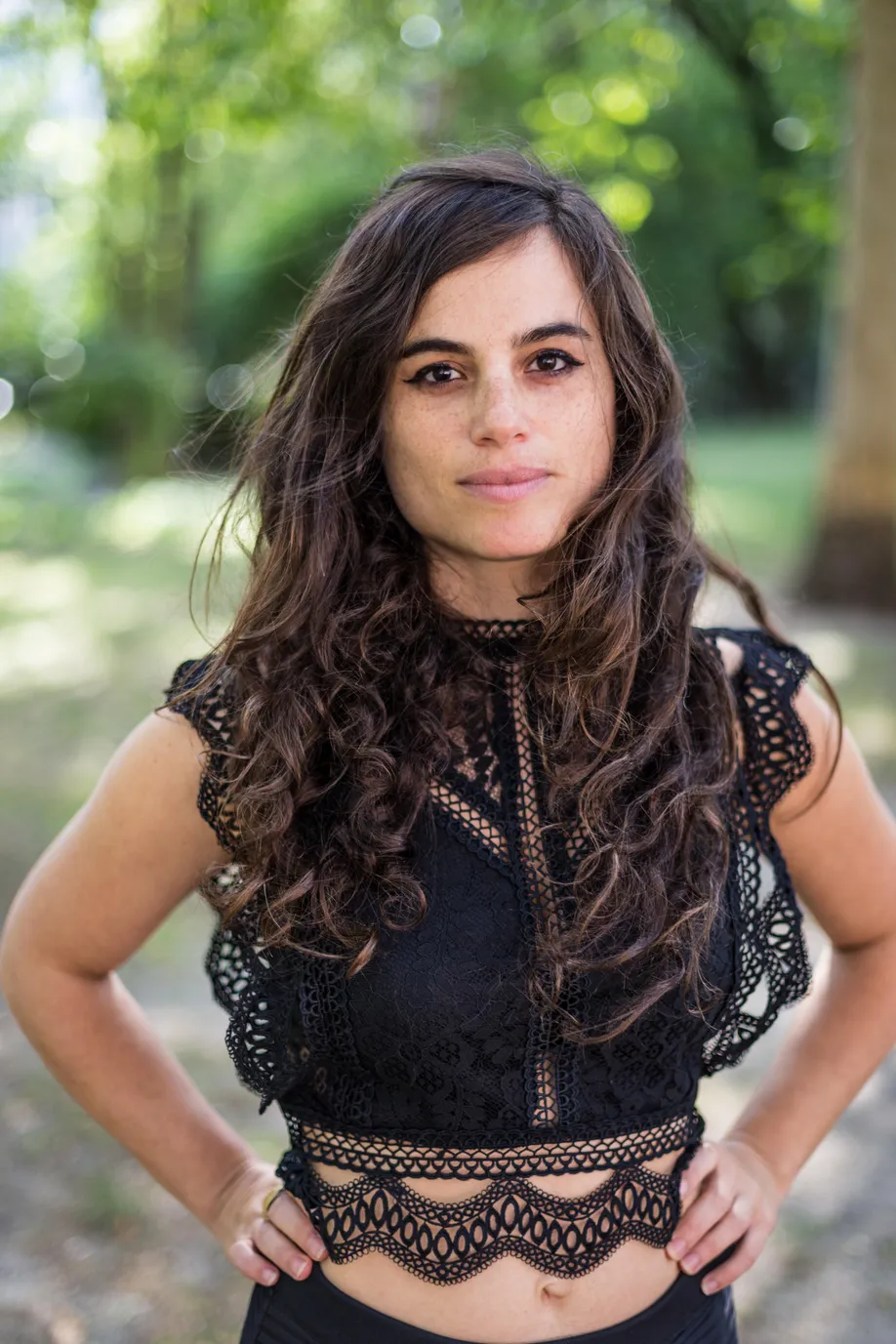
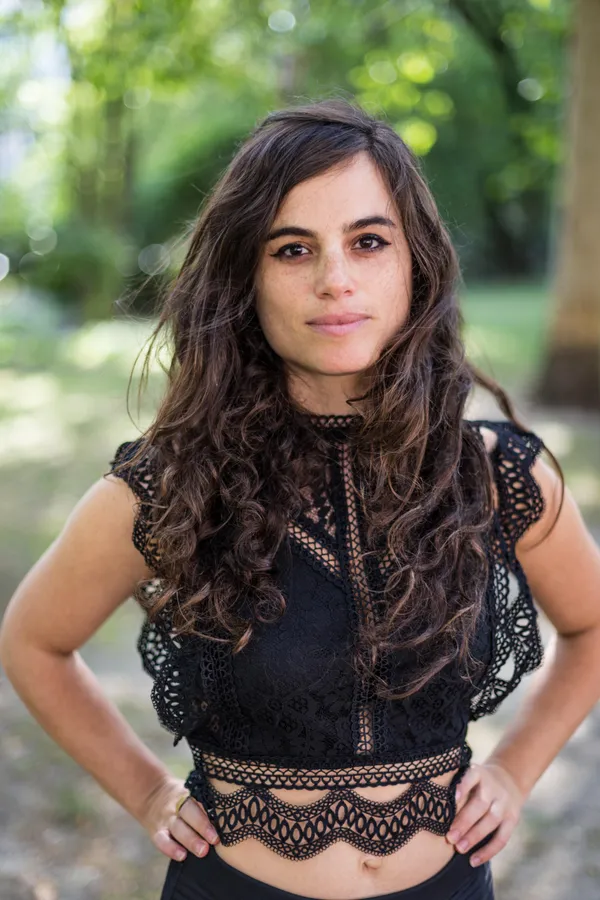
Yael Nachshon Levin. Credit: Yotam Shwartz
In October 2016, just a few months after she and her family moved to Germany, she decided to take advantage of their newly rented spacious apartment. She invited over a friend who is involved in electronic music, another who is a photographer and another 30 guests. They included Israelis whom she knew, German neighbors and friends from her German-language class. “There was something miraculous there,” she recounts six years on. “The combination of people from all over the world and the music. Hosting them and the cooking worked great. Everything came together for me, and I had a feeling that there was a hunger for this.”
Following the success of the initial evening, others followed and the format became a monthly event (for a fee) that includes a concert, art exhibit and good food. Nachshon Levin, who paid the artists from the beginning even when there was barely any money, found a patron to help finance the venture. The venue switched from her private living room to other locations, and a graphic artist friend of hers designed a logo and helped her find a name for the project: Framed, offering an open space for creativity.
“On the one hand, it’s like a house party,” explains Nachshon Levin, who already has 73 events under her belt. “On the other, it’s a high-level combination of music and art. The artists come from all over the world. The setting is intimate, warm and not pretentious. There’s no stage or backstage, and that encourages attentiveness, listening, observation and the ability to connect – which is a rarity. It’s a dreamlike situation for performing; an attempt to create a utopia.” In addition to that venture, she hasn’t neglected her own music. She recently finished recording a second album in Berlin, “Tigers and Hummingbirds,” which includes 10 songs in English and is being released by the Berlin recording label LowSwing Records.
It’s a beautiful album that extends in spirit beyond where it was recorded. It could have been recorded in Tel Aviv, Copenhagen or New York. The melodies are interesting and the arrangements complex. Nachshon Levin’s voice is mature and precise, and hits the right spots. “When you create an album in Germany,” she says, “you don’t need to organize everything alone amid an ongoing feeling of dread and humiliation.” In general, the creative experience she encountered in Berlin was quite different from her experience in Israel.“I only understood that I had suffered in Israel after coming here. Like a child who has something bad happen to him at school but only starts crying when he comes home to Mommy, I understood that the experience of being an artist in Israel involved ongoing insult,” she says.
“The more I put down roots here, the more I receive recognition and enjoy the audience’s curiosity and openness to hear something new – it’s clear to me how abusive the attitude in Israel was. People were always asking: ‘What do you want from me?’ ‘Why should I come?’ ‘How much does it cost?’ It was a relationship of exploiter and exploited. Artists in Israel live with a sense that this is the reality, but it’s an aberration compared to the artist’s role in the world. There’s so much pressure and so little free time. There’s just no room for it in your head.
“Until I came to Berlin, I had no language to explain it,” she adds. “I didn’t know why I was feeling bad. Things were always lacking: money, space, support, as if the essence of art – the generosity – was taken from it.” Of course, not everything is rosy in Berlin. “Clearly, there are less appealing aspects here,” she concedes. “The weather, the cold, the darkness and the fact that German culture is the exact opposite of Israeli culture. There are also people who come here and don’t make it. It’s not always easy, and my choice is full of sadness. The longer I’m here, every trip to Israel is more difficult.”
And there are many trips. Despite the universal nature of her work, Nachshon Levin has her roots and doesn’t forget them. She and her husband and children insist on speaking Hebrew. She visits Israel two to three times a year. She participated in the Israeli elections and takes pride in being Israeli. Is the Israeli audience still important to her? She says that while she would really love to create what she does in Berlin “for the people whom I love in Israel, in the current situation there’s no chance. I also want my voice to be heard in Israel – but at the moment it’s only possible from here.”
In the meantime, she suffices with the community of Israeli expats also in the German capital. “There’s an amazing community here,” she says. “There are friends with whom I’ve connected in a simple and natural manner, people whom I count on. And it’s happening because, despite the fact that there are several different groups of Israelis here, there’s a filter that has brought a certain group of people here who are rather similar. It’s a group with a common language, common disappointments and common discoveries. That’s not something I felt in New York when I lived there,” says Nachshon Levin, who studied music at Manhattan’s New School. “There are cultural refugees here who create a network of Israelis. There will always be someone to provide information, to help, and there are always new waves of emigration. Probably now, after the election, a new wave will come,” she says, referring to the November 1 election that resulted in a far-right government in Israel.
Nachshon Levin is not alone in expecting a new wave of emigration following the rise to power of antidemocratic and illiberal forces in Israel.
If it actually happens, it would just be the latest round of what she calls “cultural refugees” – singers, filmmakers, television producers, poets, writers and those involved in the plastic arts – looking to make Berlin their home. The list of “refugees” is long: curators Dorit Levita-Hertman and Hila Peleg; artists Yael Bartana, Alona Rodeh and Alona Harpaz; musicians Adi Gelbart and Maayan Nidam, and the members of Jealous – Paz Bonfil and Adi Kum. There is also the opera singer and actress Ruth Rosenfeld; director Rivka Ofek; and Avichai Partok, David Elimelech and Roi Perez, who all regularly deejay at Berlin’s Berghain nightclub.
These are just some of the hundreds of Israelis in the arts for whom Berlin is seen as a magnet and home for multidisciplinary cultural activity. What brought them here and did they find what they were looking for? And are they still in a cultural dialogue with Israel? Has Berlin given them opportunities they had trouble finding in Israel? The answer is a complex web of motives and consequences that Haaretz sought to unravel.
‘Feierabend’
Tal Alon, an Israeli journalist who came to Berlin in 2009, cites a German word that sums up an aspect of life in the German capital that is apparently one of the attractions for Israelis seeking a place to engage in the arts: Feierabend. It’s a combination of the words for “celebration” and “evening,” and describes the end of the workday. “It’s the time devoted to leisure, to rest or to family,” she explains – or what many Israelis would simply call quality of life. “After work, when you take leave of colleagues or the cashier at the supermarket, you say ‘Schönen Feierabend,’ and it doesn’t just mean ‘Have a good evening.’ It’s ‘Enjoy the evening celebration,’ from the time when you’ve stopped working and sat down with a glass of wine or beer, and when no one would expect you to respond on WhatsApp.”
The glass of wine is probably a reference to a wider cultural and social phenomenon.
“There’s something about Berlin that makes choices possible. You can choose making money, dining at expensive restaurants and having a glittering lifestyle. But you can also live modestly, buy secondhand, eat simply and subsist. Even following the price increases, rents here are cheaper [than Israel]. Even after inflation, the prices at the supermarket are lower. Kindergartens are subsidized, and it’s not looked down upon to be an artist,” Alon says. “On the contrary. People who create culture and art are respected.”
Tal Alon, Credit: Olaf Kühnemann
Alon, who spoke to Haaretz at a bar in Berlin’s Kreuzberg neighborhood, is a key figure in Berlin’s Israeli community. Three years after her arrival in the city, she founded Spitz – a Hebrew-language independent magazine that is an integral component of the Israeli community upon which it focuses. Particularly in recent years, it has also been a bridge between the community and German society, providing coverage of municipal and national news in Hebrew. In fact, it is the first Hebrew newspaper in Germany since the Holocaust. It initially appeared in print and online. Now it’s entirely online and also has podcasts. Alon describes its development and her own in Berlin as happening simultaneously.
“At first, there was a fascination with the very presence of Israelis in Berlin,” she recounts. “There was a lot of attention to the questions of identity, history and whether an Israeli community would be created here. Twelve or 13 years ago, it wasn’t clear if it would happen or was a passing fad. Later, people became a bit sick of the subject – mainly because of its instrumentalization in the public debate in Israel, which also came here.”
What do you mean?
“Israelis aren’t really interested in the Israelis in Berlin. It’s true that a lot has been written about us, and for a while they spoke about us a lot. But it was simply a tool to advance an agenda. On the one hand, they spoke about traitors, ‘lefty weaklings’ who had thrown up their hands, and this whole schtick, which was combined with slander and fearmongering regarding antisemitism.
“On the other end of the spectrum, we had glorification and romanticization of the good life – how easy and cheap it is there and how good it is for those who had fled [Israel]. Anyone who lives in the real world, certainly anyone who has emigrated, knows that real life isn’t at either end of the spectrum.”
And is this instrumental aspect just Israeli, or does German society also play a role in it?
“With regard to the German side, there’s a theory of ‘reforestation,’” Alon says, referring to the view that after Germany destroyed its Jewish community in the 20th century, it was now replenishing it. “The establishment is rather obsessed with ‘restoring Jewish life’ in Germany, and the expectation from us is to play that role so we give it legitimacy: ‘If the Jews are again living here,’ they say, ‘we must be wonderful. We’ve changed and rehabilitated ourselves.’”
When one adds political discourse to the mix – who is allowed to criticize Israel in Germany and who is not, and Germany’s involvement in the Middle East – the issues become even more complicated. “As a journalist, I understand the fascination,” she says. “But as a person, I’ve grown tired of being a pawn in that theater.”
Weariness over such discourse motivated Alon to seek a new journalistic direction. Shortly afterward, the coronavirus pandemic hit – and provided that new direction.
“COVID-19 created a need to serve as an intermediary for Israelis – particularly those who don’t speak German – about what’s happening here,” she says. “But that was only part of the issue. The coronavirus also cut off a lot of people, including myself, from existing with one foot here and one foot there. I was still involved with what was happening in Israel, but what was local became critical. During lockdowns, reading the Israeli press didn’t help me and others understand what was happening here. And I found myself consuming more German news and wading into what was happening here.
“Spitz took on the role of mediating and translating. At the same time, for example, we also issued a daily edition – a COVID diary in which Israelis living in Berlin shared what was happening to them during the pandemic.” Spitz still occasionally deals with questions of identity, but its focus is on serving as a bridge between German society and Israelis, and all things in Berlin pertaining to Hebrew and Israelis.
There’s a “kulinarische” section on Israeli-owned restaurants; a section featuring cultural events; and a “nostalgia” section featuring online versions of prior print issues that serves as an archive of sorts for the community. Alon also published a blog and, to mark her 10th anniversary in Berlin, launched a fascinating podcast based on conversations with “10 knowledgeable female Israeli Berliners.” In the process, she has become a mainstay of the community. One Berliner even call her Israelis’ mayor of Berlin.
In the first issue of Spitz, you described the community as a community in formation. How do things look 10 years on?
“It’s clear there’s a large group of Israelis who are not here temporarily. They speak Hebrew. They have connections among themselves. They have common fields of interest and they have events in common. But unlike the organized Jewish community, it’s not institutionalized or centralized. The Israelis aren’t interested in anything official, in the formality and the public activity usually associated with it. I’ve documented that and created a situation in which I have a role,” she says.
“Spitz’s right to exist is due to its niche, and I’m a zealot when it comes to this niche: between German and Hebrew; between Berlin and Israelis living here.” Referring to the “.de” address on the Spitz portal, Alon calls it a metaphor for her Hebrew-language website, indicating its hybrid nature.
And does that hybrid nature also express your sense of belonging?
“From the standpoint of language, culture and family, I still have an Israeli [sense of] belonging. But belonging is also about values – and in Berlin, the majority shares my values: seeking equality and taking care of the weaker parts of society and planet Earth aren’t esoteric positions here,” she says.
“When this article appears in Israel, there will be hundreds of [online] comments full of contempt and swearing. In that respect, from a values perspective, this is my home. The group that holds the same opinions as me in Israel is still affected on a daily and immediate basis by what is happening in Israeli politics, but those who live here have managed to keep an esthetic distance from these things. I was shocked by the results of the last election in Israel because there had been nothing like it before. But relative to my past emotional involvement, one can say that I’ve been remote. I’ve been here.”
‘A sense of roots’
Emotional involvement is a topic that recurs with Israelis working in the cultural sphere here. If every trip to Israel becomes more difficult for Nachshon Levin and if Tal Alon has maintained a certain distance, Shani Leiderman has found a way to reconcile the two worlds. She left Israel when she was 21 to study theater and dance in Amsterdam. After eight years in the Netherlands, she moved to Berlin with her German partner, whom she met while studying.
After she had her first child, she began working at Infarm – a startup, founded by Israelis, that is involved in hydroponic urban agriculture. She has also performed as a musician and appeared with her partner, who was part of the creative aspects of the music. Her work at Infarm involved working with food, events and chefs, and that whet her appetite.
“I’ve always been interested in what we’ll eat next,” she says, half-jokingly, “and it was natural that my next step would be to open a place of my own. I left Infarm and met someone who put me in touch with the Gropius Bau museum – one of the most highly regarded for contemporary art in Berlin – and in 2019 I opened my restaurant there, Beba, named after my grandmother.”
Now, at the age of 39, after separating from her partner and meeting a new one – an Israeli who brought a daughter of his own into the family – she’s a full-time restaurateur. And as in the world of music, comparisons between Germany and Israel are in order in the restaurant business too. Leiderman says Israel has been a source of inspiration for her for its high level of service, food and operations. On the other hand, everything is easier in Germany, she says.
Shani Leiderman, Credit: Noam Rosenthal
“The restaurant business is not a simple profession anywhere in the world,” she notes. “There’s a shortage of staff, costs are high, profit margins are low and there’s a very small margin for error. But during the coronavirus, for example, I felt the differences. There was a moment every day when I expressed thanks for being in Germany. I was thankful for the speed at which the government authorities worked. Also, the compensation was a reasonable sum and it arrived quickly and without complications.”
Leiderman actually had the best of both worlds. The German setting was more convenient, but the food was from Israel. “My food is Jewish and is inspired by my grandmother,” she explains. “The place that I cook and create from is a place of family, closeness and home. That’s my inspiration. The dishes, for instance, are plates that remind me of the house I grew up in. “The entire motivation,” she continues, “is to give people a sense of home – and as an immigrant, it’s most natural that I give people a sense of my home, of my places. It gives me a lot. That people are eating the same stuffed peppers that my grandmother made gives me a daily emotional connection. I’m creating a small world here with a sense of roots.”
Leiderman says she and other Israelis in Berlin aren’t cut off from their identity and actually connect with their Israeliness on a daily basis. “A lot of people have left Israel, but they don’t have anything against the language or the culture. I didn’t run away. I miss it. My life’s circumstances brought me here. I came as a result of a girl’s ambition to be a dancer. I stayed because life was pleasant and easy. And the fact that I could continue speaking Hebrew, creating the food that I create and maintaining my friends, makes it much easier. I don’t know if I could have stayed if it had been otherwise.”
Leiderman’s Beba restaurant is just one of several Israeli culinary institutions in Berlin. Just a few bus stops to the east is Goldadelux, which actually opened after other restaurants went bust: It was both during the pandemic and because of it. Goldadelux began in January 2021 as one of a series of pop-up restaurants opened by two Israelis, Yuval Tidhar and Avi Levy. Last year it began operating on a permanent basis, and is an anchor and source of solace – particularly during the winter, when the sun sets at 3 P.M. and the temperatures drop below freezing.
“The pandemic was a period of severe isolation for Israelis living in Berlin and for everyone else. We felt depressed too. We wanted the winter and the coronavirus to end,” says Levy, who arrived in the German capital a year before COVID. “This wasn’t our first pop-up, but when we posted [on social media] that we were coming back with another pop-up where this time the focus would be on our sabich [pita stuffed with grilled eggplant, hard-boiled egg and salad], there was particular enthusiasm,” he adds.
Levy and Tidhar describe the weekends that followed as a rare social encounter at a time when that was precisely what was missing. “All of a sudden, you saw a group of dozens of people, most of them speaking Hebrew, but they also brought their friends – Germans and others,” Levy says. “There were encounters, new connections. People broke the law together and didn’t keep a meter and a half apart. It was consoling and it was exactly what we wanted to do: pamper people, feed them, give them what we like.” The business grew. The sabich became their menu’s flagship dish, which quickly began to be served in paper bags decorated by tattoo artist Barak Radovich – who of course is also Israeli. The circle of customers grew. The local media gave the place enthusiastic reviews and, six months after the pop-up era ended, Goldadelux got a permanent location. “Opening a small place like this was a calculated risk,” Tidhar says. “And it was the result of what we went through during the days of the pandemic. Now people of all kinds are coming here: families with children, young people, as well as people 70 and older.”
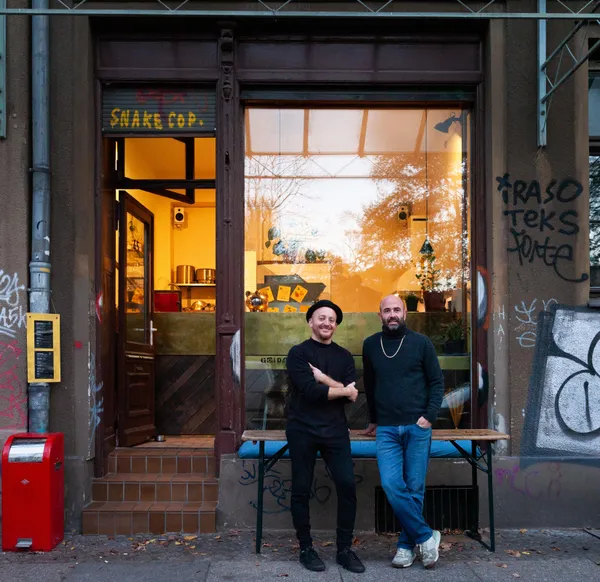
Yuval Tidhar and Avi Levy, Credit: Inbal Lori
Complex identities
The Fraenkelufer synagogue is a three-minute walk from Tidhar and Levy’s sabich place in the Kreuzberg neighborhood. It was built in 1916 and partially destroyed on Kristallnacht in 1938. It was also bombed during World War II. In the 1990s, after the Jewish community in the neighborhood had dwindled, activity at the synagogue waned. But about 10 years ago, as Jews – including young people, secular Jews and Israelis – moved into the neighborhood, something began happening in and around it. New connections were forged between German Jews and Israelis, in part through their work in the arts.
This renaissance is thanks to the efforts of Israeli Dekel Peretz, who grew up in an Orthodox home and whose life in Berlin actually began as a form of getting away from his religious background. After completing his army service, he arrived in the city in 2002, straight from Goa after a trip to the Far East.
Olaf Kühnemann, Dekel Peretz and Rachel Libeskind.Credit: Bella Lieberberg
He married a German woman who converted to Judaism, and they have a child. As part of his wife’s conversion, and because he still wanted to celebrate the Jewish holidays, he started to visit the old synagogue in the neighborhood and became program director for the nonprofit organization that supports it. At first, they organized events for families, Hanukkah celebrations and traditional events that are popular in Israel like the Moroccan-Jewish Mimouna celebration following Passover and Tikkun Shavuot.
But there is now a project in the area that spans the globe. It began in 2016 with celebrations of the synagogue’s centennial, which were organized by Peretz and his wife Nina, who is currently the shul manager. The ties that were established with local politicians led to an initiative to found an adjacent Jewish community center and cultural center. This in turn led, in 2019, to the establishment of a partnership of Jewish social organizations called ERUV, which is headed by Peretz. Another new venture is LABA Berlin, an international project that brings together Jewish artists from Germany and around the world to study Jewish texts for three months, followed by another three months of creating works inspired by their studies. These are then exhibited for a month at the independent CLB Berlin, a gallery also located in Kreuzberg.
“Every year we bring eight artists from all different fields: visual artists, theater artists, writers and musicians,” Peretz says. “The idea is for collaborations to arise that will address the question of Jewish art and also that of the Jewish voice in Germany – a voice that is not confined to issues connected to the Holocaust, antisemitism and the treatment of minorities, but takes in broader social issues as well. Every year, the studies have a different theme. In the last exhibit, which was on the theme of ‘Broken,’ the artists addressed topics like patriarchy, body, gender, disability, family relations and immigration – wider questions that are relevant to German society as a whole but were discussed from a Jewish perspective.”
Last year, half of the participants were Israelis living in Berlin: the writer, poet and translator Tomer Dotan-Dreyfus; painter Roey Victoria Heifetz; performance artist and choreographer Gal Ovadia Naor; and visual artist Ella Ponizovsky Bergelson. However, Peretz says it was not essentially an Israeli experience. He says he and his partners – artistic director Olaf Kühnemann and creative director Rachel Libeskind – are striving to create a meeting place for everyone. “We’re building a Jewish-Berliner center here,” he says. “The Israelis are part of this, but LABA Berlin is first of all a community of artists, and the identities here are more complex than that.”
Which brings us back to your identity. How do you define yourself today?
“I’m a Berliner. I’m building institutions for my daughter and my grandchildren, and for my friends’ children and grandchildren. I’m here to stay.”
And would you say the Israeli community has changed over the course of your time in the city?
“Talk about the ‘Berlin utopia’ was very prevalent a decade ago. There was a lot of talk then about the cost of living and about the escapism of the Israeli left that was fleeing to Berlin. Today, the Israelis here are not a political group, certainly not a homogenous group. A lot has changed in the past 10 years, and it’s a good thing. Jewish Berlin is a more developed place and the Israelis are a heterogenous community composed of people who came here for work, for art, for studies, for anything and everything.
“Even if there is still a ‘Tel Aviv bubble’ in Berlin, it’s only part of the picture – because all types of things are happening in this city. It’s a city of startups; it has a wide variety of cultural offerings; public transportation that functions well; and immigrants from all over the world who together create a cosmopolitan urban life that’s hard to find in Israel.”
A virtual nightclub
Berlin is not Little Tel Aviv, and it certainly doesn’t look like Tel Aviv, particularly in December when a thin layer of snow covers the sidewalks, the subway station entrances and the banks of the Spree River that crosses the city. But in the Neukölln district, the city’s general resemblance to “classical Europe” – with its tidiness and centuries-old architecture – also disappears.
Israelis who came to Berlin 20 years ago or more tried to avoid neighborhoods like this because of their image as hubs for impoverished and hostile Middle Eastern migrants. But that is no longer the case. Kreuzberg and Neukölln are now both known as a home for alternative culture and avant-garde art. And among the first-, second- and third-generation immigrants who still live there, now one also finds many Israelis living and working in an area where Arabic and Turkish are heard just as frequently as German. In this sense, too, this is no Little Tel Aviv. If anything, it is Jaffa.
One such Israeli is DJ and music producer Doron Mastey – better known by his professional moniker, Charly. “It’s not an idyllic utopia,” he says at a Neukölln coffee shop. “There are places where you feel unwanted, but it’s the closest place to Israel you can imagine. I shop at a Palestinian store and there’s a Lebanese shop in the area and Turkish supermarkets too. I feel at home here. I’m basically just a kid from Beit Shemesh who is living here and enjoying life.”
Charly, who comes from a family of Moroccan immigrants and attended boarding school in Jerusalem before serving in the paratroopers, first got into music – especially house and techno – as a kid. After his army service, he met his musical partner, Ori Itshaki, at Tel Aviv’s BPM College for sound and music production, and they forged a successful career together in the city. They also opened nightclubs, worked as DJs, organized parties and founded a pioneering record label.
In 2019, they decided to move to Berlin, which Charly calls the undisputed world capital of electronic music. It is a city where the large number of nightclubs, DJs and music producers creates an atmosphere that attracts young people from around the world who want to be part the club scene. “We were looking for career fulfillment,” he says. “We were frustrated because it was hard to get gigs in Tel Aviv. We had done deejaying gigs in Germany, Poland and Hungary before making the move, but it wasn’t a regular thing. We’re not just DJs. We also produce the music – meaning that we worked all week in the studio and on weekends we deejayed at clubs, so we were more niche than other Israeli DJs who broke the glass ceiling related to Israel. We felt we would be more accessible in Berlin, and it would be good for us.”
But the transition was not easy. Like many young immigrants from around the world, Charly also had to reinvent himself. “No one was waiting for us with flowers at the airport,” he recalls. “In Israel, we were very well known in our scene. Here we had to start from zero. We felt like we were nothing. We rented a rundown little apartment; we slept on mattresses on the floor. There was no living room or dining area. We started out from a dark place, and I felt that salvation was not going to spontaneously present itself. No nightclub was going to suddenly offer us a residence.”
But salvation did arrive, in the form of an Israeli friend who worked in a property management company in Berlin and proposed that they come up with a joint project. In turn, Charly and Itshaki proposed establishing a meeting place for people like them: people new to the city who had yet to integrate and wanted to meet others like them.
The idea was to create a virtual music platform that would enable artists to present an audiovisual taste of what they could do and to introduce them to an audience unfamiliar with their work. The property company’s director liked the idea and offered the use of a space located on the Kreuzberg- Neukölln boundary. He invested the necessary capital and Hör went live in August 2019.
Things were a little rough at first. The two Israelis were not yet well-enough connected to get big names to join their enterprise. But they managed to fill the first two weeks with music and hoped to create that important buzz. “To our surprise, we were able to fill the lineup until the end of the year,” Charly says. “The program exploded. We were in the right place at the right time with the right format. The pandemic period that began a few months into our project gave us an even bigger boost. In our scene, people did not have anything to do when all the clubs were closed. We became everyone’s virtual nightclub.”
Hör now broadcasts on a website, YouTube and Instagram channels that have close to a million users. It is not a purely Israeli project. Although Israeli DJs sometimes appear, Charly and his partners don’t give them special preference. Any affirmative action is devoted to women, the LGBTQ community and to non-whites. “DJs in Berlin have it easier,” he says. “The Israeli scene is a lot more aggressive. There are a small number of clubs and a lot of DJs. You have to really stand out in order to get gigs. And it’s also easier for us in terms of government support. Here it’s a respected profession and the government supports artists. During the pandemic, freelancers in the arts received all kinds of support – including an immediate 5,000-euros grant [$5,370] – without having to show any kind of proof. Health insurance is also 50-percent subsidized, and [there are] pensions for self-employed artists.
“Another thing is that Tel Aviv is squeezing out its cultural institutions. At Alphabet [Charly was one of the club’s founders], we paid 50,000 shekels [$14,400] rent a month for 150 square meters [1,615 square feet]. In Kreuzberg, you pay the equivalent of 8,000 shekels for a commercial space of that size.”
Is the economic side of things what’s keeping you here? Or is Berlin also an inspiration?
“It’s comfortable for me to work here because I need quiet and seclusion in order to create. Here I can earn a living doing what I love and my partner, who is also Israeli, works with me as an art director. I’m still connected to Israel. But anyone who’s here for a long time knows there’s no going back – in terms of the cost of living, and politically too.
“It’s hard to imagine returning to Israel, about working three or four jobs just to get through the month, and living in an environment where violence, hatred, aggressiveness and intolerance are rampant. But whoever says they don’t miss Israel is lying. We all miss it.”
בסוף השבוע שעבר הופיעה במוסף "גלריה שישי" כתבה שבמסגרתה ראיינתי אומנים ויוצרים ישראליים החיים בברלין. הכתבה עוררה תגובות רבות, חלקן זועמות למדי. היו שכעסו על מיטב בניה ובנותיה של החברה הישראלית שנטשו אותה, היו שקראו להם בוגדים וזלזלו בכישרונם, היו שביכו את העדרם מהציבוריות הישראלית והיו שהזדעזעו מכך שבחרו לחיות דווקא בגרמניה, ארצם של משמידי יהדות אירופה. עמדות אלו הן מובנות והן לא נשמעות בפעם הראשונה, ממש כפי שהכתבה עצמה חשפה פיסת מציאות שנחשפה כבר בעבר.
יש, עם זאת, כמה מאפיינים של התפוצה הישראלית בברלין שחורגים באופן מהותי מהאופן שהיה נהוג לתאר אותה עד עתה. למעשה, היא מעניינת דווקא בגלל המיתוסים סביבה שאינם תואמים את המציאות. ראשית, הכתבה ב"גלריה" התמקדה, מטבע הדברים, בישראלים הפעילים בתחומים שהמוסף עוסק בהם – אומנות, עיתונות ומסעדנות. עם זאת, מרבית הישראלים בברלין עוסקים בתחומים אחרים לחלוטין – הם פסיכולוגים ונדל"ניסטיות, קוסמטיקאים והייטקיסטיות, סַפָּרִים וסטודנטיות לפילוסופיה. בתור שכאלו, הם אינם עונים לסטריאוטיפ הקולקטיבי שנבנה סביב דמותם בישראל.
שנית, ההגירה מישראל איננה הגירה על רקע כלכלי בלבד והיא איננה מורכבת מאנשי שמאל קיצוני. יוקר המחיה ודאי משפיע על מי שהחליט להגר לברלין ובמיוחד על פרילנסרים נטולי תלוש משכורת בסוף החודש. אבל זה רק מרכיב אחד, וברלין ממילא התייקרה מאוד בשנים האחרונות. קווי הטיסה הנוחים מתל אביב והנגישות לדרכונים אירופיים לא מזיקים, אבל גם הם רק נתון אחד במכלול. הגירה היא מעשה קשה, היא אינה נעשית בקלות והיא כמעט תמיד תוצאה של מרכיבים רבים ומארג מסובך של סיכויים וסיכונים. הישראלים בברלין, כמו מיליוני מהגרים אחרים בעולם, מנסים לבנות לעצמם חיים טובים יותר, חלקם מצליחים בכך, אבל הם גם משלמים מחירים יקרים, הם עובדים קשה מאוד כדי להתגבר על המפגש עם שפה זרה ותרבות זרה והם נאלצים להשקיע מאמץ רב כדי להמציא את עצמם מחדש.
גם מבחינה פוליטית הדברים אינם פשוטים. איש לא יטען שבברלין ישנו מיקרוקוסמוס מייצג של החברה הישראלית ואכן סביר שחיים בה יותר ישראלים שמאלנים מימנים ויותר חילוניים מדתיים, אבל אסור לתת לזה להטעות – גם אם מדי פעם יש בברלין הפגנה נגד מדיניות ישראל שמשתתפים בה ישראלים לשעבר, התפוצה הישראלית-ברלינאית אינה מורכבת ברובה המוחלט מלוחמי BDS ואקדמאים פוסט-ציוניים, ממש כמו שהיא לא מורכבת מצעירים שעזבו את ישראל בגלל מחירי מוצרי-חלב ממותקים או מישראלים שהיגרו לברלין בגלל השואה. או למרות השואה. או כנקמה לשואה. בעולם האמיתי, זה שמעבר לסמלים ולסיסמאות, מדובר בישראלים מכל הסוגים שמתגעגעים, נאבקים על זהותם ורובם לפחות זקוקים לקשר עם מולדתם, שפתם ושורשיהם.
והקשר הדו-סטרי הזה בין הישראלים בברלין לבין החברה הישראלית הוא אולי הסיפור המרכזי והמקום בו יש לוותר על התגובות הפבלוביות, אלו הקוראות להגירה מהארץ מתוך ייאוש מהמצב הפוליטי, אלו הזועמות על הבגידה ואלו הבזות ל"מהגרים הפריבילגים שמתעלמים מההיסטוריה של עמם". בעבר התייחסה החברה הישראלית בבוז ובאיבה לישראלים שהיגרו למדינה אחרת. הם נקראו "יורדים" – אנשים תלושים שבגדו בציונות מתוך אגואיזם ואסקפיזם. ייתכן שהיום, כשישראל מבוגרת יותר, הגיע הזמן לשקול את הנושא מחדש. במדינות חופשיות, פתוחות וליברליות קשה למצוא היום שיח ביקורתי על אזרחים שעוזבים אותן. אנשי עסקים בריטים שעוברים לארה"ב, אומנים קנדים שעוברים לפריז ורופאי שיניים שוודים שעוברים להולנד אינם "נפולת של נמושות". להיפך, במקרים אלו ברור שיש לכל הצדדים מה להרוויח ממעבר חופשי בין מדינות. רק מדינות כמו בלארוס וצפון קוריאה מגבילות וממשטרות את הכניסה אליהן והיציאה מהן. לא רשימה שמפתה להצטרף אליה.
הישראלים שגרים ויוצרים בברלין ממשיכים לקיים שיח עם ישראל, גם אם הימין הישראלי מתייחס אליהם כבוגדים וחלקים בשמאל כועסים עליהם כי נטשו לכאורה את המאבק (אולי כי בדיוק הם היו הקולות החסרים שמנעו ממרץ לעבור את אחוז החסימה). אלו טענות מובנות, אבל אפשר גם לטעון שמדינה חופשית, פתוחה וליברלית זקוקה לתפוצה אקטיבית מחוץ לגבולותיה כדי להישאר בדיוק כזו – חופשית, פתוחה וליברלית. כלומר, התנועה פנימה והחוצה, בין אם היא בדמות חוקרים באקדמיה, הייטקיסטים ברילוקיישן או אומנים המקיימים דיאלוג בין-תרבותי, היא הכרחית לקיומה של חברה טובה יותר. נכון, מעמד ה"ניידים" אינו התשובה לרוב בעיותיה של ישראל והוא בוודאי אינו חף מבעיות, אך הישראלים בברלין, ובמדינות אחרות בעולם, יכולים להוות חלק מהמאמץ למניעת הפיכתה של ישראל למדינה קנאית, סגורה ומנותקת. התגובות לכתבה עליהם ב"גלריה" הראו שיש מי שמונעים משנאה, זלזול וקנאה ויש המודאגים מבריחת מוחות, איבוד זהות ושיקולים דמוגרפיים. כל זה מובן לגמרי, אך למי שמודאג מדמותה העתידית של מדינת ישראל, אפשר לראות את התפוצה הישראלית-ברלינאית, לא כנטל או ככישלון אלא להיפך, כגשר לעולם. במובן הזה היא כבר איננה חלק מהבעיה, היא חלק מהפתרון.
הם עוסקים במוזיקה, עיתונות, קולינריה ועיתונות וכולם עזבו את הארץ לטובת ברלין. בשיחות שנערכו בדצמבר 2022 הם מספרים מה מצאו בברלין ומה מצפה למהגרי העתיד, אם יהיו כאלו.
כשיעל נחשון-לוין הגיעה לברלין ב-2016 היא בכלל לא חשבה שתישאר בה. בשלב הזה בחייה היא כבר היתה מבוססת למדי כמוסיקאית ישראלית. בין השאר, היא הקליטה שלושה אלבומים, הופיעה עם יוני רכטר ולימדה פיתוח קול. אבל אז היא חלתה בסרטן. המחלה שקטעה את הקריירה המוסיקלית, בעלה, המשורר והבמאי אהרון לוין, שתמיד רצה להסתובב בעולם והאפשרויות שמעניקה האזרחות הגרמנית שהיתה לו ולשני הילדים של הזוג, הכריעו את הכף. "האמת היא שלא הייתי בעניין של מעבר לברלין, אבל לא רציתי להיות זו שאומרת לא", היא מספרת בראיון בבית-קפה כמה רחובות צפונה מאלכסנדרפלאץ, "אמרתי, יאללה, נעשה את זה לשנתיים".
השנתיים הסתיימו מזמן ויעל נחשון-לוין ומשפחתה עדיין בברלין ללא כוונה לעזוב בעתיד הנראה לעין. אחת הסיבות לכך שהיא מרגישה נוח בביתה החדש הוא המפעל התרבותי שהקימה ושמשלב רבים מהדברים שהיא אוהבת – מוסיקה, אומנות ואוכל טוב. באוקטובר 2016, חודשים ספורים בלבד אחרי המעבר, היא החליטה לנצל את דירתה השכורה, המרווחת והמזמינה והזמינה חבר שעסק במוסיקה אלקטרונית, חברה צלמת ועוד כשלושים אורחים, ביניהם ישראלים שהכירה, שכנים גרמנים וחברים ללימודי הגרמנית. "היה שם משהו ניסי", היא מספרת שש שנים מאוחר יותר, "השילוב של אנשים מכל העולם עם המוסיקה, האירוח והבישולים עבד מצוין. הכל התחבר לי והרגשתי שיש צמא לזה". לאחר הצלחת הערב הראשון, הגיעו נוספים והמתכונת התקבעה – אירוע חודשי הכולל קונצרט, תערוכת אומנות ואוכל טעים. נחשון-לוין מצאה פטרון שיסייע במימון, הסלון הפרטי התחלף במיקומים אחרים וחֲבֵרָה, מעצבת גראפית, יצרה לוגו ועזרה למצוא את השם: Framed – מסגרת היוצרת מקום חופשי ופתוח ליצירה.
"מצד אחד, זה כמו מסיבת בית", אומרת נחשון-לוין שמאחוריה כבר 73 אירועים, "מצד שני, זה שילוב ברמה גבוהה בין מוסיקה ואומנות. האומנים מגיעים מכל העולם, הרקע הוא אינטימי, מזמין ולא מתיימר מה שיוצר הקשבה, האזנה, צפייה ויכולת להתחבר שהם נדירים. זה מצב חלומי להופעה". היא מוסיפה שבערבי Framed אין במה ואין אחורי במה, כך שיש קשר קרוב בין האומנים לקהל. היא גובה תשלום מהמשתתפים כי "צריך לשלם בעבור תרבות" והיא שילמה לאומנים כבר מתחילת הדרך, גם כשבקושי היה כסף. נחשון-לוין מתארת את המפגש האנושי, תהליך היצירה ומערכת היחסים בין היוצרים לקהל ב-Framed כ-"ניסיון ליצור אוטופיה" וזהו ניסיון שנוצר על רקע ברור של דיס-אוטופיה ישראלית – הניסיון שלה כמוסיקאית בישראל.
"הבנתי שסבלתי בארץ רק כשהגעתי לכאן, כמו שילד שקורה לו משהו רע בבית-הספר מתחיל לבכות רק כשהוא מגיע הביתה לאמא", היא אומרת, "הבנתי שהחוויה של להיות אומן בארץ היא חוויה של התעללות. ככל שאני מעמיקה שורשים כאן, ככל שאני זוכה להכרה ונהנית מהסקרנות של הקהל ומהפתיחות שלו לשמוע משהו חדש, ברור לי עד כמה היחס בארץ היה מתעלל. כל הזמן שאלו "מה את רוצה ממני?", "למה שאני אבוא"?, "כמה זה עולה"? זו היתה מערכת יחסים של מנצל ומנוצל. אומנים בישראל חיים בתחושה שזו המציאות, אבל זה שיבוש של תפקידו של האומן בעולם. בפסטיבלים ישראליים יש את אותו הליינאפ כבר שלושים שנה. אין פתיחות לדברים חדשים ואפשר גם להבין למה. יש כל כך הרבה לחץ וכל כך מעט זמן פנוי. אין לזה מקום בראש. עד שהגעתי לברלין לא היתה לי את השפה להסביר את זה, לא ידעתי למה אני מרגישה רע. תמיד היה מחסור, בכסף, במקום, בתמיכה. כאילו שנלקחה המהות של האומנות – הנדיבות". נחשון-לוין מדברת על חייה כמוסיקאית בארץ כחיים קשים כלכלית ולא פחות קשים מבחינת היכולת "להביע את הקול" שלה. היא אומרת שבגרמניה, היא מוצאת כבוד לאומנים ומספרת שכשהתראיינה לעיתונאי גרמני הוא הקדיש לה וליצירתה שעות רבות של שיחה ותחקיר. לעומתו, עיתונאים ישראלים חיפשו רק קיצורי דרך וחומרים צהובים. וזו לא רק התקשורת, כשמשיקים אלבום בגרמניה, היא מספרת מתוך ניסיון, "לא צריך לארגן הכל לבד מתוך תחושה של סיוט ועלבון מתמשכים, ובכל זאת, מגיעים מאות אנשים, לא רק דודות שעושות טובה".
האלבום האחרון שיעל נחשון-לוין הקליטה, Tigers and Hummingbirds (בלייבל הברלינאי Low Swing Records), כולל עשרה שירים באנגלית. זהו אלבום יפיפה שחורג ברוחו מהמקום בו הוקלט. הוא יכול היה להיות מוקלט בתל-אביב, קופנהגן או ניו-יורק. הלחנים מעניינים, העיבודים מורכבים והקול של נחשון-לוין בשל, מדויק ונוגע במקומות הנכונים. אבל למרות האוניברסליות של היצירה שלה, יש לנחשון-לוין גם שורשים. והיא לא שוכחת אותם. היא, בעלה והילדים מקפידים לדבר עברית, היא בארץ לפחות פעמיים או שלוש בשנה, היא טסה להצביע בבחירות ויש בה גאווה ישראלית אמיתית. ביומיום שלה, לעומת זאת, היא מסתפקת בינתיים בתפוצה הישראלית-ברלינאית. "יש פה קהילה מדהימה", היא מספרת, "יש חברים שהתחברתי אליהם בצורה פשוטה וטבעית, אנשים שאני סומכת עליהם וזה קורה כי למרות שיש כאן כמה קבוצות שונות של ישראלים, יש מסננת שהביאה לכאן קבוצה מסוימת של אנשים די דומים. זו קבוצה שיש לה שפה משותפת, אכזבות משותפות וגילויים משותפים. זה לא משהו שהרגשתי בניו-יורק כשחייתי שם (נחשון-לוין חיה בניו-יורק כשלמדה מוסיקה ב-New School University בין 2001 ל-2004, ד.ס). יש כאן פליטי תרבות שיוצרים רשת של ישראלים. תמיד יהיה מי שיעביר מידע, תמיד יהיה מי שיעזור ותמיד יש גלי הגירה חדשים. בטח גם עכשיו, אחרי הבחירות, יגיע גל חדש".
ובכל זאת, לא הכל וורוד בברלין. "ברור שיש גם צדדים פחות טובים", היא אומרת, "מזג האוויר, הקור, החושך והעובדה שהתרבות הגרמנית היא 180 מעלות מהתרבות הישראלית. יש את אלו שמגיעים ולא שורדים. זה לא תמיד קל. גם הבחירה שלי מלאה בעצב, ככל שאני כאן יותר זמן, כל נסיעה לארץ קשה יותר". כשהיא נשאלת אם היא עדיין רואה בעצמה יוצרת ישראלית, אם הקהל הישראלי עדיין חשוב לה היא אומרת שהיתה רוצה מאוד לייצר את מה שהיא עושה בברלין גם בעבור האנשים שהיא אוהבת בישראל, אבל היא מודעת לכך שבמצב הנוכחי אין סיכוי להתקרב לזה. "אני נשארת למרות שאני רוצה שהקול שלי יישמע גם בארץ", היא מסכמת, "אבל כרגע זה אפשרי רק מפה".
יעל נחשון-לוין (במרכז) וחברי FRAMED בברלין. צילום: Katha Mau
גברתי ראש-העיר
ישנם לא מעט הסברים להגירת ישראלים העוסקים ביצירה מסוגים שונים דווקא לברלין. יוקר המחייה הוא אולי אחד מהם, אם כי ברלין התייקרה בשנים האחרונות. גם קווי הטיסה הזולים מת"א והנגישות של ישראלים רבים לדרכונים אירופאים, לא מזיקים. אך זה לא כל הסיפור. רבים מהישראלים בעיר מדברים על "איכות חיים" וטל אלון, עיתונאית ישראלית שהגיעה לברלין ב-2009, מספקת שיעור גרמנית קצר שנותן למונח המופשט הזה ביטוי מוחשי. "המילה הגרמנית – פָיֶרְאֲבֶּנְד (Feierabend), היא הלחם של המילים "חגיגה" ו"ערב". זוהי המילה שמתארת את סוף יום העבודה. את הזמן שמוקדש לפנאי, למנוחה או למשפחה. אחרי העבודה, כשנפרדים מהקולגות או מהקופאית בסופר, אומרים Schönen Feierabend!, זה לא סתם "ערב טוב", זה "תהנו מחגיגת הערב", הזמן שהפסקתם לעבוד והתיישבתם עם כוס יין או בירה ואף אחד לא מצפה לתשובה בווטסאפ". המרכיב הזה של החיים בברלין הוא כנראה אחד מכוחות המשיכה לישראלים המחפשים מקום ליצור בו. "יש משהו בברלין שמאפשר בחירה", אלון מסבירה, "אפשר לבחור במרוץ, להרוויח כסף, לאכול במסעדות יקרות ולחיות חיים נוצצים. אבל אפשר גם לחיות בצניעות, לקנות יד-שנייה, לאכול פשוט ולהתקיים. גם אחרי עליות המחירים, השכירות זולה יותר כאן, הגנים מסובסדים והסופר, גם אחרי האינפלציה, זול יותר. וזה לא דבר בזוי להיות אומן. להיפך, יש כבוד לאנשים שעושים תרבות ואומנות".
אלון היא דמות מפתח בקהילה הישראלית-ברלינאית. שלוש שנים אחרי שהגיעה לעיר, היא ייסדה את "שפיץ", מגזין עצמאי שעוסק בקהילה ומהווה חלק אינטגרלי ממנה. בנוסף, הוא בונה גשר בין הקהילה לבין החברה הגרמנית בכך שהוא מסקר חדשות מוניציפליות ולאומיות בעברית. למעשה, זהו העיתון העברי הראשון בגרמניה מאז השואה. בשנים הראשונות התפרסם "שפיץ" בדפוס ובאינטרנט, כיום הוא מגזין דיגיטלי שכולל גם פודקסט ואלון מתארת את ההתפתחות שלו ושלה בעיר כקווים מקבילים. "בהתחלה היתה היקסמות מעצם הנוכחות של הישראלים בברלין", היא מסבירה, "היה המון עיסוק בשאלות של זהות, בהיסטוריה ובשאלה האם תיווצר כאן קהילה ישראלית. לפני 12 או 13 שנים לא היה ברור אם זה יקרה או שזה טרנד שיחלוף. בהמשך הנושא הזה נמאס קצת, בעיקר בגלל האינסטרומנטליזציה שלו בדיון הציבורי בישראל שהגיעה גם לכאן".
"הישראלים בברלין לא באמת מעניינים את הישראלים", מסבירה אלון את כוונתה, "זה נכון שנכתב עלינו המון ודיברו עלינו המון בתקופות מסוימות, אבל זה היה פשוט כלי לקידום סדר-יום. מצד אחד דיברו על בוגדים, נפולת של נמושות שהרימו ידיים וכל הרפרטואר הזה שהשתלב בהשמצות והפחדות מאנטישמיות. בצד השני של הסקאלה, היתה גלוריפיקציה ורומנטיזציה של החיים הטובים – כמה קל שם, כמה זול שם וכמה טוב לכם שברחתם. מי שחי את החיים, בוודאי מי שהיגר, יודע שהחיים האמיתיים הם לא באף קצה של הסקאלה". המבט האינסטרומנטלי על הקבוצה המוגבלת למדי של הישראלים בברלין, בסביבות עשרת אלפים איש בסה"כ, לא מוגבל למבט הישראלי. גם החברה הגרמנית משתתפת בחגיגה. אלון מסבירה: "לגבי הצד הגרמני, יש את התזה על הייעור מחדש (ההשקפה שאחרי שגרמניה עקרה במאה הקודמת את היהודים מתוכה, היא כעת נוטעת אותם מחדש, ד.ס). הממסד הגרמני די אובססיבי לגבי "השבת החיים היהודיים" בגרמניה והציפייה מאיתנו היא לגלם את התפקיד הזה כדי שנעניק לגיטימיזציה. אם היהודים שוב גרים כאן, הם אומרים, אנחנו נהדרים, השתנינו, השתקמנו". כשמוסיפים לסיפורים האלו גם את השיח הפוליטי, למי מותר ואסור לבקר את ישראל בגרמניה וכיצד גרמניה מעורבת במזה"ת, העניינים מסתבכים עוד יותר. "כעיתונאית אני מבינה את זה", אומרת אלון, "אבל כאדם עייפתי מלהיות פיונית בתיאטרון הזה".
העייפות מהשיח מהסוג הזה גרם לטל אלון לחפש כיוון חדש ליצירה העיתונאית שלה. ואכן, אחרי תקופת מעבר קצרה הגיעה הקורונה והביאה איתה בדיוק את זה. "הקורונה יצרה צורך לתווך לישראלים, בעיקר לכאלו שלא מדברים גרמנית, מה קורה כאן. אבל זה היה רק חלק מהעניין, הקורונה קטעה להרבה אנשים, וגם לי, את הקיום של רגל פה ורגל שם. עדיין הייתי מעורבת במה שקורה בארץ, אבל הלוקאלי נהיה קריטי. בתקופת הסגרים, קריאה של עיתונות ישראלית לא עזרה לי ולאחרים להבין מה קורה כאן ומצאתי את עצמי צורכת יותר חדשות גרמניות וצוללת למה שקורה פה. "שפיץ" קיבל תפקיד של תיווך ותרגום ובמקביל הוצאנו, למשל, גם מדור יומי, יומן קורונה שבו כל יום ישראלי או ישראלית שחיים בברלין שיתפו במה שקורה להם בזמן המגפה. זה היה הצייטגייסט".
כיום "שפיץ" עוסק עדיין מדי פעם בשאלות של זהות, אך הוא מתמקד בתיווך החברה הגרמנית לישראלים ובכל הקשור לעברית ולישראל בברלין – מסעדות בבעלות ישראלית מופיעות במדור "קולינריש", אירועי תרבות במדור האירועים וגיליונות הדפוס הישנים, שהם מעין ארכיון של הקהילה, מופיעים במדור "נוסטלגיש". אלון גם פרסמה בלוג (ברלינרית) ולרגל עשור להגעתה לברלין הפיקה פודקאסט מרתק המבוסס על שיחות עם "עשר ברלינריות יודעות דבר". כך היא הפכה לעמוד תווך מרכזי בקהילה. יש אפילו מי שקראה לה "ראש-העיר של הישראלים". את הקהילה עצמה היא עדיין מתארת כקהילה בהתהוות, גם עשור אחרי שכונתה כך בגיליון הראשון של שפיץ. "ברור שיש קבוצה גדולה של ישראלים שהם לא זמניים כאן", היא אומרת, "הם דוברי עברית, יש ביניהם קשרים, יש תחומי עניין משותפים ויש אירועים משותפים. אבל, בניגוד לקהילה היהודית המאורגנת, זו קהילה לא ממוסדת ולא ממורכזת. הישראלים לא מעוניינים בדבר הרשמי, בפורמאליות ובעסקנות שבד"כ מגיעה עם זה. אני באתי לתעד את זה ונוצר מצב שיש לי תפקיד. זכות הקיום של "שפיץ" הוא הנישה שלו ואני קנאית לנישה – בין גרמנית לעברית, בין ברלין לישראלים שחיים בה. הסיומות .de לאתר של תוכן בעברית היא מטאפורה מצוינת להיברידיות שלו".
בסיכום השיחה עם אלון, שמתקיימת בבר בקרויצברג, אי אפשר להתחמק מההבנה שההיברידיות הזו מתבטאת גם בהשקפה פוליטית. היא אמנם ישראלית אבל כמו רבים מהקוראים שלה, עמדותיה הפכו לעמדות מיעוט בישראל, והן מותאמות יותר לביתה החדש. "מבחינת שפה, תרבות ומשפחה, יש לי עדיין שייכות ישראלית. אבל שייכות נוצרת גם סביב ערכים ובברלין אני חולקת את הערכים שלי עם הרוב", היא אומרת, "השאיפה לשוויון, הדאגה לחלש והדאגה לכדוה"א היא לא עמדה אזוטרית כאן. כשהכתבה הזו תתפרסם בישראל יהיו לה מאות תגובות של נאצות וגידופים. במובן הזה, הערכי, כאן אני בבית. הקבוצה שחושבת כמוני בארץ עדיין מושפעת ממה שקורה בפוליטיקה הישראלית, אבל אלו שחיים כאן הצליחו לתפוס מרחק אסטטי מהדברים. הזדעזעתי מתוצאות הבחירות האחרונות בישראל כי עוד לא היה דבר כזה, אבל יחסית למעורבות הרגשית שלי בעבר, אפשר לומר שנשארתי מרוחקת. הייתי כאן".
טל אלון, צילום: אולף קונמן
הסביח בקצה במנהרה
כמו טל אלון, גם שני ליידרמן לא חדשה בעיר. היא עזבה את הארץ בגיל 21 כדי ללמוד תיאטרון ומחול באמסטרדם. אחרי שמונה שנים בהולנד היא עברה לברלין יחד עם בן-זוגה הגרמני אותו הכירה במהלך לימודיה. אחרי שילדה את בנה הראשון היא הצטרפה לצוות של Infarm, סטרטאפ שהוקם על ידי יזמים ישראלים והפך מאז לחברה מצליחה בתחום החקלאות העירונית המקוּרה. במקביל עשתה ליידרמן מוסיקה, היא הקליטה והופיעה עם בן-הזוג שהיה גם שותף ליצירה. העבודה ב-Infarm היתה כרוכה בעיסוק במזון, אירועים וקשר עם שפים ועם האוכל בא התיאבון. "מה שעניין אותי תמיד היה מה נאכל", היא אומרת חצי בצחוק, "והיה טבעי שהצעד הבא שלי יהיה לפתוח מקום משלי. עזבתי את Infarm, הכרתי מישהי שחיברה ביני לבין מוזיאון מרטין גרופיוס באו, אחד המוזיאונים הכי נחשבים לאומנות עכשווית בברלין, וב-2019 פתחתי שם את המסעדה שלי, בֶּבָּהּ על שם סבתא שלי". כיום, בגיל 39, אחרי שנפרדה מבן-זוגה הקודם ואחרי שהכירה בן-זוג חדש, ישראלי שצירף לתא המשפחתי גם ילדה משלו, היא מסעדנית במשרה מלאה. כמו בעולם המוסיקה, גם בעולם המסעדנות ההשוואה בין גרמניה לישראל מתבקשת. מצד אחד, ליידרמן אומרת שישראל היא מקור השראה בעבורה בגלל הרמה הגבוהה של השירות, האוכל והתפעול במסעדות הישראליות. מצד שני, ממש כמו בעולם המוסיקה, בגרמניה הכל קל יותר.
שני ליידרמן, צילום: נועם רוזנטל
"מסעדנות היא מקצוע לא פשוט בכל מקום בעולם", היא אומרת, "יש חוסר בכוח-אדם, העלויות גבוהות, שולי הרווח נמוכים ויש מרווח צר מאוד לטעויות. אבל בתקופת הקורונה, למשל, הרגשתי את ההבדלים. זה היה רגע שאמרתי כל יום תודה על זה שאני נמצאת בגרמניה. הודיתי על התפקוד המהיר של הרשויות, הפיצויים היו בסכומים הגיוניים והם הגיעו מהר ובלי סיבוכים". כך נהנתה ליידרמן מכל העולמות – מצד אחד, הסביבה הגרמנית נוחה יותר. מצד שני, האוכל בא מהבית. "האוכל שלי הוא יהודי ובהשראת סבתא שלי", היא מספרת, "המקום שממנו אני מבשלת ויוצרת הוא מקום של משפחה, של קרבה ושל בית. זו ההשראה שלי. הצלחות, למשל, הן צלחות שמזכירות לי את הבית שגדלתי בו. כל המוטיבציה היא לתת לאנשים תחושה של בית ובתור מהגרת, זה הכי טבעי שאתן לאנשים תחושה של הבית שלי, של המקומות שלי. וזה נותן לי המון. היכולת לעבור כל יום ליד הדלפק שלי ולראות את הבורקיטוס שסבתא שלי היתה עושה ולראות אנשים אוכלים את הפלפל הממולא שלה, עושה לי חיבור רגשי יומיומי. אני יוצרת כאן עולם קטן עם תחושה של בית ושורשים". ליידרמן אומרת שהיא וישראלים אחרים בברלין, לא רק שאינם מתנתקים מהזהות שלהם, הם יוצרים חיבור לישראליות שלהם באופן יומיומי, "הרבה אנשים עזבו את ישראל, אבל אין להם שום דבר נגד השפה והתרבות. לא ברחנו. יש געגוע. הנסיבות של החיים הביאו אותי לפה. הגעתי בגלל אמביציה של ילדה להיות רקדנית, נשארתי בגלל שהחיים הם נעימים ונוחים והעובדה שאני יכולה להמשיך לדבר עברית, ליצור את האוכל שאני יוצרת ולשמור את החברים שלי מאוד מקלה. לא יודעת אם הייתי יכולה להישאר כאן אם זה היה אחרת".
המסעדה של ליידרמן היא רק אחת ממוסדות הקולינריה הישראליים בברלין. במרחק כמה תחנות אוטובוס מזרחה נמצאת גולדה דלוקס שנולדה דווקא כשמסעדות אחרות קרסו, בימי הקורונה. למעשה, אפשר לומר שהיא נולדה בזכות ימי הקורונה. שני הישראלים שהקימו אותה, יובל תדהר ואבי לוי, הוציאו אותה לדרך עוד לפני שזכתה למקום קבע כסדרת מסעדות פופ-אפ. לוי, שהגיע לברלין לפני ארבע שנים, נזכר בינואר 2021, התקופה אותה הוא מתאר כזמן הסגר הקשה ביותר. "אלו היו ימים של בדידות קשה לישראלים שחיים בברלין וגם לכל השאר. גם אנחנו הרגשנו את הדיכאון, רצינו לגמור כבר עם החורף ועם הקורונה", הוא אומר, "כשהוצאנו את הפוסט שסיפר שאנחנו חוזרים עם עוד פופ-אפ ושהפוקוס יהיה על הסביח שלנו היתה התלהבות. זה היה הסביח שבקצה המנהרה". את מה שקרה בסופי השבוע הבאים מתארים יובל ואבי כמפגש חברתי נדיר בימים שבהם זה היה בדיוק מה שחסר. "אנשים יצאו מהבית", הם מספרים, "פתאום ראית גוש של עשרות בני-אדם, רובם מדברים עברית, אבל הם הביאו גם את החברים שלהם, גרמנים ואחרים. היו מפגשים, חיבורים חדשים, אנשים שברו יחד את החוקים ולא שמרו על מרחק של מטר וחצי. זה ייצר נחמה וזה בדיוק מה שרצינו לעשות – לפנק, להאכיל אנשים, להביא להם את מה שאנחנו אוהבים".
העסק צמח והתפתח. מנת הסביח הפכה למנת הדגל, במרץ המנות החלו להיעטף בשקיות נייר מעוטרות על-ידי אומן קעקועים, ברק רדוביץ', גם הוא ישראלי כמובן. מעגל הלקוחות התרחב, ביקורות נלהבות התפרסמו בעיתונות המקומית וחצי שנה אחרי סוף ימי הפופ-אפ, המסעדה קיבלה מקום קבוע. "היה לנו פשוט יותר לפתוח מקום קטן עם משלוחים", מספר תדהר, "זה היה סיכון מחושב והוא נולד כתוצאה ממה שעבר עלינו בימי הקורונה. היום מגיעים לכאן אנשים מכל הסוגים. משפחות עם ילדים, צעירים וגם בני שבעים פלוס". עושה רושם שגולדה דלוקס הפכה לאחד העוגנים של התפוצה הישראלית בברלין. לא מעט מחבריה משבחים אותה וסופרלטיבים רבים נשמעים על הסביח המפורסם. ואכן, האווירה במקום נעימה, השיחה קולחת בעברית, אנגלית וגרמנית והסביח הוא מהטובים שיש. גם הכנאפה המוגשת לקינוח משובחת ולא קונבנציונאלית. אפשר להבין בדיוק מדוע ישראלים שמוצאים את עצמם בעיר בתקופה שבה השמש שוקעת בשלוש אחר-הצהריים והטמפרטורות יורדות מתחת לאפס יכולים למצוא כאן נחמה.
אבי לוי ויובל תדהר,
הזווית היהודית
מרחק שלוש דקות הליכה מהסביח של יובל ואבי עומד בית-כנסת. בעבר נכתב רבות על היחסים בין הקהילה היהודית לישראלים החדשים בעיר. מסיבות רבות, החיבור בין שתי הקבוצות איננו טבעי ובאופן כללי הן חיות את חייהן בנפרד. עם זאת, בשנים האחרונות החלו להיווצר חיבורים חדשים, חלקם קשורים קשר עמוק ליצירה אומנותית ותרבותית. אחד החיבורים המעניינים ביותר מתרחשים בבית-הכנסת פרנקלאופר בקרויצברג, מבנה שהוקם ב-1916 ושבחלקו נהרס בליל-הבדולח ובהפגזות במלה"ע השנייה. החל משנות התשעים הקהילה הצטמצמה והפעילות בבית-הכנסת דעכה, אבל לפני כעשר שנים החל להיווצר במקום משהו חדש. יהודים שהיגרו לשכונה, ביניהם ישראלים, צעירים וחילונים רבים, החלו להגיע לבית-הכנסת ולקיים בו פעילויות שונות. אלו לא היו רק התפילות המסורתיות, אלא כל דבר מתהליכי למידה בנושאים שונים, דרך אירועים למשפחות ועד חגיגות מימונה, מסיבות חנוכה ותיקוני ליל-שבועות. על הרנסנאס הזה אחראי בעיקר אדם אחד, דקל פרץ שמו, ואם טל אלון היא ראש-העיר של הישראלים, אפשר בהחלט לומר שפרץ, יחד עם אשתו, נינה, המשמשת היום כגבאית, הוא הרב הראשי.
הוא הגיע לברלין ב-2002 במסגרת טיול אחרי צבא. ישירות מגואה. הוא היסטוריון במקצועו, נשוי לגרמניה שהתגיירה ואב לילדה. פרץ גדל בבית אורתודוכסי והחיים בברלין התחילו כדרך להתרחק מהרקע שלו אבל מכיוון שהיה לו חשוב לחגוג את החגים וכחלק מתהליך הגיור של רעייתו, נוצר חיבור עם בית-הכנסת הוותיק בשכונת מגוריו, חיבור שהוביל ליצירתה של הקהילה החדשה. אך בית-הכנסת היה רק ההתחלה. אחרי שנוצר קשר עם פוליטיקאים מקומיים סביב חגיגות מאה שנה לבית-הכנסת החלה להירקם תוכנית להקמת מרכז קהילתי ומרכז תרבות יהודי סמוך לבית-הכנסת. "זה מקום שיכול לשרת יוזמות חברתיות של יהודים מכל מיני מקומות וכל מיני גוונים, מקום שהם יכולים לבוא אליו ולהפוך אותו לשלהם", פרץ אומר ומספר כיצד הוקמה ב-2019 "עֵרוּב", שותפות של ארגונים חברתיים יהודיים שונים שמשתמשים בחלל co-working סמוך לבית-הכנסת. אחת היוזמות החשובות שנולדה ב"ערוב" היא LABA Berlin – יוזמה בינלאומית שמביאה אומנים יהודים ללמוד יחד טקסטים יהודיים. כל שנה נבחר נושא, ובסוף הלמידה האומנים יוצרים יצירות בהשראת הטקסטים שלמדו. "אנחנו מביאים אומנים מכל מיני סוגים – אומנים וויזואליים, אומני במה, סופרים ומוסיקאים", פרץ מספר, "הרעיון הוא שייווצרו שיתופי פעולה שיעסקו בשאלה של אומנות יהודית וגם בשאלה של הקול היהודי בגרמניה, קול שלא מצטמצם לנושאים שקשורים לזיכרון השואה, ליחסי מיעוטים ולאנטישמיות, אלא מתרחב לנושאים חברתיים רחבים יותר. בתערוכה האחרונה, למשל, שהייתה סביב הנושא "שבר", האומנים והאומניות עסקו בנושאים כמו פטריארכיה, הגוף, מגדר, נכות, יחסים בתוך המשפחה והגירה, אלו שאלות כלליות שרלוונטיות לחברה הגרמנית הכללית והן נידונו מתוך פרספקטיבה יהודית".
פרץ מספר שבערך מחצית מהאומנים שמשתתפים בפרויקט הם ישראלים, האחרים הם מקומיים, קנדים, ברזילאים, אמריקאים ועוד. יחד עם שותפיו אולף קונמן, המנהל האומנותי ורייצ'ל ליבסקינד מנהלת הקריאייטיב, הוא חותר להקמת מקום מפגש לכולם. זהו לא מפגש ישראלי קלאסי, הוא מתקיים ברובו באנגלית, הוא פתוח ליהודים מהעולם כולו והוא מהווה גשר בין הישראלים ליהודים המקומיים. "אנחנו בונים כאן מרכז יהודי-ברלינאי, הישראלים הם אמנם חלק מזה, יש הרבה יוזמות של ישראלים ב"ערוב" והרבה אומנים ישראלים מתחברים ל-LABA, אבל LABA Berlin זו קודם כל קהילת אומנים ואומניות, לא קהילה ישראלית והזהויות כאן הן מורכבות יותר". גם ברמה האישית פרץ אמנם לא מתנכר למוצאו הישראלי, אבל אחרי עשרים שנה בברלין, כבר ברור מה נקודת המוצא שלו. "אני ברלינאי", הוא אומר, "אני בונה מוסדות לבת שלי, לנכדים שלי ולאלו של ידידי. אני כאן כדי להישאר". פרץ טוען שהקהילה הישראלית השתנתה. "אוטופית ברלין היתה חזקה לפני עשור. אז דיברו על יוקר המחייה ועל האסקפיזם של השמאל הישראלי שעובר לברלין. היום הישראלים כאן הם לא קבוצה פוליטית, בטח שלא קבוצה הומוגנית. בעשר שנים האחרונות הרבה השתנה, וזה טוב, ברלין היהודית היא מקום יותר מפותח והישראלים הם קהילה הטרוגנית שמורכבת מאנשים שהגיעו לכאן כמהגרי עבודה, מהגרי אומנות, מהגרי לימודים, הכל מהכל. גם אם יש בברלין עדיין "בועה תל-אביבית", היא רק חלק מהתמונה שנוצרה כי זו עיר של יזמות מכל הסוגים, עיר של סטרטאפים, היצע תרבותי מגוון, תחבורה ציבורית מתפקדת ומהגרים מכל העולם שיוצרים חיים אורבניים, קוסמופוליטיים שקשה למצוא בישראל".
ברלין לא נראית כמו תל-אביב. בטח שלא בדצמבר. השיח על ברלין כ"בועה תל-אביבית" או "תל-אביב הקטנה" לא לוקח בחשבון את שכבת השלג הדקה המכסה את המדרכות, את נהר השְׁפְּרֵה שחוצה אותה ואת הרכבת התחתית. לא בדיוק מאפיינים תל-אביבים קלאסיים. כשמדובר בשכונת נויקלן נעלם גם הדמיון למה שמכונה לעיתים אירופה הקלאסית על הניקיון והאדריכלות בת מאות השנים המאפיינים אותה. ישראלים שהגיעו לברלין לפני עשרים שנה ויותר השתדלו להימנע משכונות כמוה בגלל תדמיתן כשכונות מהגרים מזרח-תיכוניות עניות ועוינות. היום הדברים שונים. קרויצברג ונויקלן ידועות בעולם כבית לתרבות אלטרנטיבית ואומנות אוונגרדית. בין המהגרים מדור ראשון, שני ושלישי שעדיין חיים בהן, חיים היום גם ישראלים רבים שעובדים, יוצרים, מקימים משפחות ובונים חיים במרחב ציבורי שיש בו לא פחות ערבית ותורכית מאשר גרמנית. גם מבחינה זו לא מדובר בתל-אביב הקטנה, אם כבר זוהי יפו.
אחד מהישראלים שחיים באזור הוא דורון מסטיי שידוע יותר כצ'ארלי, הכינוי בו הוא מוכר כדי-ג'יי ומפיק מוסיקה. "זו לא אוטופיה אידילית", הוא אומר בשיחה בבית-קפה בנויקלן, לא רחוק מהמקומות בהם הוא חי ועובד, "יש מקומות שמרגישים בהם לא רצויים, אבל זה המקום הקרוב ביותר לישראל שאפשר לדמיין. אני קונה בחנות של פלסטיני ויש באזור חנות לבנונית וסופרמרקטים תורכיים. אני מרגיש כאן בבית. אני בסך הכל ילד מבית-שמש שחי כאן ונהנה מהחיים". צ'ארלי, בן למשפחת עולים ממרוקו שלמד בפנימייה בירושלים ושירת בצנחנים, החל לעסוק במוסיקה, בעיקר בהאוס וטכנו, עוד כילד. אחרי השירות הצבאי הוא הכיר את שותפו המוסיקלי אורי יצחקי במכללת BPM ויחד איתו הוא החל בקריירה מצליחה בתל-אביב. עם שותפים שונים, הוא פתח מועדונים, תיקלט, ארגן מסיבות והקים לייבל חלוצי שהוציא לאור מוסיקה של טאלנטים מקומיים. ב-2019 יצחקי והוא החליטו לעבור לברלין אותה הוא מתאר כבירה הבלתי מעורערת של המוסיקה האלקטרונית בעולם, עיר שהמספר הגדול של המועדונים, הדי-ג'ייאים והמפיקים שלה יוצר אווירה שמושכת אליה צעירים מכל העולם כדי לחיות בה חיים של רייברים וקלאברים. "רצינו להגשים את הקריירה שלנו", הוא מספר, "היינו מתוסכלים כי היה קשה לקבל גיגים בתל-אביב. אמנם תקלטנו בגרמניה, פולין והונגריה לפני המעבר, אבל זה לא היה קבוע. אנחנו לא רק די-ג'ייאים, אנחנו גם מפיקים את המוסיקה, כלומר, עבדנו כל השבוע באולפן ובסופי-שבוע תקלטנו במועדונים, כך שהיינו יותר נישתיים מדי-ג'ייאים ישראלים אחרים שפרצו את תקרת הזכוכית שקשורה בישראל. הרגשנו שבברלין נהיה נגישים יותר וזה יעשה לנו טוב".
אבל המעבר לא היה פשוט. כמו מהגרים צעירים מכל העולם, גם צ'ארלי נאלץ להמציא את עצמו מחדש. "אף אחד לא חיכה לנו עם פרחים בשדה-התעופה", הוא נזכר, "בישראל היינו מוכרים מאוד בסצנה שלנו. כאן היינו צריכים להתחיל מאפס. הרגשנו שאנחנו כלום. שכרנו דירה עלובה, ישנו במזרנים על הרצפה. לא היה לנו סלון ולא פינת אוכל. התחלנו ממקום אפל והרגשתי שהישועה לא תגיעה מעצמה. אף מועדון הרי לא יציע לנו רזידנס". כאן מתחיל סיפור הצלחה מהסרטים. חבר ישראלי שעבד בחברה בעלת נכסים בברלין הציע לעשות פרויקט משותף. צ'ארלי ושותפו הציעו להקים מקום מפגש לאנשים כמוהם – זרים שהגיעו לעיר, טרם השתלבו בשוק ומעוניינים להיפגש עם אנשים מסוגם. הרעיון היה ליצור פלטפורמת מוסיקה ווירטואלית שתאפשר ליוצרים להציג באודיו-וויז'ואל את מה שהם יודעים לעשות ולהפגיש אותם אונליין עם קהל שעוד לא מכיר אותם. מנכ"ל החברה השתכנע, הוא הציע חלל על גבול קרויצברג-נויקלן, השקיע את הכסף הנדרש ו-Hör (הקשב) עלתה לאוויר באוגוסט 2019. ההתחלה היתה מהוססת. שני הישראלים עוד לא היו מספיק מקושרים בשביל לצרף אליהם שמות גדולים. למרות זאת, הם הצליחו למלא את השבועיים הראשונים במוסיקה וקיוו לייצר את הבאז הנדרש. "להפתעתנו, הצלחנו למלא את הליינאפ עד סוף השנה", מספר צ'ארלי, "התכניה התפוצצה, היינו במקום הנכון, בזמן הנכון עם הפורמט הנכון. תקופת הקורונה שהגיעה אחרי החודשים הראשונים בעטה אותנו עוד יותר למעלה. בסצנה שלנו, לא היה לאנשים מה לעשות כשכל המועדונים נסגרו. הפכנו למועדון הווירטואלי של כולם".
דורון מסטיי (צ'רלי) ב-Hör, ברלין
כיום Hör משדרת באתר אינטרנט ובערוצי יוטיוב ואינסטגרם שיש להם קרוב למיליון משתמשים. זוהי אינה יצירה ישראלית במהותה. למרות שיש, מדי פעם, די-ג'ייאים ישראלים, צ'ארלי ושותפיו לא נותנים להם עדיפות. את ההעדפה המתקנת הם מעדיפים לתת לנשים, לקהילת הלהט"ב, וללא לבנים. בעניין זה האווירה כאן, לפי צ'ארלי, שונה מזו של תל-אביב. "הסצנה הישראלית מאוד מרפקנית", הוא אומר, "יש מעט מועדונים והרבה די-ג'ייאים. חייבים לבלוט מעל כולם בכדי לתקלט. לדי-ג'ייאים בברלין קל יותר גם מבחינת היחס של המדינה – זה מקצוע שמכבד את בעליו, המדינה תומכת באומנים, בזמן הקורונה פרילנסרים שעוסקים באומנות קיבלו תמיכה מכל מיני סוגים כולל מענק מיידי של 5,000 יורו בלי להראות שום הוכחה. יש גם ביטוח בריאות מסובסד ב-50% ופנסיה לאומנים עצמאיים. יותר מזה, תל-אביב דוחקת את המוסדות התרבותיים שלה החוצה. במועדון האלפבית בתל-אביב (שצ'ארלי היה בין מקימיו, ד.ס) שילמנו 50,000 ₪ שכירות בחודש על 150 מ"ר. בקרויצברג משלמים 8,000 ₪ על שטח מסחרי בגודל כזה". בימינו צ'ארלי נהנה מברלין מסיבות רבות. נוח לו לעבוד כאן כי הוא זקוק לשקט כדי ליצור, הוא מתפרנס ממה שהוא אוהב ויש לו בת-זוג, ישראלית שעובדת איתו כארט-דירקטורית. עם זאת, הוא קשור עדיין לישראל. "מי שיגיד שהוא לא מתגעגע לארץ הוא שקרן", הוא מסכם, "כולם מתגעגעים. אבל מי שכאן לתקופה ארוכה יודע שאין לאן לחזור. גם מבחינת יוקר המחייה וגם מבחינה פוליטית. אני חי כאן חיים שלווים. קשה לחשוב על חזרה לארץ, על להחזיק שלוש או ארבע עבודות כדי לגמור את החודש ולחיות בסביבה של אלימות משתוללת, שנאה, אגרסיביות וחוסר סובלנות".
צ'ארלי לא לבד. יש ככל הנראה מאות יוצרים ישראלים בברלין – זמרות, קולנוענים, יוצרות טלוויזיה, משוררים וסופרות. יש הקרנות של סרטים ישראלים, השקות של ספרים בעברית ומסיבות של מיטב הדי-ג'ייאים התל-אביבים לשעבר. עם זאת, מטבע הדברים, לא כל הישראלים בברלין הם אומנים ואנשי תרבות. כמו תמיד, הסטריאוטיפים מבוססים על אמת מסוימת, אבל היא חלקית ומטעה. בברלין חיים גם ישראלים וישראליות אחרים – פסיכולוגים ונדל"ניסטים, קוסמטיקאיות, הייטקיסטיות וסטודנטיות לפילוסופיה, סַפָּרִים ומורות. גם השיח על נטיית התפוצה הישראלית-ברלינאית לשמאל הפוליטי הוא מוגזם. אף אחד לא יטען שברלין היא מיקרוקוסמוס מייצג של החברה הישראלית ואכן סביר להניח שחיים בה יותר שמאלנים מימנים ויותר חילוניים מדתיים, אבל אסור לתת לזה להטעות – גם אם מדי פעם יש בה הפגנה נגד מדיניות ישראלית שמשתתפים בה ישראלים לשעבר, הקהילה הישראלית-ברלינאית אינה מורכבת מלוחמי BDS ואקדמאים פוסט-ציוניים בלבד, ממש כמו שהיא לא מורכבת מצעירים שעזבו את ישראל בגלל מחירי מוצרי-החלב או ישראלים שהיגרו לברלין בגלל השואה. או למרות השואה. או כנקמה לשואה. הגירה היא מעשה קשה, היא אינה נעשית בקלות והיא כמעט תמיד תוצאה של מרכיבים רבים ומארג מסובך של סיכויים וסיכונים. הישראלים בברלין, כמו מיליוני מהגרים אחרים בעולם, מנסים לבנות חיים טובים יותר אבל הם גם מתגעגעים, נאבקים על זהותם ורובם לפחות זקוקים לקשר עם מולדתם, שפתם ושורשיהם.
והקשר הזה, הקשר בין הישראלים בברלין, ואולי בכל מקום אחר, לבין החברה הישראלית הוא דו-סטרי. בעבר התייחסה החברה הישראלית בבוז ובאיבה לאלו שהעתיקו את מגוריהם למדינה אחרת. הם נקראו "יורדים" – בוגדים תלושים ואסקפיסטים. האם ייתכן שהיום, כשמדינת ישראל מבוגרת ומבוססת יותר, הגיע הזמן לשקול את הנושא מחדש? במדינות חופשיות, פתוחות וליברליות קשה למצוא היום שיח ביקורתי על אלו שעוזבים אותן. אנשי עסקים בריטים שעוברים לארה"ב, אומנים קנדים שעוברים לפריז ורופאי שיניים שוודים שעוברים להולנד אינם "נפולת של נמושות". להיפך, במקרים אלו ברור שיש לכל הצדדים מה להרוויח מהמעבר החופשי בין מדינות מפני שהוא מהווה מקור של עושר תרבותי ומנוע ליצירת רעיונות מקוריים, טכנולוגיות חדשות ויחסים בין-תרבותיים שמאפשרים להכיר את השונה, ללמוד, להתפתח וליצור מחוץ למסגרת המקומית. רשימת המדינות שעזיבתן והכניסה אליהן היא נושא להגבלה ולמשטור כוללת את בלארוס, צפון-קוריאה, רוסיה וסין. לא רשימה שמפתה במיוחד להצטרף אליה. אם הישראלים שגרים בברלין ימשיכו לקיים שיח תרבותי, חברתי ופוליטי עם ישראל, זו תרוויח עוד גשר חשוב עם העולם. במצב הנוכחי, הימין הישראלי מתייחס לישראלים בברלין כבוגדים במפעל הציוני בעוד השמאל כועס עליהם כי הם נטשו את המאבק (ואולי כי בדיוק הם היו הקולות החסרים שמנעו ממרץ לעבור את אחוז החסימה). אבל גם השקפה אחרת אפשרית. ייתכן שמדינה חופשית, פתוחה וליברלית זקוקה לתפוצה אקטיבית מחוץ לגבולותיה כדי להישאר כזו – מדינה חופשית, פתוחה וליברלית. אין חופש בלי תנועה פנימה והחוצה ואין פתיחות אמיתית בלי השפעות ושיח בין-תרבותי. האומנים והיוצרים הישראלים בברלין לא חייבים וגם לא מעוניינים להיות אלטרנטיבה לישראל. להיפך, הם יכולים להיות ערובה לכך שהיא לא תדרדר ותהפוך למדינה קנאית, סגורה ומנותקת מהעולם הנאור. המודאגים והמיואשים מנטישת הצעירים, מבריחת המוחות ומנישואי התערובת יכולים, אם כן, לשקול את האפשרות שהתפוצה הישראלית בברלין אינה חלק מהבעיה אלא להיפך, אולי היא יכולה להיות חלק מהפתרון.
הכרתי את אווה קאילי, חברת הפרלמנט האירופי שנעצרה בחודש שעבר, בפגישה בבריסל לפני שש שנים. קאילי ובני משפחתה, מסתבר, אחראים על אחת מפרשות השחיתות הגדולות בתולדות האיחוד האירופי ואת תוצאותיה ניתן היה לראות בחזיון המביש של המונדיאל בקטאר.
זו היתה כתבה שניסתה לגלות את המנהיגים העתידיים של אירופה. כדי לכתוב אותה, נסעתי לבריסל וראיינתי מספר חברים צעירים בפרלמנט האירופי. הכתבה התפרסמה במוסף "הארץ" בדצמבר 2016 ואחת המרואיינות המרכזיות היתה פוליטיקאית מבטיחה מהמפלגה הסוציאל-דמוקרטית היוונית בשם אווה קאילי. קאילי, אז בת 38, היתה מרשימה למדי. עמדותיה בסוגיות שהיו על הפרק, ברקזיט, החוב היווני ומשבר הפליטים, היו מנומקות ומאוזנות, היא היתה חדורת מוטיבציה לעשות טוב והיא סיפרה על דרכה האישית בפוליטיקה ועל ההתקפות השוביניסטיות נגדה. היא גם אמרה שהיא שונאת פוליטיקאים מקצוענים, שהיא מודאגת מעליית הפופוליזם ושלמפלגתה נדרשת התחדשות ברוח ערכי השלום, הדמוקרטיה והסולידריות. "מעבר לכך", הוסיפה, "אנחנו צריכים להראות שאנחנו נגד שחיתות".
שש שנים מאוחר יותר, בשבוע שעבר, פשטה המשטרה הפדרלית הבלגית על משרדה וביתה של קאילי ועל כעשרים אתרים נוספים. החשד הוא שקאילי, בן-זוגה, אביה וגורמים נוספים קיבלו שוחד מקטאר, הלבינו הון והיוו למעשה ארגון פשע בשירות אינטרסים קטרים. קאילי, שהספיקה בשנים האחרונות להתמנות לאחת מסגניות נשיאת הפרלמנט האירופי, יושבת כעת במעצר, נכסיה הוחרמו והיא נזרקה ממפלגתה ומתפקידיה בפרלמנט. היא אמנם מכחישה שלקחה שוחד והקטרים מכחישים שנתנו אותו, אך גורמים קרובים לחקירה טוענים שהיא נתפסה על חם, שבן-זוגה כבר הודה ושמזוודות עם מזומנים בערך של כמיליון וחצי יורו נמצאו אצל שותפיה לקנוניה.
פגישה בבריסל. אווה קאילי ב-2016
אין לי מושג אם אווה קאילי היתה מושחתת כבר כשפגשתי אותה או שזרע הפורענות נזרע מאוחר יותר. יכול להיות שחושיי לא היו מחודדים ויכול גם להיות שהיא נסחטה או נפלה קורבן למזימה. כך או כך, יש להכיר בכך שהדמוקרטיה הפתוחה והליברלית בכל העולם נמצאת תחת מתקפה. הבעיה היא לא רק האגרסיביות של משטרים רודניים כמו רוסיה, סין וקטאר, אלא העובדה שהעולם המכונה חופשי לא ערוך למתקפה ולעיתים אפילו לא מודע לקיומה. אם מדינה כמו קטאר מסוגלות לקנות פוליטיקאים כמו קאילי, גופים אזרחיים כמו פיפ"א ותאגידים בינלאומיים מכל הסוגים, החולשה היא מערכתית. תאוות בצע אמנם תמיד היתה, אך לאחרונה דומה שמנגנוני ההגנה מתקשים לעמוד בפניה.
אחד ממנגנוני ההגנה הוא עיתונות חופשית. בשבוע שעבר פרסם ארגון "עיתונאים ללא גבולות" נתונים המראים שב-2022 ישבו במעצר ובמאסר 533 עיתונאים ברחבי העולם, 57 עיתונאים נהרגו, 65 הוחזקו כבני ערובה ו-49 הם בחזקת נעדרים. אלו המספרים הגבוהים ביותר שהארגון רשם מעולם. למרות שעיתונאים נפגעים בעיקר במדינות כמו איראן ובלארוס, גם מדינות דמוקרטיות אינן חסינות. ראשית, מפני שמה שנעשה בדיקטטורות במרתפים אפלים, חדרי עינויים ועמודי תלייה, יכול להיעשות בדמוקרטיות באמצעות חקיקה נגד השידור הציבורי ובקניית מהדורות חדשות בכסף. שנית, דמוקרטיה היא לא מצב קבע. מה שקורה היום במקסיקו ובתורכיה יכול לקרות בעתיד במדינות אחרות.
הדו"ח השנתי של IDEA, ארגון בינלאומי שבוחן את מצב הדמוקרטיה בעולם, מראה שבשש השנים האחרונות מספר המדינות שנעות לכיוון אוטוריטרי הוא יותר מכפול מאלו שנעות לכיוון דמוקרטי. הדו"ח, שבנוי על נתונים מ-173 מדינות הנבחנים ומנותחים ע"י מומחים בכל העולם, מראה גם שישנה הדרדרות בפרמטרים דמוקרטיים גם במדינות דמוקרטיות. כלומר, משטרים נבחרים בצורה דמוקרטית אך מחלישים מוסדות דמוקרטיים חיוניים. אתגרים כמו מלחמות אזוריות, מגפות, מיתון, עליית מחירים וחדשות כזב הממלאות את הרשתות החברתיות, מעמיסים על השיטה הדמוקרטית וגורמים לפוליטיקאים לאבד בלמים ולהתפתות לשינויים משטריים. זה אולי נשמע מוכר, אך זוהי בעיה גלובאלית, לא מקומית.
הפתרון לכל אלו, על פי הדו"ח של IDEA, הוא יצירת אמנות חברתיות חדשות. כדי לעשות זאת, יש להילחם בשחיתות ולבנות אמון. רק מערכות ציבוריות הזוכות לאמון הציבור מאפשרות לדמוקרטיה אמיתית להתקיים ובסופו של חשבון, רק דמוקרטיות חזקות מאפשרות זכויות-אדם בסיסיות, רשת ביטחון חברתית ושלטון חוק. זה לא מקרי שעל פי נתוני ה-OECD עשרת המדינות שיש בהן את הרמה הגבוהה ביותר של אמון בממשלה הן פחות או יותר עשרת המדינות שיש בהן הכי פחות שחיתות ואלו שנמצאות בעשירייה הראשונה של מה שמכונה "מדד החיים הטובים יותר" המשלב קריטריונים של חינוך, בריאות, דיור, הכנסה, ביטחון ועוד. נתונים אלו מראים שדמוקרטיה המבוססת על אמון ציבורי גבוה אינה רק נכונה מוסרית, היא ערובה לחיים טובים יותר.
אבל המתקפה על הדמוקרטיה מנצלת שוב ושוב את החולשות שלנו. לפני תחילת אליפות העולם בכדורגל עוד היו מי שביקרו את קטאר, המדינה ששיחדה לכאורה גם את אווה קאילי ושותפיה. אחרי הגמר השבוע, הכל נשכח כי המארחת סיפקה את ההצגה הטובה בעיר והתכנית שלה הצליחה – המופע של מסי הלבין את פשעיה. כך גורמים לנו בידור ושעשועים גם להתעלם מנזקי הרשתות החברתיות שפוגעות בדמוקרטיה ובמקרים קיצוניים מסייעות לדיקטטורים ורוצחי המונים. צדק עמיתי, אורי משגב, כשכתב על המונדיאל כ"טקס השפלה מתגלגל" הנובע מתאוות בצע, אובדן אמונה בצדקת הדרך וחוסר נכונות לשלם מחיר הכרוך במאבק על ערכים. אבל זה לא רק כדורגל. המקרה של אווה קאילי מדגים שהשחיתות חדרה לכל מקום. היא על המפה והיא נשארת על המפה, לא רק בספורט, בהכל.
Published in Swedish daily newspaper Svenska Dagbladet (please note: this is an unoficial and unedited English translation)…
Israel is sometimes called the "only democracy in the Middle East", and in many ways it is. But Israeli democracy is very different from the Swedish one, even though theoretically both have similar parliamentary systems and the same kind of general elections. The differences are more about dynamics than technicalities. One important difference is that governments in Israel very rarely last an entire term, which is why Israelis will be going to the polls again on November 1st in what may seem like a déjà vu. This is the fifth election campaign in the last four years and the 11th since 2001. In the same period Sweden had only six.
Even though recent years have been unusually unstable in Swedish politics, with weak minority governments and changing political alliances, this is nothing compared to the instability of Israeli politics. This instability combined with unique historical and cultural differences, make the coming up elections very difficult to understand for those who are not locals. Here are a few things to keep in mind if you're following the political drama in the land of milk and honey.
There's probably only one global household name in current Israeli politics – the name of Benjamin Netanyahu. Since Netanyahu first became Prime Minister in 1996, he has held the job for 15 years, even more than David Ben-Gurion who's considered to be Israel's founding father. Netanyahu is head of the "Likud" party and currently leads the opposition even though he's standing trial for bribe and fraud charges. But Netanyahu is more than just a candidate. He's the key issue of these elections. He's not a man leading an agenda. He is the agenda itself. In these elections, many Israelis won't be voting because they want to promote their ideology or influence concrete issues, they'll be voting because they love or hate Netanyahu.
This leads to a misconception of Israeli politics. Since all recent elections ended in a tie between rival blocks, some assume this is a tie in the European style, meaning between left and right. But nothing could be further from the truth. In a European sense the Israeli left makes up 10 to 15 percent of the electorate on a good day. That is if left means socialist or social-democratic ideology combined with progressive values like secularism, civil rights, feminism, LGBT rights and multiculturalism. In Israel the blocks have nothing to do with all that. It's not socialists against capitalists or conservatives against liberals. It's all about Netanyahu. One block supports him, the other wants to get rid of him.
On Netanyahu's side, things are pretty clear – together with Netanyahu's "Likud" party, there's a coalition of Jewish ultra-orthodox parties, nationalist parties and representatives of West-Bank settlers. The other side, however, has no common values, ideas or interests with the exception of one – the idea of replacing Netanyahu. Led by centrist current Prime Minister Yair Lapid, it's a bizarre coalition based on middle class secular Jews supported by left-wing liberals, a variety of Israeli Palestinians (some Islamist, others secular, some nationalists, others old-school communist) and right-wing conservatives who for some reason or another are in conflict with Netanyahu. This is the main reason why the last Israeli government stayed in power for only a year and even during this short period it had to have two heads of government in rotation. If in Swedish politics, the old left-right spectrum became more complicated in recent years and developed into the so-called GAL-TAN spectrum, in Israel the opposite happened, things became simpler – the whole spectrum is reduced to one man.
But where exactly is Netanyahu on a left-right scale? That should be a simple question to answer since Netanyahu is and always has been a self-proclaimed right-wing leader. He's been called an Israeli Trump, an Israeli Orbán and even an Israeli Erdoğan (although they should be called American, Hungarian and Turkish Netanyahus since he assumed office before them). But context is king, and in an Israeli one, Netanyahu may be hated by the left, but that doesn't mean he's as right as it gets. In a social-economic perspective, Netanyahu used to be a Thatcherist, pushing for privatisations, tax cuts and restraining government spending, but it's been years since he spent his political capital on those kinds of issues. Today he leaves the economy in the hands of others. Though he's certainly a hawk and a sceptic when it comes to relations with the Palestinians, he's always been careful with the use of military power and he never went all the way towards Israel's hard core right which supports the annexation of the West Bank and putting an end to the so-called two state solution. In recent years Netanyahu has been mostly concerned with staying in power and avoiding prison. Unlike his potential successors, he's secular, he was raised in the US and has a western education and world view and he's an intellectual. In Israel this means that in many ways he's actually a centrist.
Just for the sake of perspective, the rising star of these elections is the 46-year-old leader of the "Jewish Strength" party, Itamar Ben Gvir, a man who first came to public attention when he threatened the life of Prime Minister Yitzhak Rabin a few weeks before he was assassinated in 1995. Ben Gvir also supported Baruch Goldstein an American Jew who massacred 29 Muslims in Hebron in 1994. The party Ben Gvir is currently part of has the support of 10 percent of the electorate in the latest polls. When it comes to ideology, Netanyahu is a middle of the road pragmatist compared to Ben Gvir and other Israeli nationalist and religious fanatics. The stark opposition he faces is more about his alleged corruption, opportunism and his relentless populist crusade against Israel's judicial system and law enforcement officials.
One of the reasons that Netanyahu's party is supported by over 25% of the voters according to polls is that in Israel many people don't vote according to their opinions. Rather, they vote according to their identity. It's not about what you think, it's about who you are. Arabs vote for Arab parties, religious people vote for religious parties, traditional Jews with an Eastern background vote for the Likud and secular Jews from a western background vote for one of the liberal centrist parties, usually led by ex-Army generals or former media celebrities. These include the Labour Party led by former TV and radio anchor, Merav Michaeli, and the National Unity Party led by Benny Gantz, former army Chief of Staff. To put it in a Swedish context – no one in Israel needs a "Val Kompas", many parties don't even have a party platform. a strong sectorial identity is much mor useful. The comparison may not be entirely fair, but in this aspect, Israeli parties are not very different from "Nyans".
Finally, Swedes may be surprised to know that the Palestinian issue is no longer an important part of the Israeli discourse. Back in the 80s and 90s, the lines of Israeli politics were drawn according to policies towards the Palestinians. The left promoted the two-state solution, the right argued against a Palestinian state. These days, the two-state solution is probably discussed more in Sweden's Foreign Ministry at Gustav Adolfs Torg, than it is in Jerusalem. It seems like both Israelis and Palestinians have lost faith in concepts like negotiations, compromise and peace agreements and a reality of a never ending low-intensity conflict is accepted on both sides. As a result, Israelis will not be voting to stop or to continue the occupation of the West Bank, they'll also not be voting about the threat from Iran, social issues or the economy. Instead, it's a mix of identity politics combined with anger about an eclectic collection of issues which happened to appear in yesterday's papers or social media feeds. When it comes to art and culture, entrepreneurship and industry, history and science, Israel is a beautiful country full of promise and potential. Its political establishment, on the other hand, has lost its way and is deeply divided. The only democracy in the Middle East is stuck in an endless spiral of election campaigns. The result of this fifth round is still unknown, but it may very well simply be nothing more than round number six.
כשלילייה אלחנדרה נמצאה מתה כשבוע לאחר שנעלמה, הרשויות במקסיקו אמרו לאמה שהיא צריכה להיות "מרוצה" כי לפחות הגופה נמצאה. עשרים שנה אחרי, משימת חייה של נורמה אנדרדה היא למנוע את הרצח האישה הבאה
"בדרך כלל היא היתה חוזרת מהעבודה בשמונה בערב", מספרת נורמה אנדרדה על היום בו נעלמה בתה בפברואר 2001. "כשלא חזרה, הלכתי לחפש אותה בתחנת האוטובוס. מאוחר יותר התקשרתי למקום העבודה שלה, חשבתי שאולי עבדה שעות נוספות. אחר כך התחלתי להתקשר לחברים".
בתה של נורמה, לילייה אלחנדרה, היתה אז בת 17. היו לה כבר שני ילדים קטנים משלה והיא עבדה במקִלָה, מפעלים הנפוצים ברחבי אמריקה הלטינית המעסיקים עובדות רבות בשכר נמוך ובתנאים גרועים, בדרך כלל בייצור עבור חברות אמריקאיות. העיר בה חיה המשפחה, סיודאד חוארס שבמדינת המחוז צ'יוואווה, קרובה לגבול עם ארה"ב. האזור נחשב למרכז חשוב של תעשייה זו והוא סובל שנים רבות מעוני, פשע ואלימות. "ביום שלמחרת חיפשתי בבתי חולים", ממשיכה אנדרדה את סיפורה. "תליתי מודעות והודעתי למשטרה שאלחנדרה נעדרת, אבל לא ראיתי אותה יותר לעולם".
אנדרה לבושה שחור, מחזיקה את תמונת בתה קרוב לליבה. היא מספרת שגופתה של אלחנדרה נמצאה כשבוע אחרי שנעלמה, כשעובד ניקיון ניקה את האזור בו היא הושלכה. כשנמצאה גופתה היא היתה מתה רק 24 שעות. על הגופה היו סימני אלימות ופגיעה מינית. על אף שעל גופתה היו עקבות דנ"א בשלושה מקומות — מתחת לציפורניים, על גופה, ובדם שנמצא בשמיכה שעטפה אותה — המשטרה, כך אומרת אנדרדה, לא עשתה דבר.
התובעת אמרה לה שהיא צריכה להיות "מרוצה". לפחות הגופה נמצאה, דבר שאי אפשר לומר על קורבנות רבים מספור באזור. "כשמצאנו אותה, התחלתי לחפש צדק, לדרוש צדק, רציתי לדעת מי עשה את זה ולמה. חוסר הכבוד של הרשויות פגע בי", אומרת אנדרדה ל"הארץ" בראיון שמתקיים בסטוקהולם. דמעות בעיניה.
נורמה אנדרדה ותמונת בתה, לילייה אלחנדרה. מאחור: תמונתו של הארלד אדלסטם. באדיבות קרן אדלסטם, צילום: Fredrik Bengtsson
אנדרדה הגיעה לשוודיה כדי לקבל את פרס אדלסטם המוענק לה על כך "הקדישה את חייה למלחמה למען צדק עבור נשים במקסיקו, תוך לקיחת סיכונים גדולים ולמרות אינספור איומים על חייה". הפרס מוענק לזכר הדיפלומט השוודי הארלד אדלסטם, שסייע לרבים מיהודי נורווגיה במהלך מלחמת העולם השנייה והציל צ'יליאנים וקובנים רבים ממשטרו הדיקטטורי של פינושה בשנות השבעים. היא מספרת כי ההשפלה והרצון שגורלה של בתה לא יהיה גורלן של נשים ונערות אחרות הניעו אותה להקים את הארגון Nuestras Hijas de Regreso a Casa (ישובו בנותינו הביתה) שמטרתו הפעלת לחץ על השלטונות למציאת הרוצחים, ענישתם ומניעת מעשי הרצח הבאים.
הרצח של לילייה אלחנדרה אנדרדה הוא אחד מאלפי מקרי רצח בחוארס בפרט ובמקסיקו בכלל. מקובל לכנות את התופעה פמיסייד, פשע שנאה הכולל הרג מכוון של נשים ונערות רק בגלל מגדרן. פמיסייד כולל במקרים רבים גם אונס, התעללות ואלימות מינית והמניעים שלו הם מגוונים. במקסיקו פשעי פמיסייד מגיעים על רקע של סחר בסמים, פשע מאורגן ותרבות שבחלקים ממנה היחס לנשים הוא מבזה ומשפיל. באופן כללי, פמיסייד מגיע בצורות שונות החל בשנאת נשים גרידא, רצח בגין מה שמכונה "שמירה על כבוד המשפחה", סחר בנשים וכלה ברצח תינוקות בגלל העדפת תינוקות זכרים.
בראיון מספרת אנדרדה על המצב החמור במדינה. "גוף האישה הוא גוף של מוות", היא אומרת, "בערך 11 נשים נרצחות כל יום במקסיקו. 98% מהמקרים לא נפתרים. אבל זה יותר מסטטיסטיקה. הבת שלי היא לא סטטיסטיקה. אנחנו במגננה, אין לנו הרבה מה לעשות. זו הרגשה של פחד. צריכות לחשוב בכל פעם שיוצאות החוצה. להחליט מה ללבוש. גברים לא צריכים לחשוב על הדברים האלה".
דו"ח של הלשכה המרכזית לסטטיסטיקה במקסיקו מסוף אוגוסט תומך בנתונים האלה, ומוסיף שיש במדינה עשרות אלפי נעדרות. כ-70% מיותר מחמישים מיליון נשים בנות 15 ויותר שחיות במדינה חוו אלימות. במרבית המקרים, הנשים לא הגישו תלונה רשמית ולא נעזרו ברשויות. מכלל הנשים שנסקרו, 23% אמרו שהן חוו אלימות בשנה האחרונה.
באשר למניע לרצח בתה, כמו גם אלה של מקרי הרצח הנוספים במדינה, השיבה אנדרדה כי היא סבורה שמדובר בשנאת נשים. "ריטה לאורה סגטו (אנתרופולוגית פמיניסטית ממוצא ברזילאי-ארגנטיני, ד"ס) טוענת שזה עניין של מאפיה. הגברים צריכים להוכיח את היכולות שלהם ולהראות שהם נאמנים. הם מבצעים פשע והופכים להיות חלק מהקבוצה. זו דרך לקשור את כולם יחד על ידי כך שהידיים של כולם מגואלות בדם. אבל אני חושבת שהתשובה היא אחרת — זו התקפה מינית ויותר מזה, זו שנאה של נשים".
אנדרדה מסבירה כי התופעה במקסיקו נפוצה במיוחד בגלל ש"פשוט אין ענישה. אין שום רצון פוליטי לפתור את הבעיה ולא מכירים בה בכלל, כך שהרוצחים מרגישים בטוחים". היא אומרת שחיי הנשים במקסיקו פשוט זולים יותר ומוסיפה כי "הנכדה שלי אמרה שחיי נשים שווים פחות מבוטנים".
אחד מהישגיה הבולטים של אנדרדה היא ההכרה הבינלאומית במצב הנשים החמור במדינה והלחץ הבינלאומי על השלטונות המקסיקאיים לעשות משהו בנושא. חלק גדול מלחץ זה הגיע ממקום שקרוב מאוד לסיפורה האישי של אנדרדה ומפרשה שהתחילה מספר חודשים אחרי מות בתה. "שלושה קילומטרים מהמקום שבו נמצאה אלחנדרה, מצאו שמונה גופות נוספות", היא מספרת. "חצי קילומטר משם, נמצאו עוד שתיים, הכל באותו רחוב. המקום נקרא 'שדה הכותנה' כי פעם גדלה שם כותנה. חלק מהגופות זוהו ואחרות היו רק עצמות. כשדיברתי עם המשטרה, הם אמרו לי שהם מפסיקים לחקור את מותה של אלחנדרה כי הם עסוקים עכשיו בחקירה החדשה".
אנדרדה הבינה שהמשטרה לא חוקרת את המקרים ברצינות ואחרי שנעצרו שני נהגי מוניות, שאחד מהם מת בכלא בנסיבות מחשידות, היא יצרה קשר עם הנציבות הבין-אמריקאית לזכויות אדם (Inter-American Commission on Human Rights), גוף עצמאי המאגד 35 מדינות מרחבי היבשת. התיק הובא לבית הדין הבין-אמריקאי לזכויות אדם, שקבע שממשלת מקסיקו מנעה ממשפחות הקורבנות את זכות הגישה לצדק ולהגנה משפטית. ממשלת מקסיקו גונתה בפומבי ונאלצה לפעול. כך הצליחו נורמה אנדרדה ושותפיה להכניס לחוק המקסיקאי את פשע הפמיסייד.
אנדרדה מספרת כי מקסיקו כבר גונתה וקיבלה המלצות שעליה למלא בנושא. היא מספרת כי "ההמלצות היו, בין השאר, לערוך קמפיין נגד פמיסייד ולחוקק חוקים חדשים למניעתו. אבל צריך לומר — האימהות לא קיבלו צדק, האמת עדיין לא יצאה לאור ואיש עוד לא נעצר. בשבילנו זה היה כישלון והמדינה לא עשתה בשבילנו כלום. אחרי המשפט התקבלו אמנם חוקים חדשים והונחה תשתית חוקית, אבל נשים עדיין נרצחות והמצב לא השתפר. להיפך, הוא נהיה גרוע יותר. החוקים פשוט לא נאכפים והפושעים עדיין לא נענשים".
קרולין אדלסטם, יו"ר חבר המושבעים של הפרס שקיבלה אנדרדה, ומייסדת שותפה של הקרן, אמרה כי "נורמה אנדרדה מייצגת את קולן של נשים רבות, קורבנות חסרות קול שהמקרים שלהן מעולם לא נפתרו". אדלסטם הוסיפה כי "הצדק חייב לנצח. אי הענישה המערכתית במקסיקו והעובדה שחלק מהמדינות בה כלל לא מכירות בפמיסייד כעבירה נפרדת מרצח — מעוררת דאגה גדולה".
אנדרדה לא מאמינה שתמצא את הרוצחים של אלחנדרה. "אך הייתי רוצה שהאנשים שמגינים על הרוצחים ייעצרו". היא מלטפת את תמונתה של ביתה שנרצחה לפני למעלה מעשרים שנה ואומרת: "מי שרצח את אלחנדרה ירצח כנראה עוד אנשים. זה אמור היה להכריח את הממשלה לעשות משהו, אבל כלום לא נעשה. אולי זה חלום, אבל הכי הייתי רוצה שאף אישה או נערה לא תיהרג רק בגלל שהיא אישה או נערה".
בשנים שלאחר מלחמת העולם השנייה, המילים "לעולם לא עוד" היו לא רק צו מוסרי אלא גם תוכנית עבודה. תוצאות הבחירות האחרונות בשוודיה, באיטליה ובצרפת מסמנות שאנחנו על סף תקופה של שמרנות והסתגרות
בשנים 1945-1950 היו המילים "לעולם לא עוד" מילות מפתח בהבנת ההתרחשויות הפוליטיות והחברתיות באירופה. מיד בתום מלה"ע השנייה נשפטו בנירנברג פושעי המלחמה הנאציים הבכירים, ב-1948 יצאה לפועל תכנית מרשל האמריקאית כדי לשקם את היבשת ולהעלותה על פסים של צמיחה. עוד לפני כן הוקם ארגון האומות המאוחדות בכדי לשמור את השלום והביטחון בעולם. אחת האָמַּנוֹת הראשונות שאומצו על ידי הארגון היתה "האמנה למניעת וענישת הפשע רצח-עם", מונח שטבע עוה"ד היהודי רפאל למקין. בזכות כל אלו ועוד היה הביטוי "לעולם לא עוד" בסוף שנות הארבעים ותחילת החמישים ליותר מצו מוסרי. הוא הפך לתוכנית עבודה.
עם זאת, לצידן של התרחשויות אלו החלה תנועה היסטורית מקבילה, מוכרת פחות. זה התחיל במחשכים, רחוק מעיני התקשורת והממסדים הבינלאומיים. אחר כך הפכו הדברים לגלויים יותר. ההיסטוריונית השוודית, אליזבת אוסברינק, מתארת את התהליך בספרה "1947 – סיפורה של השנה ששינתה את ההיסטוריה" (אחוזת בית, תרגום: רות שפירא). אוסברינק מספרת על המנהיג הפשיסטי השוודי, פר אנגדהאל, שחילץ פושעי מלחמה נאצים מגרמניה לשוודיה ומשם למקומות שונים בעולם. במקביל הוא החל לחבר ולהפגיש פשיסטים, נאו-נאצים ולאומנים מרחבי היבשת. כנסים התקיימו, תוכניות עבודה נכתבו ומפלגות הוקמו במדינות רבות. כך נמצא הקו המקשר בין הפשיסט האנגלי אוסוולד מוסלי לחברי "התנועה החברתית האיטלקית" (MSI), ממשיכת דרכו של מוסוליני, לניאו-נאצים מסקנדינביה ומדינות השפלה ולשרידי נאמני היטלר בגרמניה. בצילה של הקמת אירופה חדשה, חופשית ודמוקרטית, החלה להתגבש חזית מאוחדת שתשיב עטרה ליושנה.
אך האחדות לא נמשכה זמן רב. חילוקי דעות לגבי שאלות אידאולוגיות על גזע ותרבות, לאומיות ואחדות אירופית התערבבו במאבקי כוחות אישיים. תנועת האם הכלל-אירופית התמוססה וכך גם התנועות במדינות השונות, חלקן הפכו לארגונים אלימים ומהפכניים בשולי הפוליטיקה, אחרות חתרו להתקרב למיינסטרים. בשוודיה הוקמו בעשורים הבאים תנועות ניאו-נאציות רבות, מ"מפלגת העובדים הנאציונל-סוציאליסטית"(NSAP) בשנות הארבעים ועד "שמרו את שוודיה שוודית" (BSS) בשנות השמונים. באיטליה ה-MSI עברה גלגולים שונים עד שהפכה ל"חזית הלאומית" (AN) בשנות התשעים. בצרפת הוקמה ב-1954 מפלגת "העצרת הלאומית הצרפתית" על ידי מוריס ברדשה, אחד המנהיגים החשובים בתנועתו של אנגדהאל בשיתוף עם ז'אן לואיס טיקשה-ווינינקור ששירת בממשל ווישי משתף הפעולה עם הנאצים. כך, ככל שצילן הארוך של אושוויץ וטרבלינקה התעמעם צצו ברחבי היבשת עוד ועוד תנועות ומפלגות שנשאו את המורשת האנטי דמוקרטית, הגזענית והלאומנית של הנאצים. הרעיונות הישנים לא מתו, מסתבר, להיפך, במקומות רבים הם נולדו מחדש.
אך מה לכל אלו עם המציאות באירופה ב-2022? ובכן, שלושת המדינות שבהן התרכזו רבים ממנהיגי הימין של שנות החמישים והשישים, שוודיה, איטליה וצרפת, מראות את הקשר בבירור. ב-1988 החליטו מספר חברים מהסצנה הניאו-נאציות השוודיות להקים מפלגה חדשה. אחד הפעילים המרכזיים בהתארגנות זו היה גוסטאב אקסטרום בן ה-81. בעברו התנדב אקסטרום לוואפן-אס.אס והיה פעיל ב-NSAP, אחת המפלגות הנאציות השוודיות הוותיקות. המפלגה שהוקמה בסוף שנות השמונים נקראה "השוודים הדמוקרטים". הם עברו את אחוז החסימה בפעם הראשונה ב-2010 ובבחירות בספטמבר האחרון המפלגה זכתה במעל 20% מהקולות. היא כעת המפלגה השנייה בגודלה בשוודיה והממשלה השוודית הבאה תלויה לחלוטין בתמיכתה. במקביל לעלייה בכוחם של השוודים הדמוקרטיים בשנות התשעים, הצטרפה נערה בת 15 בשם ג'ורג'ה מלוני לתנועת הנוער של המפלגה הניאו-פשיסטית האיטלקית. בשנים הבאות היא התקדמה בשורות המפלגה כאשר זו מתפרקת ומתאחדת עם תנועות אחרות עד שלבסוף היא הופכת ל"אחים של איטליה" (Fdl), הזוכה הגדולה של הבחירות שנערכו גם הן בספטמבר השנה. מלוני תהיה ראשת-הממשלה הבאה של איטליה וסמל מפלגתה נשאר הסמל הפשיסטי הישן של "התנועה החברתית האיטלקית" – הלהבה בעלת שלושת הצבעים, ירוק, לבן, אדום.
גם בצרפת נערכו השנה בחירות. כזכור, הנשיא מקרון אמנם ניצח בהן, אך המתמודדת שעלתה לסיבוב השני, מארין לה-פן, זכתה במעל ל-40% מהקולות. שורשיה של לה-פן נטועים באותה ערוגה. לתנועת ההתחדשות של הימין הקיצוני האירופי בראשית שנות החמישים היה כתב-עת חודשי. שמו היה Nation Europa והוא נוסד על ידי קצין אס.אס לשעבר. בין כותבי הטקסטים היו הוגי דעות שהפכו להיות הרוח החיה של הימין האירופי החדש. אחד מהם היה כותב צרפתי צעיר ששימש גם כקמפיינר של "העצרת הלאומית הצרפתית". שמו היה ז'אן מרי לה-פן. מפלגתה של בתו של לה-פן, מארין, דומה למדי למפלגת "השוודים הדמוקרטים" ולמפלגתה של ג'ורג'ה מלוני. שלושתן מהוות הוכחה מאוחרת להצלחה של המהלך הימני קיצוני הפוסט מלחמתי, שלושתן נטועות עמוק בפשיזם ושלושתן טוענות בלהט שהן כבר לא כאלו. נכון, הן שמרניות, הן אוהבות משפחות מסורתיות וחושבות שפמיניזם, זכויות להט"בים והזכות להפלות הלכו רחוק מדי. שלא לדבר על הגירה. גם בתי-משפט עצמאיים מדי או תקשורת ואקדמיה חופשיות מדי הם לא כוס התה שלהן. אבל מגזענות ונטיות אוטוריטריות הן מתנערות בעקשנות. זכותן.
למעשה, ייתכן שכדאי לעסוק פחות בגזענות, באנטישמיות ובקסנופוביה של תנועות הימין הפופוליסטי ויותר בחוסר הרצינות שלהן. בניגוד לתדמית, כאילו השמאל הוא חולמני, תמים ולא ריאליסטי, באירופה של היום דווקא הימין הפופוליסטי הוא כזה. מנותק מהמציאות, חולם חלומות, מתרחק מפרגמטיזם ומשנה את דעתו כל הזמן. פעם הוא מתקרב לרוסיה ולנשיא פוטין, ופתאום הוא תומך בנאט"ו. מצד אחד, הוא רואה את האיחוד האירופי כמקור כל רע, מצד שני, אין לו בעיה לקבל ממנו צ'קים בסכומים אסטרונומיים. גם התנגדותו להגירה ועצימת העיניים שלו לנוכח ההתחממות הגלובלית מעוררת תמיהות. למרות קונצנזוס מדעי מוחלט על כך שהאנושות עומדת בפני משבר קיומי, הימין הפופוליסטי לא מאמין למדענים והוא מתנגד לצעדים להפחתת גזי החממה. באותה מידה הוא גם מתעלם מקיומם של המלחמות האזוריות, הבצורות ומעשי הטבח שיוצרים את הפליטוּת העולמית. בזמן שהשמאל והימין השמרני האירופיים מציעים פתרונות שונים לבעיה, הימין הפופוליסטי מכסה את עיניו וחושב שהיא פשוט תעלם. לדידו אפשר לבנות חומה סביב היבשת ולהמשיך לבלבל את המוח עם תיאוריות קונספירציה ויצירת אויבים שימושיים. מצד אחד, אסור לקלוט פליטים, מצד שני, אסור להעביר כסף לאפריקה ולמזה"ת ואסור להשקיע במוסדות בינלאומיים ובפתירת סכסוכים. מי יעצור את עשרות מיליוני מבקשי המקלט שעושים את דרכם מערבה וצפונה? הימין הפופוליסטי מחפש את הפתרונות איפשהו בין "הפרוטוקולים של זקני ציון" לפוקס ניוז. לעיתים נטען ששיתוף פעולה עם מפלגות כאלו, הוא רכיבה על נמר פשיסטי. האמת היא שזה קרוב יותר לרכיבה על בת-יענה.
ונשאלת כמובן השאלה לאן כל זה מוביל? האם אירופה העתידית תהיה יבשת שמרנית ומסתגרת שחוזרת אחורה בכל הנוגע לזכויות-אדם, קליטת הגירה והתמודדות עם אתגרי כלל האנושות? התשובה לשאלה זו מונחת דווקא אצל השמאל. כבר עתה עובר השמאל האירופי והאמריקאי תהליך התאמה ליריביו מהימין. פופוליזם הרי אינה תופעה ייחודית לימין. גם השמאל יכול להפוך את עורו, או נכון יותר, להפריט את עצמו לדעת ולהציע זר של מאבקים ספציפיים, המחולקים לפי גזע, מין, מגדר וגיל, במקום פתרונות חברתיים כלליים המותאמים לחברה כולה. מפלגות סוציאל־דמוקרטיות שעדיין פועלות ככאלו מנסות לפתור בעיות חברתיות מורכבות באמצעות מערכות רווחה, חינוך, דיור וביטחון המבוססות על מגזר ציבורי גדול, ארגוני עובדים חזקים וסולידריות חברתית. אך במדינות בהן הסוציאל-דמוקרטים הפסידו ופינו את מקומם לפוליטיקת הזהויות של השמאל ה"רדיקלי" ולנאו-ליברליזם של השמאל ה"מתון", הזירה כבר אינה המציאות עצמה אלא הרשתות החברתיות והמסכים. במדינות אלו קשה לראות מי ישנה את כיוון הספינה המפליגה לקראת הקרחון הפופוליסטי.
העתיד אמנם אינו ידוע, אבל לא צריך לחזור שנים רבות מדי אחורה כדי לדעת מה קורה באירופה כאשר הימין הקיצוני והשמאל הקיצוני נאבקים על השלטון בזמן שהמתונים מתעמתים בינם לבין עצמם ובפריפריה של היבשת נערכת מלחמה שהמעצמות עושות בה ניסוי כלים (פעם בספרד, היום באוקראינה). כפי שכתבו כבר רבים, ההיסטוריה נוטה לחזור על עצמה ומפתה, בהקשר זה, להשתמש בציטוטו הידוע של ג'ורג' סנטיאנה על כך ש"אלו שאינם זוכרים את העבר נידונים לחיות אותו שוב". כך או אחרת, באירופה של שנה זו מתחיל להצטייר תרחיש שבסופו תבוא תקופה חדשה. תקופה שמשפט המפתח שלה עלול להיות "לעולם לא עוד".
At the end of the 1940s, while Europe was putting ‘never again’ into a work plan, a parallel movement was arising. What began in obscure realms now characterizes the far-right renaissance in Europe
In the years following World War II, the words “never again” were a key to understanding political and social events in Europe. Shortly after the war, senior Nazi war criminals were tried in Nuremberg, and the United Nations was founded to safeguard the peace and security of the world. Then in 1948 the United States launched the Marshall Plan, with the aim of rehabilitating the Continent and setting it on a path of growth. One of the first treaties adopted by the UN was the Convention on the Prevention and Punishment of the Crime of Genocide, a term coined by the Jewish lawyer Raphael Lemkin, who was one of the convention’s initiators. Thanks to these developments, by the end of the decade, the term “never again” had become more than a moral imperative: It was a work plan.
But concurrently, a parallel historical movement was rising, one that attracted less public attention. In the shadow of the new and free Europe, a united front began to coalesce; it aimed to restore Nazi and fascist values and ideas to dominant roles. A few years after the mass murders ended, an increasing number of movements and parties that bore the racist, nationalist and antidemocratic heritage that was vanquished in 1945 cropped up across the Continent.
It began in obscure realms, far from the eyes of the international institutions and the press. The Swedish historian Elisabeth Åsbrink describes the process in her 2016 book “1947: Where Now Begins.” She notes that Per Engdahl, the leader of the Swedish fascist movement who had been active during the war, began connecting nationalists from across the Continent – those from the losing side in the war. He brought Nazi war criminals to safe haven in Sweden and from there smuggled them around the world. Conferences that were public knowledge were held, working plans were written and parties were founded in many European countries. This is how the English fascist Oswald Mosley could be linked both ideologically and organizationally via the Italian Social Movement (MSI), the heir to Mussolini’s path, to the neo-Nazis in Scandinavia and the Low Countries and to the last of Hitler’s loyalists in Germany.
That unity did not last long. Ideological differences – questions of race, culture and nationalism – arose quickly, and were compounded by personal power struggles. The trans-European parent movement was gradually dissolved, and its branches in the various countries split into movements and parties of two main types: Some became violent, revolutionary fringe groups, while others strove to draw close to the mainstream.
In Sweden, which had been neutral during the war, thus evading the devastation caused by the fighting, a large number of neo-Nazi movements would emerge in the decades to come – from the National Socialist Workers’ Party (NSAP) in the 1940s during the war to Keep Sweden Swedish in the 1980s. In Italy, the MSI went through several incarnations before morphing into the National Alliance, in the 1990s. In 1954 France saw the establishment of the Rassemblement National Français by Maurice Bardèche, who was close to Engdahl, and Jean Louis Tixier-Vignancour, who had served in the Vichy regime. It’s these same three countries that now embody the far-right renaissance in Europe.
In 1988, members of the Swedish neo-Nazi scene founded the Sweden Democrats. One of its key figures was Gustaf Ekström, then 81, a former Swedish volunteer in the Waffen SS who had also been active in the NSAP. Ekstrom died in 1995, but his party is still around, and it crossed the electoral threshold for the first time in 2010. In last month’s parliamentary election, it became the country’s second-largest party, garnering more than 20 percent of the vote. Sweden’s next government will be wholly dependent on it.
While the Sweden Democrats were slowly and cautiously consolidating their strength, in 1992 a 15-year-old girl named Giorgia Meloni joined the youth movement of Italy’s the neo-fascist party, the MSI. She rose through the ranks of the party, which eventually became the Brothers of Italy (FdI), which in September won Italy’s parliamentary election. Meloni will be the next prime minister of Italy, borne on the wings of a party whose emblem makes use of the tricolor flame, the old Italian fascist symbol.l
In last April’s runoff presidential election in France, Emmanuel Macron, the incumbent and the centrist candidate, was victorious; but the losing candidate Marine Le Pen, received 41.45 percent of the vote, a personal high. Le Pen’s roots were planted in the same fascist ground that had been plowed originally by Per Engdahl. The European far right’s renewal movement in the 1950s had a monthly journal, Nation Europa, which was founded by a former SS officer, Arthur Ehrhardt. Among its writers were thinkers who became the living spirit of the new European right. One of them was a young Frenchman campaigning for the Comité National Français: Jean-Marie Le Pen.
His daughter’s party, recently renamed the National Rally, is similar to the Sweden Democrats and to Meloni’s party. The three, which represent the success of the far right’s postwar evolution, vehemently insist they are not fascists. They take pride in their conservatism and in encouraging “traditional family values”; they think that feminism, LGBTQ rights and access to abortion – not to mention immigration – have gone too far. Independent and activist courts, a free and unbiased media, and academia are also not their cup of tea. But publicly, they shake off accusations of racism and authoritarian tendencies.
It may well be that the great problem with these parties may not be their extremism, antisemitism and xenophobia, but the lack of seriousness of those who wish to lead the Continent (and are poised to do so in no few countries). A major contention against the left is that it is naïve and unrealistic, even dreamy. But in today’s Europe, it is the populist right that is afflicted with these childhood ailments: disconnected from reality, delusionary, unpragmatic and fickle in its views. At times its leaders draw close to Russia and its president, Vladimir Putin, then it suddenly supports NATO. It views the European Union as the root of all evil but when in power happily accepts astronomical checks from it. This isn’t necessarily extremism, it’s populism that avoids responsible long-term solutions while fueling well-organized crusades against so-called corrupt elites.
This childish, look-the-other-way behavior is most blatant in the far right’s denial of the climate crisis, in the face of an absolute scientific consensus. For these parties and the leaders they spawned, the approaching consequences and the existential crisis that humanity is facing are akin to fairy tales, and they oppose almost all the measures being proposed to reduce greenhouse gas emissions.
Riding an ostrich
But it’s not just global warming, the droughts or the rising sea levels. The populist right closes its eyes to the realities of the waves of immigration, the refugee crisis and the wars of the future. While the left and the conservative right suggest solutions – some better, some less so – the populist right believes that if it ignores the problem, it will simply go away. As far as it’s concerned, it’s possible to build a wall around the Continent and explain the world using a variety of alternative sources, from Fox News to “The Protocols of the Elders of Zion.”
On the one hand, they are against taking in refugees, but they are also opposed to offering economic aid to the countries in Africa and the Middle East where the migrants come from. Similarly, it’s out of the question to invest in international institutions and conflict resolution. The flow of immigrants westward and northward, which could total tens of millions, will simply end by itself. It is sometimes said that cooperating with these far-right parties is like riding a tiger, but in reality it’s more like riding an ostrich.
The answer to the question of where all of this is leading, and whether the Europe of the future will be a conservative, insular continent that has regressed in regard to human rights, immigrant absorption and coping with the challenges facing humanity, actually rests with the left. Today, both in Europe and the United States, the left is adapting to its right-wing rivals. Populism is not an exclusively right-wing phenomenon; both sides are adept at deconstructing themselves and putting forward a garland of specific struggles that are divided according to race, sex, gender and age, instead of coming up with solutions that are intended for society as a whole.
Social Democratic parties still advocate traditional solutions such as crafting full-employment policies, strengthening trade unions, investing in welfare and providing public housing and a strong social safety net. But in some countries these parties have given way to the identity politics of the so-called radical left, or to the neoliberal policies of Social Democratic parties that have lost their way. For these kinds of parties, reality is no longer the political arena, it’s the endless chatter on TV and social media. In countries that have lost their traditional left, it’s hard to see who will right the ship that’s sailing toward the populist iceberg.
Predicting the future isn’t easy, but we don’t have to go back many years to remember what happens in Europe when the extreme fringes on the right and left fight for power while the moderates are preoccupied with internal wrangling. While all this is going on, the war in Ukraine is becoming an echo of the Spanish Civil War of the 1930s, which was the preview for World War II. As the cliché goes, history tends to repeat. The past year looks like the start of a process that may end with the ushering in of a new period – one whose guiding principle may very well once more be “never again.”
Sweden’s new foreign minister, Tobias Billström, talks to Haaretz about recalibrating foreign policy, the importance of ties with Israel and the new government's far-right partners
STOCKHOLM – Swedish foreign policy has been unique for many years in Europe. The Scandinavian nation hasn’t joined military alliances since it was a military power in the 17th and 18th centuries, and hasn’t been involved in a war for over 200 years (with the exception of occasional peacekeeping missions far away from its borders). In the second half of the 20th century, its policy of avoiding alliances and maintaining wartime neutrality created a foreign policy that in many ways wasn’t about serving Swedish national interests. Instead, it was about becoming a “humanitarian superpower” and endeavoring to make the world a better place.
Naturally, there were those both at home and abroad who criticized this policy. Some saw Sweden’s attempts to position itself on the right side of history as self-serving, opportunistic and hypocritical. Others claimed its private sector’s thriving arms industry was incompatible with a government preaching peace, love and understanding. Another problematic aspect was Sweden’s close ties with a host of dictators and oppressive regimes.
Still, for decades, Swedish diplomats were crucial in bringing wars to a close. Swedish policymakers were generous when it came to humanitarian aid, and vocal when it came to issues like the struggles against apartheid and the Cold War arms race.
This tradition was maintained in recent years as well. As well as being the only Western European country to recognize a Palestinian state, Sweden did its best to export progressive ideas like “feminist foreign policy,” taking radical steps against climate change and building stronger international institutions.
“Since I took office, I’ve been very clear that we need a recalibration of Swedish foreign policy,” says Sweden’s new foreign minister, Tobias Billström. “We need to make some very clear statements about our priorities. One priority, above anything else, is the NATO accession. With that we also have to think about our neighborhood – the Nordic states, the Baltic states and the countries surrounding the Baltic Sea. This is where we’re putting our emphasis. It’s not a choice between being active in the international arena and being focused on our neighborhood. You can do both. What you can’t do is be everywhere all the time and be active in all aspects. We’ll have to prioritize.”
This may be a seismic change on the national level but it’s not for Billström, who notes that his party “has supported joining NATO for years. And I believe that the question of neutrality ended in 1995 when Sweden became a member of the European Union.”
No Jerusalem embassy yet
Billström, 48, is an experienced politician despite his relatively young age. He has been a parliamentarian for 20 years, serving as migration and asylum policy minister from 2006 to 2014, and was a local politician before that. The role he now holds is one of his country’s most important considering current regional instabilities. He meets Haaretz at his Stockholm office, which is located in a beautiful 18th-century palace facing the Royal Opera House on one side and the Royal Palace and Parliament House on the other. He has just accompanied the king and queen of Sweden on a state visit to Jordan, one of his first on the job. He says he’d like to visit Israel one day and thinks that Sweden’s relationship with Israel is “excellent following the establishment of dialogue in 2021.” Still, no official visit has as yet been planned.
Eight years ago, one of the first steps of the previous government was to recognize a Palestinian state. What is your government’s position on the issue?
“The decision to recognize Palestine in 2014 was premature and unfortunate. However, the decision has been taken and this government doesn’t plan to revoke it.”
But it wasn’t just about recognition. The previous government was very active in this field: it appointed a special envoy to the Israeli-Palestinian conflict; it actively opposed Israeli settlements in the West Bank; and it supported the Palestinian Authority and the two-state solution. Is Sweden’s new government still committed to these policies?
“On the Israeli-Palestinian conflict, the government stands firmly behind the EU policy. We want to see a negotiated two-state solution based on international law. That decision will remain. As for being active, we will continue to criticize the parties when called for, when violations of international law are committed and when human rights are abused. We’ll do that in the same way we criticize other states when it’s justified. This is in no way contrary to having excellent relations with Israel or Palestine. The government will at all times stand up for Israel’s legitimate security needs.”
Would Sweden consider moving its embassy from Tel Aviv to the capital, Jerusalem?
“Like the EU, the government will continue to respect the broad consensus of the international community and relevant UN Security Council resolutions and regard Jerusalem as a final-status issue. Pending a peace agreement, Sweden’s embassy will not be moved.”
Your government plans to cut foreign aid drastically in the next couple of years – will this affect Swedish aid to the Palestinians, and could this lead to a problem with Sweden’s Palestinian partners?
“Sweden’s development cooperation with Palestine, just like the EU’s, ultimately aims to build the conditions and promote a two-state solution in line with international law. This goal will remain. As we review our overall development cooperation, we will also recess our Palestine strategy, which applies to the period of 2020 to 2024.”
“The government takes terrorist accusations very seriously and several of these civil society organizations – which were listed by Israel as terror groups in October 2021 – receive support from the EU, the United Nations, Sweden and other donors. Together, the donors within the EU followed up thoroughly on the allegations and concluded that no substantial evidence was provided. The donors will therefore continue to support Palestinian civil society. We believe that a free and strong civil society is indispensable for promoting democratic values and the two-state solution. Needless to say, if Israel makes convincing evidence available that would justify a review in the policy toward these organizations, we would act accordingly.
“When it comes to antisemitism, it is of course unacceptable and it’s very important that the PA ensures that its textbooks fully meet UNESCO standards, and that the EU continues to be clear in its dialogue with the Palestinians to ensure that this is the case.”
Israel’s new government will be led by former Prime Minister Benjamin Netanyahu. Are you confident that Israeli-Swedish relations, which have recently improved under another government, won’t deteriorate again under the new one?
“As Sweden’s foreign minister, I would like to see a good dialogue with countries we think we can maintain good relations with. The question of relations between Sweden and Israel is exactly about that: to have a dialogue on issues that we might disagree on – but we think it’s still a good thing to sit and talk about them.
“It’s not up to me as foreign minister of Sweden to say anything about Israel’s domestic policy. The people of Israel have a right to elect their government, just as the Swedish people have a right to elect our government. The important thing is to understand that in Sweden we cherish dialogue and would like to see it maintained.”
“It’s up to the Israeli government through its ambassador here in Sweden to choose with whom it wants to talk. As foreign minister, the case is very clear: the Swedish constitution says that foreign policy is shaped by the government, which keeps parliament informed. This means that since the Sweden Democrats are not part of the government, their influence is limited to exactly that – namely, parliamentary control, just like all the other parties represented in the Swedish parliament.”
A personal Holocaust story
As well as relations with Israel and the Israeli-Palestinian conflict, another Swedish policy to draw attention during the previous government’s term was the one concerning antisemitism and Holocaust remembrance.
For over 20 years, since a Swedish initiative started the International Holocaust Remembrance Alliance in 1998, Sweden has been considered a world leader in this field. Last year, the government organized a major international conference in Malmö dedicated to Holocaust remembrance and combating antisemitism. It also decided to open a new Holocaust Museum and accept the IHRA definition of antisemitism and its examples (which some have slammed for equating criticism of Israel with antisemitism).
When asked if his government is just as committed to combating antisemitism and preserving the memory of the Holocaust, Billström says: “Certainly! Combating antisemitism is very important and the new government is fully committed to doing so.”
Since Sweden is still struggling with many instances of antisemitism in schools, in some Muslim environments and in far-right circles, Billström knows the problem is still unresolved. “I will always be a very strong advocate against antisemitism,” he says. “We are working very closely with Israel on this. I appreciate the very fruitful cooperation with Israel during the IHRA presidency, and we’re looking forward to continuing the cooperation during Israel’s presidency in 2025.
“I would also like to make a personal remark on this,” he adds. “My grandparents in Malmö took in a Jewish family that escaped from Denmark across the Öresund strait, during the period in 1943 when the Gestapo tried to round up the Jews. I grew up with this story. I have this very nice diploma that says two trees were planted in their memory in Tzippori [in northern Israel] as thanks from this family. My grandmother and my mother, who remembers playing with the kids of this family, told me this story, and it has left a deep mark on me leading to my understanding of what the Jews and what Denmark went through.
“I’ve always believed that antisemitism is a horrible thing. When the Jewish burial chapel in Malmö was attacked during my time as migration minister [in 2009], I went there for the inauguration of the restored chapel and talked about my family’s story in my speech. For me, it’s obvious that there are examples of antisemitism in Swedish society that should be condemned, and it’s obvious there are people in our society who have not laid off the horrible idea that there are grounds for antisemitic persecution of people of Jewish origin in our society. That should always be combated – in schools, at workplaces, wherever we find it. As foreign minister of Sweden, this is something I have a very firm conviction about.”
What about the Sweden Democrats? Besides their past as a neo-Nazi party and many extremely problematic antisemitic opinions voiced by some of their leaders, the biggest party supporting your government supports various laws that could be problematic for Sweden’s Jewish community – such as forbidding circumcision and banning the importation of kosher meat. Are you sure your partnership with them won’t be part of the problem rather than part of the solution?
“I have to say that although there is certainly room for political debate concerning those aspects, as foreign minister it’s clear that the constitution limits their parliamentary influence. As to other issues you mentioned, they belong to areas under the influence of other ministers and I think that, again, under the limits of the constitution I shouldn’t be addressing them.”
One issue Billström is willing to address is Swedish-Iranian relations, which have been tense lately. A Swedish court recently sentenced an Iranian official, Hamid Nouri, to life in prison for war crimes committed in Iran in 1988. There are also two Iranian-born Swedes standing trial in Stockholm after allegedly spying for Russia, while Swedish nationals are also being held in Iran. The recent domestic demonstrations against the Iranian regime make it even harder for Sweden to maintain business as usual with the Islamic republic.
When asked if these events will bring about a change of Swedish policy toward Iran, Billström makes the Swedish position clear. He says that since Sweden has an independent judiciary, there is no government influence on verdicts in Swedish courts. This may be seen as a signal to Tehran about the government’s policy concerning the complicated court cases in both countries.
However, when it comes to the political arena, things are easier to act upon. “As we see it, there is no movement on the Iran nuclear deal,” Billström says. “But the developments in Iran are a source of great worry for Sweden, which also has a considerable Iranian diaspora. The violence directed against peaceful demonstrators is horrible. I had direct communication with the foreign minister of Iran a few days ago, and I was very frank about the way the Swedish government feels about this – we believe people shouldn’t be persecuted and that the use of the death penalty is absolutely unacceptable in every regard. However, we still feel there’s room for dialogue with the Iranian government on this – and the only way to influence them is by dialogue.
“We are also very clear that individuals who have participated in the persecution of demonstrators, and also those who have been involved in the sale of drones to Russia to be used in the war in Ukraine, should face sanctions. It’s very worrying that Iran is turning in this direction.”
Another Middle Eastern leader Billström’s government is dealing with is Turkish President Recep Tayyip Erdogan. Swedish Prime Minister Ulf Kristersson met him in Ankara earlier this month, in a bid to get Turkey to ease its objections to Sweden’s NATO accession.
“There is a trilateral memorandum signed by Sweden, Finland and Turkey,” says Billström, explaining the current state of affairs. “The memorandum has conditions that have to be fulfilled and will pave the way for the Turkish parliament to ratify Sweden and Finland’s accession to NATO. The visit to Ankara was good; I think it was a fruitful dialogue.”
It seems there are items on the Turkish president’s agenda – some domestic, others foreign – that are still causing him to block Sweden’s NATO ambitions. Billström thinks it is now time for the “relevant authorities in all three countries” to get to work, but doesn’t specify what the problematic issues are or when he thinks the process will be completed. “Because there are certain issues that have to be dealt with,” he concludes, “I don’t want to set a time frame. Because it’s not helpful to do that.”